



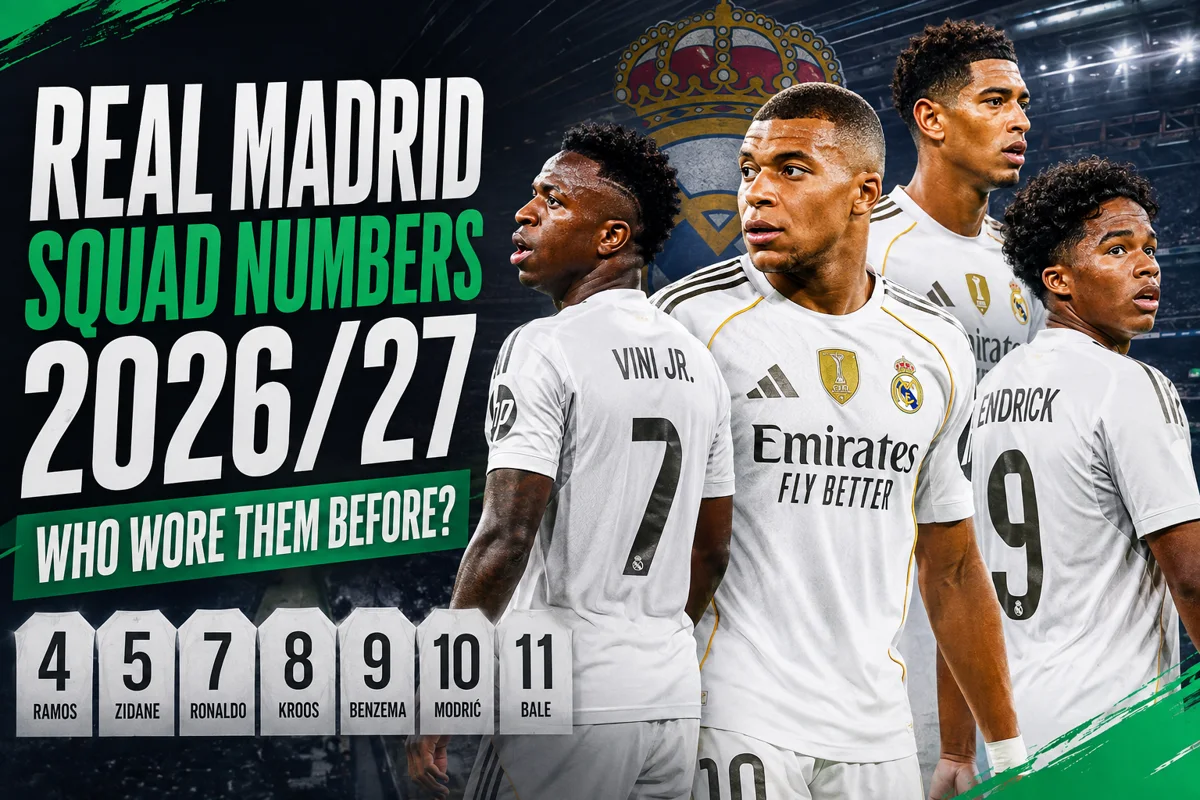
Real Madrid Squad Numbers 2026/27: Who Wore Them Before?
At Real Madrid, a shirt number is rarely just a number.
The club’s 2026/27 squad list brings several assignments loaded with history. Dean Huijsen has moved to No.4, Raúl Asencio takes No.2, while Endrick remains No.9, Kylian Mbappé No.10 and Vinícius Júnior No.7. Jude Bellingham continues in No.5 and Federico Valverde in No.8.
On paper, they are administrative details.
At Madrid, they are invitations to comparison.
Behind Endrick stand Karim Benzema, Ronaldo Nazário and Hugo Sánchez. Behind Vinícius are Cristiano Ronaldo and Raúl. Bellingham wears the number associated with Zinedine Zidane. Huijsen has stepped into a shirt once dominated by Sergio Ramos and Fernando Hierro.
The names change.
The numbers remember.
Real Madrid Squad Numbers for 2026/27
Here are the official Real Madrid squad numbers for the 2026/27 season.
| No. | Player | Position |
|---|---|---|
| 1 | Thibaut Courtois | Goalkeeper |
| 2 | Raúl Asencio | Defender |
| 3 | Éder Militão | Defender |
| 4 | Dean Huijsen | Defender |
| 5 | Jude Bellingham | Midfielder |
| 6 | Eduardo Camavinga | Midfielder |
| 7 | Vinícius Júnior | Forward |
| 8 | Federico Valverde | Midfielder |
| 9 | Endrick | Forward |
| 10 | Kylian Mbappé | Forward |
| 11 | Rodrygo | Forward |
| 12 | Trent Alexander-Arnold | Defender |
| 13 | Andriy Lunin | Goalkeeper |
| 14 | Aurélien Tchouaméni | Midfielder |
| 15 | Arda Güler | Midfielder |
| 16 | Ibrahima Konaté | Defender |
| 17 | Marc Cucurella | Defender |
| 18 | Álvaro Carreras | Defender |
| 19 | Carlos Espí | Forward |
| 20 | Bernardo Silva | Midfielder |
| 21 | Brahim Díaz | Forward |
| 22 | Antonio Rüdiger | Defender |
| 23 | Ferland Mendy | Defender |
| 24 | Denzel Dumfries | Defender |
| 25 | Yan Diomande | Forward |
| 27 | Thiago Pitarch | Midfielder |
The most historically loaded shirts in this squad are No.4, No.5, No.7, No.8, No.9, No.10 and No.11 — numbers shaped by some of the most important players in Real Madrid history.
There is also an important distinction when looking backwards.
Fixed season-long squad numbers only became standard in La Liga in the mid-1990s. Before then, shirt numbers were much more closely tied to matchday positions and could pass between players.
So Alfredo Di Stéfano, Ferenc Puskás, Paco Gento and Amancio did not “own” numbers in quite the same way Cristiano Ronaldo owned No.7 or Luka Modrić owned No.10.
That makes Madrid’s modern shirt history easier to trace.
It also makes certain numbers extraordinarily heavy.
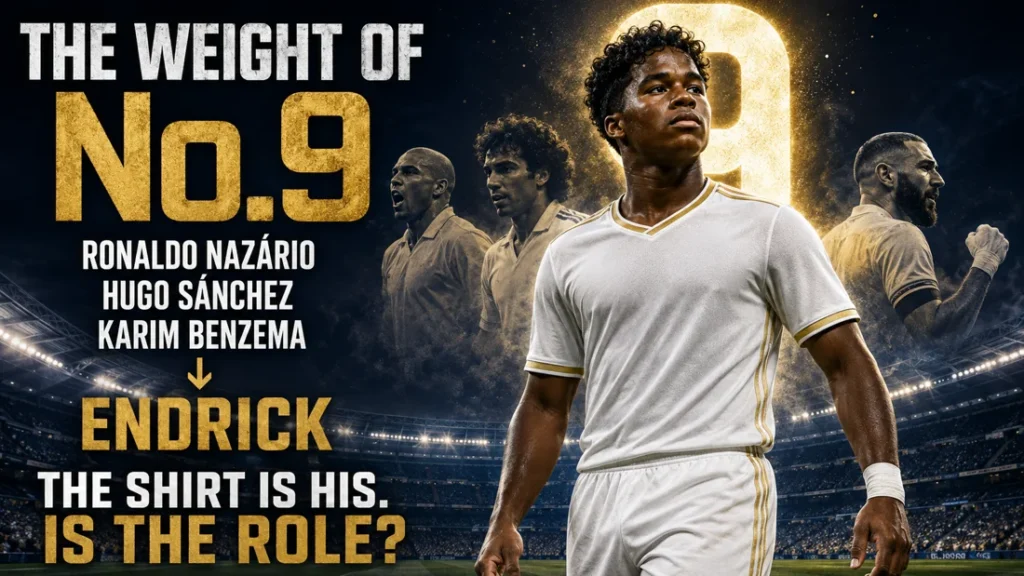
Endrick and the Weight of Real Madrid’s No.9
Endrick keeps No.9, the shirt he inherited when Mbappé moved to No.10.
Few numbers at Real Madrid explain the difference between promise and expectation more clearly.
Karim Benzema wore it for more than a decade. Before him, Cristiano Ronaldo used it during his first season in Spain. Ronaldo Nazário, Fernando Morientes, Davor Šuker and Iván Zamorano are also part of its modern lineage.
Further back stand Hugo Sánchez, Santillana and, in the pre-fixed-number era, Alfredo Di Stéfano.
It is a remarkable genealogy of goalscorers.
Yet Endrick’s situation contains an obvious contradiction.
He owns the No.9 shirt, but not necessarily the No.9 role.
Mbappé remains Madrid’s dominant central attacking reference, while competition for forward positions has increased. Endrick’s need for regular football has already raised questions over whether another loan could ultimately be the better next step in his development.
That issue is explored further in Soccer Herald’s analysis of Endrick’s possible next move.
The number therefore says more about Endrick’s potential status than his guaranteed place in the starting XI.
And perhaps that is why the shirt matters so much.
Madrid’s No.9 is not simply given to a striker. It asks him, eventually, to become one.
Why Mbappé’s No.10 Is Different
Kylian Mbappé remains Real Madrid’s No.10 after taking the shirt following Luka Modrić’s departure.
The line before him is extraordinary.
Modrić wore it for eight seasons. James Rodríguez, Mesut Özil, Wesley Sneijder, Robinho, Luís Figo, Clarence Seedorf and Michael Laudrup all carried the number in the modern era.
Ferenc Puskás also appeared in it long before permanent squad numbers existed.
But Mbappé does not fit the traditional idea of a No.10.
He is not a classic playmaker stationed behind a centre-forward. He does not need to dominate possession between the lines or dictate the rhythm of a match through passing volume.
Mbappé is primarily a scorer.
His most dangerous actions often begin from the left or inside-left channel before ending through the centre. He wants space to accelerate into, defenders forced backwards and opportunities to attack the penalty area rather than simply conduct play outside it.
That makes his No.10 significant.
The shirt expresses hierarchy more than tactical position.
At Madrid, the number once belonged to creators. Now it belongs to one of the world’s most devastating finishers.
Vinícius and Real Madrid’s Most Famous No.7
If No.9 carries the history of Real Madrid’s great centre-forwards, No.7 carries something broader.
Identity.
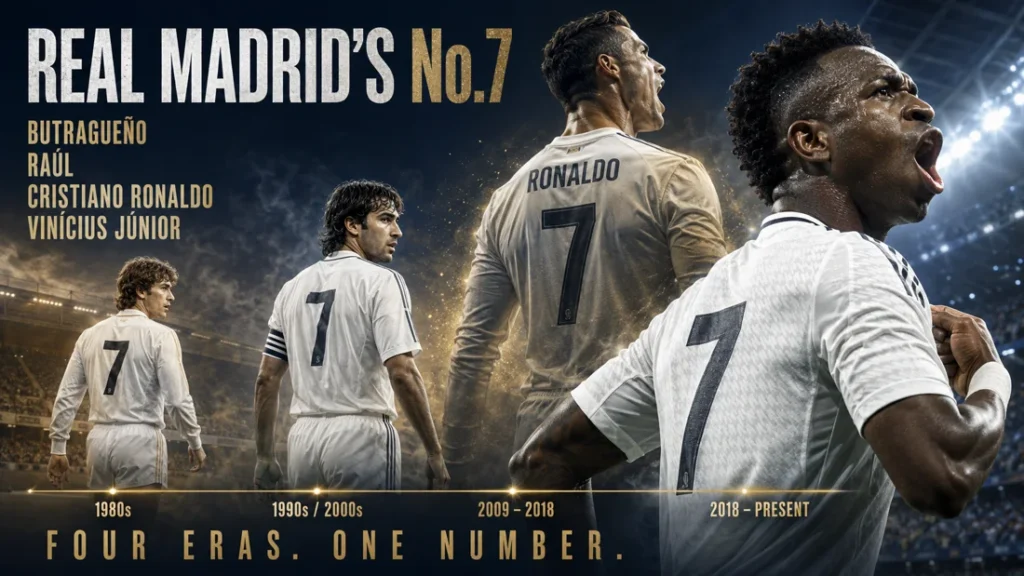
Vinícius Júnior has worn it since 2023. Immediately before him came Eden Hazard and, briefly, Mariano Díaz.
Then comes Cristiano Ronaldo.
Before Cristiano, Raúl.
Before Raúl, Emilio Butragueño.
Juanito and Amancio sit deeper in the number’s history.
Few shirts in club football offer a succession like that.
Cristiano turned No.7 into part of his global identity while becoming Real Madrid’s record goalscorer. Raúl represented something different: academy-grown, relentlessly intelligent and deeply connected to the institution itself.
Vinícius does not need to resemble either.
His football is built around acceleration, isolation and confrontation. He wants the full-back alone, the pitch stretched and the ball early enough to attack before the defensive block settles.
In tactical terms, he is very different from several of Madrid’s famous sevens.
Emotionally, though, there is a connection.
The number has often belonged to players willing to accept responsibility for decisive moments.
Vinícius has never been able to hide from that responsibility.
His importance to the club has also shaped Madrid’s stance whenever speculation has emerged over his future, as Soccer Herald examined in its Vinícius Júnior transfer analysis.
The challenge now is no longer whether he can wear Cristiano’s or Raúl’s number.
It is whether another generation will eventually associate seven with him.
Bellingham’s No.5 Changed the Meaning of the Number
Traditionally, No.5 belongs to a defender.
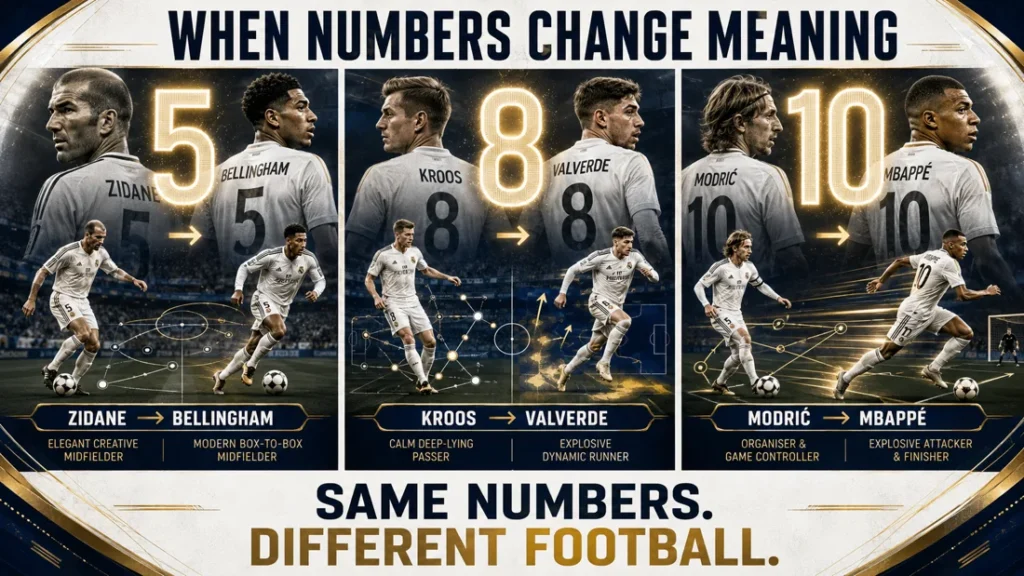
At Real Madrid, Zinedine Zidane changed the association.
Zidane wore it throughout his five seasons in Spain. Fabio Cannavaro later inherited it. Raphaël Varane also used it before Jude Bellingham took the shirt in 2023.
Manolo Sanchís and Fernando Redondo add further weight to its history.
Bellingham’s choice immediately invited comparisons with Zidane, but their football is not especially similar.
Zidane controlled games through touch, orientation and manipulation of space.
Bellingham is more vertical.
He covers enormous distances, attacks the penalty area, presses aggressively and can operate as an eight, a ten or something resembling a second striker depending on the players around him.
His versatility is an advantage, but it also creates a tactical problem.
A team containing Mbappé and Vinícius needs Bellingham close enough to the attack to exploit his movement, yet not so advanced that Madrid lose control of midfield.
That balance will be one of the defining questions of José Mourinho’s new side.
As Soccer Herald discussed in its tactical analysis of Mourinho’s Real Madrid return, Bellingham’s positioning could determine how successfully Madrid connect a powerful attack with the rest of the team.
The No.5 links him to Zidane.
His football has to create its own meaning.
Huijsen Takes the Shirt of Ramos and Hierro
Perhaps the most symbolic new assignment belongs to Dean Huijsen.
He now wears No.4.
David Alaba had the shirt before him. Sergio Ramos possessed it for 16 seasons. Before Ramos, Fernando Hierro became one of the defining Madrid defenders associated with the number.
That is formidable company for a young centre-back.
It is also appropriate that Huijsen represents a very different generation of defender.
Ramos could progress possession but was defined by aggression, recovery defending, aerial authority and an extraordinary capacity to influence decisive matches at both ends of the pitch.
Huijsen belongs to an era in which central defenders are increasingly judged by what they do before the opposition has even attacked.
Can they break the press?
Can they step into midfield?
Can they find a forward between the lines instead of simply passing sideways?
Huijsen’s distribution gives Madrid another route through the first phase of possession. For a side containing Mbappé, Vinícius and Bellingham, that matters.
The quicker Madrid can progress cleanly from defence, the more often those attackers receive the ball before the opposition has organised itself.
No.4 brings history.
Huijsen’s task is to make it useful in the present.
Valverde Takes No.8 Into a New Era
Federico Valverde inherited No.8 after Toni Kroos retired.
Kroos had worn it for a decade. Kaká, Fernando Gago, Júlio Baptista, Steve McManaman and Predrag Mijatović are among the other significant modern names associated with it.
Valverde could hardly be more different from Kroos.
Kroos controlled space through the ball.
Valverde often controls it by reaching places other players cannot.
He can press high, recover towards his own penalty area, cover a full-back, drive through midfield and arrive around the opposition box.
Kroos manipulated the geometry of a match.
Valverde frequently changes it by running through it.
That distinction is important for the new Madrid.
Trying to recreate the Kroos-Modrić era would be pointless. The personnel and physical profile of the midfield are different.
Valverde’s No.8 represents continuity in number, not in method.
Rodrygo and the Complicated History of No.11
Rodrygo keeps No.11, a shirt previously worn by Marco Asensio and, most famously in the recent era, Gareth Bale.
Karim Benzema, Arjen Robben, Michael Owen and Ronaldo Nazário also used the number at different stages, while Paco Gento was associated with it long before permanent squad numbers existed.
Rodrygo is an appropriate modern eleven because he can start wide without staying there. He drifts inside, combines between the lines and can move closer to goal when required.
That flexibility remains valuable, although Madrid’s attacking depth also makes his exact role harder to define.
The No.11 is settled.
His place in Mourinho’s attack may be less so.
Courtois Continues Madrid’s No.1 Tradition
Thibaut Courtois remains No.1, following a line that includes Keylor Navas, Iker Casillas, Bodo Illgner and Paco Buyo.
Courtois has already reached the point where he belongs in that tradition rather than simply following it.
For a Real Madrid side expected to attack aggressively and leave space behind its defensive line, his role remains simple in theory and priceless in practice: be the final barrier when everything else has failed.
Other Real Madrid Shirt Numbers to Watch
Several other 2026/27 assignments carry histories worth noting.
Raúl Asencio’s No.2 follows Dani Carvajal, Raphaël Varane, Míchel Salgado and Christian Panucci.
Éder Militão’s No.3 has previously been worn by Pepe and Roberto Carlos.
Eduardo Camavinga’s No.6 follows players including Nacho, Sami Khedira and Fernando Redondo.
Ferland Mendy’s No.23 has an unusually eclectic history, with David Beckham, Mesut Özil, Isco and Mateo Kovačić among its former owners.
At Real Madrid, even the less celebrated numbers eventually become part of another era.
What Real Madrid’s 2026/27 Numbers Really Tell Us
Real Madrid’s shirt numbers still provide something that formations and tactical diagrams cannot: inheritance.
Huijsen takes four and enters a conversation involving Ramos and Hierro. Vinícius wears seven beneath the shadow of Raúl and Cristiano Ronaldo. Bellingham’s five recalls Zidane. Endrick walks onto the pitch with Benzema, Ronaldo and Hugo Sánchez somewhere in the historical background.
At most clubs, those comparisons might feel excessive.
At Real Madrid, they are part of the institution.
The club sells the future while constantly displaying the past. New stars arrive beneath photographs of old ones. European Cups are celebrated partly because they strengthen the expectation of winning the next one. Players are measured not only against their opponents, but against those who occupied the same dressing room and sometimes the same shirt.
That is why Real Madrid’s squad numbers still matter.
They begin as administrative details.
Then somebody puts the shirt on, and history starts interfering.
Sources
Real Madrid — Official 2026/27 squad numbers


