



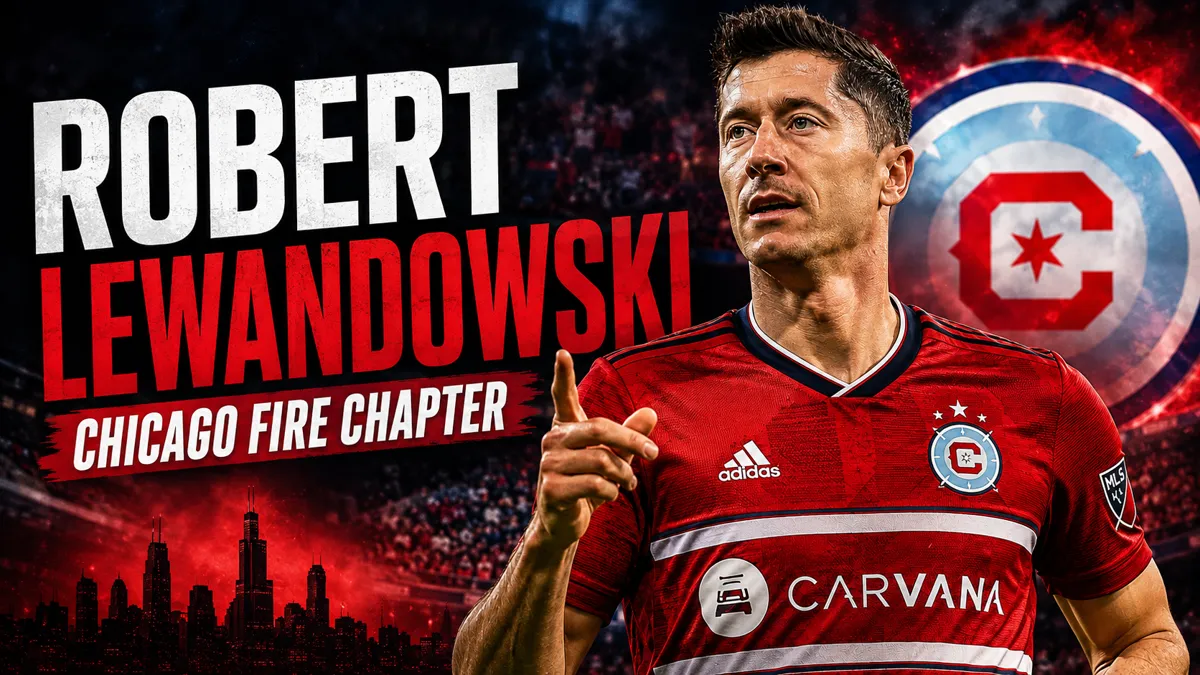
Robert Lewandowski MLS Stats: Goals & Chicago Fire Record
Robert Lewandowski did not come to Major League Soccer to discover whether he could still score goals.
That question had been answered hundreds of times across Poland, Germany and Spain.
The more interesting question was whether, at 37, one of the defining centre-forwards of his generation could adapt quickly enough to a new league, a new continent and a Chicago Fire team already in the middle of its season.
The first answer arrived at Soldier Field.
Two goals. One comeback. One victory. And, almost immediately, the familiar sight of Lewandowski deciding a football match from the centre of the attack.
His MLS numbers remain small because his Chicago career has only just begun. But the early pattern is already recognisable.
As of August 10, 2026, Lewandowski has scored two goals in three MLS appearances, with both coming in Chicago Fire’s 2-1 victory over Charlotte FC. He has no MLS assists yet and has played approximately 198 league minutes.
Robert Lewandowski MLS Stats 2026
| Statistic | Total |
|---|---|
| MLS appearances | 3 |
| MLS starts | 2 |
| Minutes | 198 |
| Goals | 2 |
| Assists | 0 |
| Goal contributions | 2 |
| Goals per 90 minutes | 0.91 |
| Game-winning goals | 1 |
| MLS Player of the Matchday awards | 1 |
Stats updated August 10, 2026.
Lewandowski’s first two league appearances came away from home against Inter Miami and New York City FC.
He started against Miami on July 22 and played 63 minutes in a 3-2 defeat. Three days later, he entered at half-time against NYCFC and played the second 45 minutes of another defeat.
Then came Charlotte.
And everything changed.
Lewandowski’s First MLS Goals
Chicago had waited for the moment.
Lewandowski had waited too.
When Charlotte scored after 18 minutes at Soldier Field on August 1, there was the possibility that his home debut might become another evening dominated by adaptation rather than celebration.
It lasted 93 seconds.
Jonathan Bamba delivered the ball towards Philip Zinckernagel, whose header dropped into Lewandowski’s path. The Pole controlled it, shifted the angle and finished from just outside the penalty area.
It was his first MLS goal.
The second was even more revealing.
Chicago worked through a possession sequence of more than 25 passes before Andrew Gutman delivered from the left. Robin Lod helped the ball into Lewandowski’s path and the striker moved inside before producing the finish that gave Chicago a 2-1 lead.
That became the winning goal.
The full story of Lewandowski’s two-goal Chicago Fire home debut showed why the performance mattered beyond the statistics.
The first goal announced his arrival.
The second explained how Chicago might use him.
Why Lewandowski Still Works as a No. 9
Age changes a striker.
It does not necessarily diminish him in a straight line.
The Lewandowski who arrived at Borussia Dortmund needed to run, press, wrestle with centre-backs and build the movements that would eventually make him one of Europe’s most complete forwards.
The later Bayern Munich version became devastating because he understood where attacks were going before defenders did.
Barcelona required another adjustment. He operated in a team where possession could be slower, the opposition penalty area congested and the spaces measured in metres rather than open grass.
Chicago now requires another version.
Lewandowski does not need to become the quickest striker in MLS.
He needs to make defenders move before the ball arrives.
That difference matters.
His movement against Charlotte demonstrated the basic principle. He was not simply standing between the centre-backs waiting for crosses. He moved away from the defensive line, attacked different channels and arrived in scoring positions after Chicago had manipulated the opposition shape.
The second goal was particularly important because it came at the end of a long passing move.
A traditional penalty-box striker might have remained fixed centrally.
Lewandowski moved with the attack.
That is the quality Chicago have bought.
Chicago’s Attack Now Belongs to Lewandowski
The original plan was different.
When Chicago introduced Lewandowski, Gregg Berhalter discussed the possibility of using him alongside Hugo Cuypers. At the time, Cuypers had 13 MLS goals and was among the league’s most productive forwards.
A two-striker structure appeared possible.
Then the situation changed quickly.
On July 23, just one day after Lewandowski made his MLS debut against Inter Miami, Chicago transferred Cuypers to Monterrey.
Suddenly, Lewandowski was not arriving to share the centre of Chicago’s attack.
He was inheriting it.
That changes the tactical question.
Berhalter can now construct the forward line around one central reference point, with players such as Jonathan Bamba, Philip Zinckernagel and Robin Lod moving around him.
The best version of that system does not ask Lewandowski to chase every long ball or constantly sprint behind the defence.
It asks him to occupy centre-backs.
If he pins one defender, space opens for a winger.
If both centre-backs narrow around him, Chicago can attack outside.
If one follows him when he drops towards midfield, another player can attack the space behind.
Lewandowski can therefore influence an attack without touching the ball.
That has always been one of the less visible parts of his game.
The Zinckernagel Connection Could Be Crucial
Philip Zinckernagel may become particularly important.
His assist for Lewandowski’s first MLS goal was his eighth of the season and his 13th direct goal contribution at that point.
He offers something a penalty-box striker needs: delivery from advanced positions combined with the freedom to appear inside.
Chicago do not have to construct every attack through Lewandowski.
In fact, they probably should not.
The better solution is to create around him and allow the striker to decide where the attack ends.
Bamba can provide width and direct running. Zinckernagel can combine between the lines. Lod can make supporting movements from deeper positions.
Lewandowski becomes the reference point that connects those different behaviours.
It is simple in theory.
Producing it consistently against organised MLS defences will determine how successful Chicago become.
From Barcelona to Chicago
Lewandowski joined Chicago as a free agent after four seasons with Barcelona and signed a Designated Player contract running through the 2027-28 MLS season.
By then, there was little left for him to prove in European football.
He arrived with 629 club goals, 159 assists and 33 major trophies, including 10 Bundesliga titles, three La Liga championships and a Champions League.
Chicago did not sign potential.
They signed memory, habit and expertise.
For Lewandowski, MLS offered something different: a new league, a new role and an attacking project increasingly built around him.
Barcelona, meanwhile, moved towards a younger attacking future, with the club’s longer-term striker planning also part of the discussion around Julián Álvarez and Barcelona’s transfer strategy.
More Than a Retirement Transfer
MLS has long fought against the idea that every famous European arrival represents a retirement tour.
Sometimes the criticism has been justified.
Sometimes it has become lazy.
Lewandowski’s opening weeks belong in neither extreme.
Three MLS matches are nowhere near enough evidence to declare the move transformative. But his circumstances matter.
Chicago were not a collapsing team looking for a famous name to sell tickets.
They reached the playoffs in Berhalter’s first season and entered the World Cup break among the stronger teams in the Eastern Conference.
Lewandowski therefore joined a sporting project with something to lose.
That creates pressure.
A famous striker scoring 10 goals for a poor team can still be considered individually successful.
A famous striker joining a contender is judged differently.
Chicago will eventually judge Lewandowski by October and November.
Not August.
Lewandowski in MLS’s Superstar Era
Lionel Messi changed the international profile of MLS, while a new wave of established European stars has continued to raise the league’s visibility.
Lewandowski represents a different type of superstar.
He does not need every possession to flow through him. His value is concentrated in and around the penalty area, where movement, anticipation and finishing remain decisive.
That makes Chicago’s task clear.
They must provide the service without becoming predictable.
His brace against Charlotte was encouraging because the goals came through two different attacking patterns. Lewandowski supplied the finishes, but Chicago created the conditions.
That relationship will define whether this becomes merely a famous signing or a genuinely successful one.
Can Lewandowski Win the 2026 MLS Golden Boot?
Two goals in three matches naturally create the question.
Could Lewandowski still enter the 2026 MLS Golden Boot race despite arriving midway through the campaign?
Mathematically, perhaps.
Realistically, it is a difficult challenge.
He joined with the league’s leading scorers already carrying a substantial advantage. Chicago also need to manage a 37-year-old forward through a demanding schedule rather than chase an individual scoring title at the expense of the postseason.
The more realistic target is efficiency.
If Lewandowski continues producing close to a goal every 90 minutes, the raw total will take care of itself.
What Chicago need is not necessarily the Golden Boot winner.
They need the striker who scores the decisive goal in a 1-0 playoff match.
There is a difference.
Robert Lewandowski Chicago Fire Stats and Records
Lewandowski has already made a small piece of club history.
His brace against Charlotte made him the fourth player in Chicago Fire history to score multiple goals in his home debut, joining Frank Klopas, Andy Herron and Tomasz Frankowski.
He also became MLS Player of the Matchday for Matchday 19.
Those are early milestones rather than major records.
But the number worth following is simpler.
Goals.
Every new Lewandowski MLS goal now adds another chapter to one of the most productive scoring careers of the modern era.
His second strike against Charlotte took him to 722 goals for club and country.
For Chicago, the more important question is what comes next.
If he keeps scoring at anything close to his current rate, this section will need regular updating.
That is exactly what the club will hope for.
Robert Lewandowski MLS Stats FAQ
How many goals has Robert Lewandowski scored in MLS?
Robert Lewandowski has scored two MLS goals for Chicago Fire as of August 10, 2026.
Both came against Charlotte FC on August 1.
How many MLS games has Lewandowski played?
Lewandowski has made three MLS appearances for Chicago Fire.
He faced Inter Miami, New York City FC and Charlotte FC in his first three league matches.
How many assists does Lewandowski have in MLS?
Lewandowski has zero MLS assists so far.
When did Lewandowski score his first MLS goal?
Lewandowski scored his first MLS goal against Charlotte FC at Soldier Field on August 1, 2026.
He added his second goal in the same match.
Who does Robert Lewandowski play for in MLS?
Lewandowski plays for Chicago Fire FC.
He joined the club as a free agent in June 2026.
How long is Lewandowski’s Chicago Fire contract?
Lewandowski is under contract through the 2027-28 MLS season.
What number does Lewandowski wear for Chicago Fire?
Lewandowski wears No. 9 for Chicago Fire.
The Next Chapter
Robert Lewandowski’s MLS statistics do not yet require a long spreadsheet.
Three games.
Two goals.
No assists.
But numbers this early are not really conclusions.
They are clues.
The important detail is not simply that Lewandowski scored twice against Charlotte. It is that Chicago found two different ways to bring him into scoring positions.
One came quickly.
One came after more than 25 passes.
One required control and an immediate finish.
The other required movement, timing and patience.
Those are more encouraging signs than the headline number alone.
Lewandowski has spent most of his career making difficult scoring look routine.
Chicago Fire did not sign him because they expect that instinct to disappear.
They signed him because they believe it can still decide matches.
The first evidence has arrived.
Now the MLS record begins to grow.
Sources
MLS — Robert Lewandowski joins Chicago Fire
Chicago Fire — Lewandowski scores twice against Charlotte FC


