



Crystal Palace 2026/27 Season Preview: The Sage Era Begins
Crystal Palace enter the 2026/27 season as European champions.
That sentence alone shows how dramatically expectations at Selhurst Park have changed.
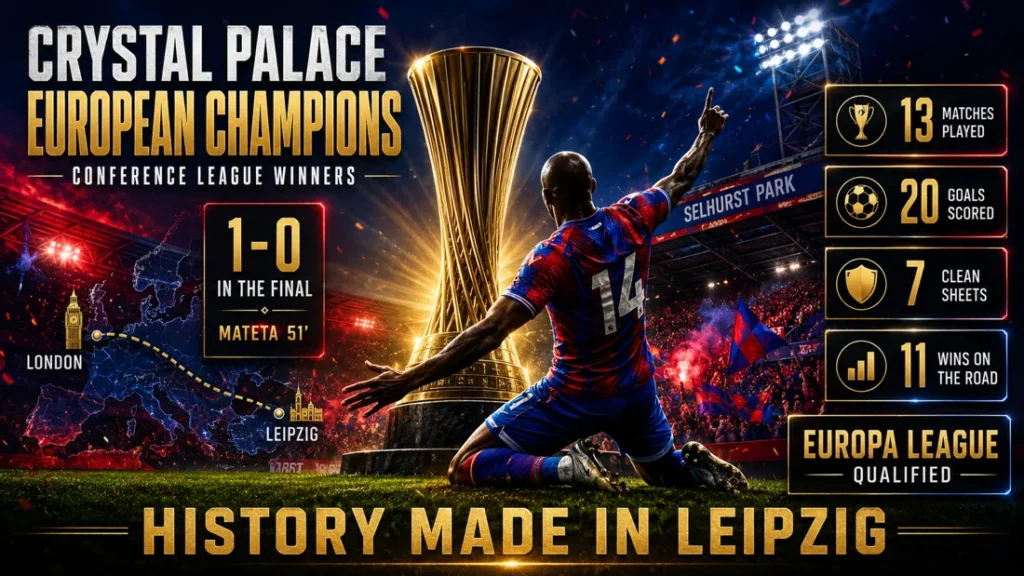
Palace finished only 15th in the Premier League last season with 45 points, yet their domestic position told only part of the story. Oliver Glasner’s side won the UEFA Conference League in their first major European campaign, beating Rayo Vallecano 1-0 in Leipzig through Jean-Philippe Mateta’s second-half goal.
It was the perfect farewell for a manager who delivered the two biggest trophies in the club’s history.
Now Pierre Sage takes over.
The former Lyon and Lens coach inherits a squad that already understands how to compete in a back-three system, but Palace must also absorb significant defensive changes. Marc Guéhi left during last season, Maxence Lacroix has now joined Chelsea, and the club has responded by signing Óscar Mingueza and Takehiro Tomiyasu.
The reward for winning the Conference League is another step forward.
Palace will play in the Europa League.
Quick Answer
Crystal Palace begin the 2026/27 season after finishing 15th in the Premier League but winning the Conference League.
Pierre Sage replaces Oliver Glasner after leading Lens to second place in Ligue 1 and the Coupe de France. His preference for a three-man defence should make the tactical transition less dramatic than the managerial change suggests.
Palace still have attacking quality through Jean-Philippe Mateta, Ismaïla Sarr, Yéremy Pino and Jørgen Strand Larsen, while Adam Wharton remains central to the midfield.
The biggest concern is defensive continuity after the departures of Guéhi and Lacroix.
Fifteenth Place Did Not Tell the Full Story
Palace finished last season with 11 wins, 12 draws and 15 defeats.
They scored 41 Premier League goals and conceded 51, ending the campaign on 45 points.
On paper, that was a disappointing league season after the club-record 53 points achieved in 2024/25.
But Palace played 60 competitive matches.
Their first major European campaign grew from an interesting side story into the defining feature of the season.
Palace survived the Conference League play-off, progressed through the league phase and then eliminated Zrinjski, AEK Larnaca, Fiorentina and Shakhtar Donetsk before meeting Rayo Vallecano in Leipzig.
Mateta scored the winner in the 51st minute.
Suddenly, 15th place mattered much less.
Palace had followed the 2025 FA Cup with another major trophy and qualified directly for the Europa League league phase.
Pierre Sage Inherits a Winning Structure
Replacing Glasner would have been difficult regardless of the successor.
The Austrian did more than win trophies. He gave Palace a clear identity.
Sage therefore arrives in a useful position because his tactical preferences do not require a complete rebuild.
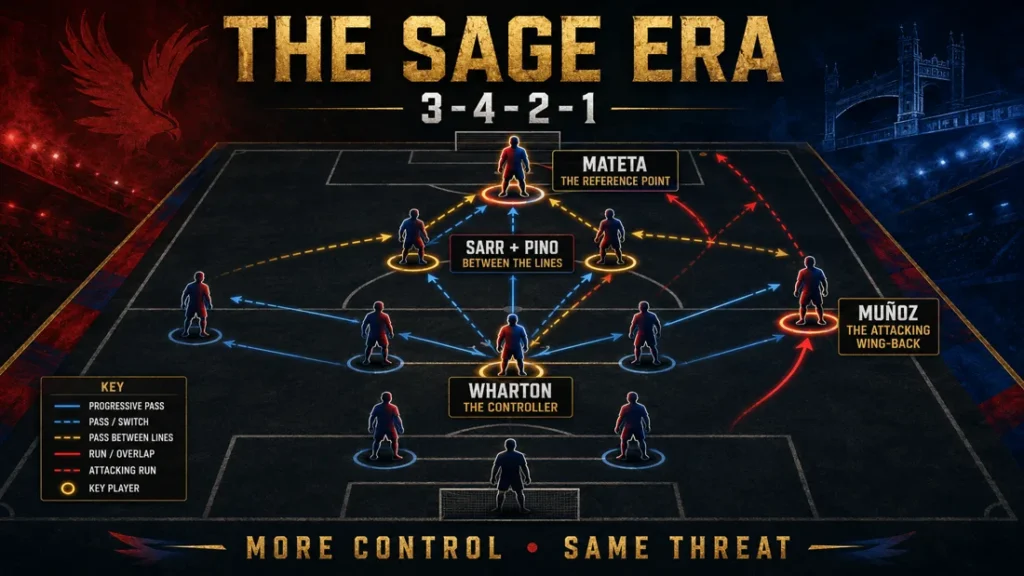
At Lens, the French coach frequently used a 3-4-2-1, a shape familiar to Palace’s squad after more than two years under Glasner.
Daniel Muñoz and Tyrick Mitchell can continue providing width from wing-back positions. Wharton can dictate play centrally, while two attacking midfielders operate close to the centre-forward.
The differences should appear in the details.
Sage has built a reputation for positional organisation, patient build-up and flexible pressing structures. Palace may therefore become slightly more comfortable keeping possession rather than relying as heavily on transitions.
The challenge is improving control without removing the directness that made Glasner’s Palace so dangerous.
The Defence Is the Biggest Question
Palace’s most important summer issue is obvious.
Their defence has changed.
Guéhi moved to Manchester City during last season, while Lacroix has now joined Chelsea after becoming one of Glasner’s most reliable defenders.
Palace have responded with Óscar Mingueza and Takehiro Tomiyasu.
Mingueza gives Sage a technically secure defender who can play centrally or on the right and is comfortable moving forward with the ball.
Tomiyasu brings Premier League, European and international experience and can cover several defensive positions.
Chris Richards, Chadi Riad and Jaydee Canvot will also compete for minutes.
The options are interesting.
The question is how quickly Sage can turn them into a reliable unit.
Adam Wharton Can Become the Centre of the New Palace
Adam Wharton may be the player who benefits most from Sage’s arrival.
Palace already relied on his passing range under Glasner, but a slightly more possession-focused approach could increase his influence.
Wharton can receive from the centre-backs, switch play towards the wing-backs and break defensive lines with early forward passes.
He also gives Palace calmness.
Europa League matches will not always suit frantic football. Palace will sometimes need to slow the game, protect possession and manage difficult away environments.
Wharton can help them do that.
Keeping him through the transfer window would be one of Palace’s most important pieces of business.
Sarr Must Build on a Historic European Season
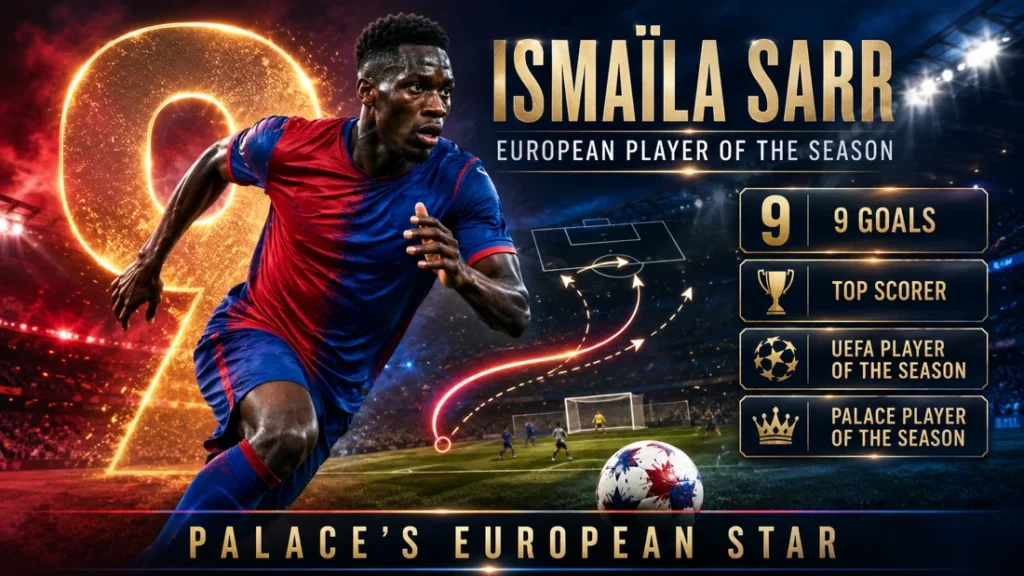
Ismaïla Sarr became one of the defining players of Palace’s historic campaign.
He scored nine Conference League goals, finished as the competition’s top scorer and was named UEFA Conference League Player of the Season.
He also won Palace’s Player of the Season and Players’ Player of the Season awards.
His pace remains his most obvious weapon, but improved movement and finishing inside the penalty area have made him much more than a transition player.
Sage will need that threat again.
Palace scored only 41 Premier League goals last season. If they want to climb back towards the top half while competing in Europe, Sarr must continue turning dangerous runs into consistent output.
Mateta Remains the Reference Point
Jean-Philippe Mateta enters another season as the reference point of the Palace attack.
His goal against Rayo Vallecano will remain one of the most important in club history.
He also reached 50 Premier League goals for Palace on the final day against Arsenal.
Mateta gives Palace a forward who can occupy centre-backs, protect direct passes and create space for runners around him.
Jørgen Strand Larsen offers another physical option, while Yéremy Pino brings technical quality between the lines.
The squad therefore contains different ways to attack.
But when Palace need a focal point, Mateta remains the obvious choice.
Muñoz Still Gives Palace a Unique Weapon
Daniel Muñoz remains one of the most important pieces of Palace’s system.
He is nominally a wing-back, but his repeated runs beyond the forward line often turn him into an additional attacker.
That movement stretches opponents and allows Palace to overload the penalty area without sacrificing a central midfielder.
Sage should preserve that aggression.
Mingueza’s ability to cover the right side could also give Muñoz greater freedom to attack.
Europa League Raises the Difficulty
Winning the Conference League sends Palace directly into the Europa League league phase.
It is a reward and a major test.
Last season already demonstrated how European football can affect league consistency. Palace played 60 competitive matches and finished 15th despite possessing enough quality to trouble strong opponents.
The Europa League will bring stronger opposition and another demanding Thursday-Sunday rhythm.
Squad depth therefore matters.
Sage cannot rely on the same small group throughout the season, particularly after changes in central defence.
The challenge is clear: compete seriously in Europe without allowing the Premier League campaign to disappear into the background.
The Opening Fixtures Offer an Immediate Test
Palace begin away to Everton before welcoming Manchester City to Selhurst Park.
They then travel to Fulham.
Opening five league opponents: Everton (A), Manchester City (H), Fulham (A), Ipswich Town (H), Leeds United (A).
Manchester City will provide an early test of Sage’s defensive structure, but Palace should see genuine opportunities for points elsewhere.
A strong start would help reduce pressure around the managerial transition before European football adds another layer to the schedule.
What Would Represent Success?
Palace should aim higher than 15th.
A top-half finish would be an excellent domestic result while competing in the Europa League.
Finishing between 10th and 13th while reaching the European knockout rounds would still represent a successful first season under Sage.
The larger question is whether Palace can make their recent trophy success sustainable.
Winning the FA Cup and Conference League transformed expectations.
Now they must prove that success was not dependent on one manager.
Soccer Herald Prediction
Predicted finish: 12th
Best-case scenario: Palace push towards the top eight and make another deep European run
Worst-case scenario: Defensive changes and fixture congestion drag them back towards the relegation battle
Key player: Adam Wharton
Player to watch: Óscar Mingueza
Most important signing: Óscar Mingueza
Attacking reference: Jean-Philippe Mateta
Biggest challenge: Rebuilding the defence while managing another European campaign
Season verdict: Palace enter a new era from a position of unusual strength. Glasner has gone, but he leaves behind a team that knows how to win knockout matches and believes it belongs on the European stage. Sage’s tactical approach should make the transition manageable, while Wharton, Muñoz, Mateta and Sarr provide an established core. The departures of Guéhi and Lacroix create legitimate defensive concerns, but Palace have enough quality to improve significantly on last season’s 15th-place finish.
The Glasner era made history.
Pierre Sage now has to prove Palace can build on it.
Sources
Premier League: Crystal Palace’s Conference League triumph and Europa League qualification


