



Coventry City 2026/27 Season Preview: Back After 25 Years
Coventry City are back in the Premier League.
For the first time since 2001, the Sky Blues will begin a season in England’s top flight after Frank Lampard transformed a promotion challenge into a Championship title.
Coventry finished with 95 points and 97 goals, scoring at least 15 more than any other Championship side. Promotion was secured at Blackburn, the title followed against Portsmouth, and a 4-0 victory at Watford completed one of the most important seasons in the club’s modern history.
Now comes the harder part.
Coventry have responded by keeping the core of Lampard’s team while adding more athleticism, Premier League experience and defensive quality.
Carl Rushworth has returned permanently after winning the Championship Golden Glove. Aurèle Amenda arrives from Eintracht Frankfurt, Frank Onyeka’s move has become permanent and Loum Tchaouna adds another direct attacking option.
Returning is historic.
Staying there is the challenge.
Quick Answer
Coventry enter the 2026/27 Premier League season as Championship champions after collecting 95 points and scoring 97 goals.
Lampard has signed a new contract until 2029, while the squad has been strengthened by Rushworth, Amenda, Onyeka and Tchaouna.
Coventry should remain aggressive and direct, but the defensive demands will increase dramatically. Protecting central areas while retaining their attacking identity may decide whether they survive.
The target is simple: finish 17th or higher.
Coventry Attacked Their Way to Promotion
Coventry did not sneak into the Premier League.
They attacked their way there.
Lampard’s side scored 97 goals in 46 Championship matches, at least 15 more than any other team. At the halfway point of the campaign, they already had 51 points and 54 goals.
What made them difficult to stop was the distribution of the threat.
Haji Wright led the team with 17 Championship goals. Ellis Simms and Brandon Thomas-Asante both scored 13, while Victor Torp reached double figures from midfield.

Coventry were therefore not dependent on one striker carrying the attack.
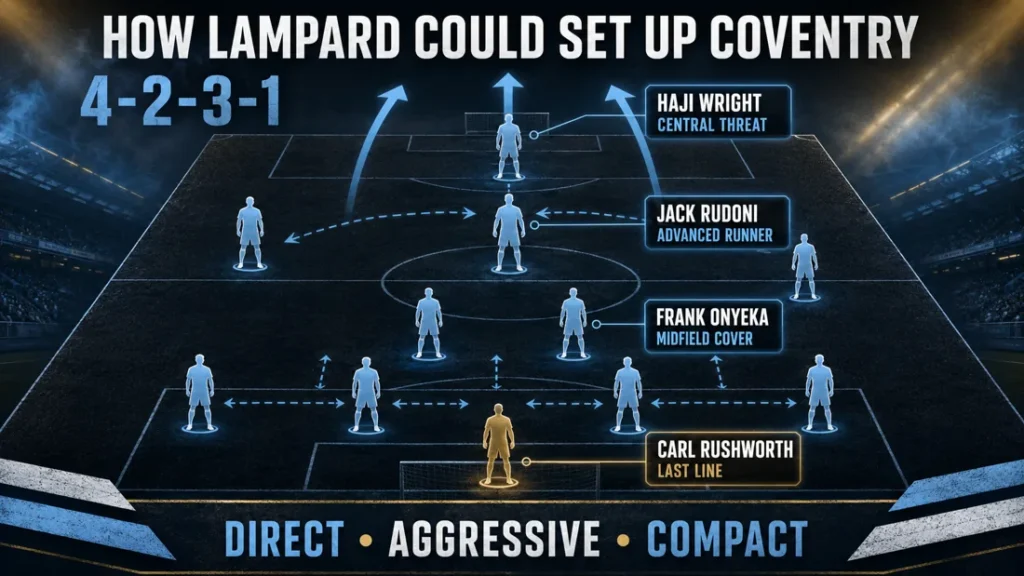
Lampard generally used a 4-2-3-1, but the team played with greater aggression than the shape suggests. Coventry progressed the ball quickly, attacked directly when space appeared and remained dangerous from set pieces.
That identity should survive promotion.
Trying to become a completely defensive team simply because the opposition is stronger would remove many of Coventry’s best qualities.

Lampard Must Adapt Without Losing the Identity
Lampard deserves enormous credit for Coventry’s rise.
He inherited the club in 17th place during the 2024/25 season, took them to the play-off semi-finals and then won the Championship in his first full campaign.
A new contract until 2029 gives both manager and club stability.
The tactical challenge is now very different.
Coventry’s direct, high-energy style can trouble Premier League opponents. Wright can occupy centre-backs, runners can attack around him and Lampard has enough pace to punish teams when possession changes quickly.
But the defensive challenge will increase sharply.
Coventry’s aggressive attacking approach worked brilliantly in the Championship, but Premier League opponents will punish transitional spaces more ruthlessly.
Lampard does not need to abandon his attacking principles.
He needs to make the spaces behind them smaller.
Rushworth Gives Coventry Crucial Continuity
Carl Rushworth may prove to be Coventry’s most important summer addition even though supporters already know him well.
The goalkeeper played all 46 Championship matches during the title-winning campaign, kept 17 clean sheets and won the division’s Golden Glove.
Coventry then brought him back permanently from Brighton.
That continuity matters for a promoted team.
Rushworth understands Lampard’s defensive structure and already has relationships with the defenders in front of him. He has also experienced the pressure surrounding Coventry’s promotion campaign.
The Premier League will demand more.
Coventry will concede more shots and spend longer periods defending. Rushworth’s shot-stopping will therefore be crucial, but so will his ability to help the team escape pressure with the ball.
A promoted side cannot spend 90 minutes simply waiting for the next attack.
Amenda Raises the Defensive Ceiling
Aurèle Amenda represents a significant upgrade in defensive potential.
The 22-year-old Switzerland international arrives from Eintracht Frankfurt after making 42 competitive appearances for the German club, including experience in the Bundesliga and Champions League.
At 1.97 metres, Amenda immediately gives Coventry size and aerial power.
More importantly, his physical profile should help Lampard defend larger spaces.
Coventry will face quicker forwards and more sophisticated movement than they encountered in the Championship. A centre-back capable of recovering when the defensive line is exposed could therefore become extremely valuable.
Bobby Thomas, Liam Kitching and the existing defenders now have stronger competition.
That depth will be needed over 38 Premier League matches.
Onyeka Could Be the Tactical Key
Frank Onyeka’s permanent move may attract fewer headlines, but it could be one of Coventry’s most important pieces of business.
Unlike much of the squad, Onyeka already understands Premier League football from his years with Brentford.
He also knows Lampard’s system after helping Coventry secure promotion during the second half of last season.
Matt Grimes provides control and passing quality. Jack Rudoni offers forward running and creativity.
Onyeka gives Coventry something different.
His intensity, defensive coverage and ability to compete in transition should become increasingly valuable when Coventry cannot dominate possession.
Those transitional spaces will become more dangerous at Premier League level.
Onyeka can help reduce that vulnerability.
Haji Wright Must Take the Threat Up a Level
Haji Wright enters the season as Coventry’s key attacker.
His 17 Championship goals led the team last season, but his importance goes beyond finishing.
There will be Premier League matches in which Coventry need a forward capable of holding direct passes, occupying centre-backs and giving the rest of the team time to move forward.
Wright has the physical profile for that role.
Simms and Thomas-Asante provide alternatives through the middle, while Tchaouna adds pace and directness from wider positions after joining from Burnley.
Lampard does not necessarily need one 20-goal striker.
He needs enough goals across the front line to reward the team’s defensive work.
If Wright can reach double figures in the Premier League, Coventry’s chances of survival increase considerably.
Tchaouna Adds Speed but Must Add Output
Loum Tchaouna gives Coventry another weapon in transition.
The winger made 32 appearances for Burnley last season, scoring three goals. His output was modest, but his pace, carrying ability and willingness to attack defenders fit Lampard’s preference for quick forward movement.
Coventry should encounter more counter-attacking opportunities in the Premier League because they will naturally have less possession against the strongest sides.
That could suit Tchaouna.
The challenge is turning dangerous positions into goals and assists.
Coventry cannot afford for their wide players to be exciting without becoming productive.
The Opening Fixtures Are Brutal
Coventry’s return could hardly begin with a bigger occasion.
Their first Premier League match for 25 years is away to champions Arsenal on August 21.
Then comes a crucial first home game against fellow promoted side Hull City, followed by another enormous trip to Manchester City.
Opening five league opponents: Arsenal (A), Hull City (H), Manchester City (A), Brighton (H), Nottingham Forest (A).
The Hull match already looks particularly important.
Coventry cannot allow the glamour of Arsenal and Manchester City to distract from the matches in which survival points are more realistically available.
Home form will be essential.
The Coventry Building Society Arena must become one of the reasons the Sky Blues stay up.
What Would Represent Success?
There should be no ambiguity.
Survival is success.
Finishing 17th would secure another year of Premier League football and give Coventry considerably more time and resources to develop the squad.
There are legitimate reasons for optimism.
Coventry were comfortably the Championship’s most productive attacking side. Lampard has built a clear identity. Rushworth offers continuity, Amenda raises the defensive ceiling and Onyeka supplies Premier League experience in midfield.
But the risks are obvious.
The speed of Premier League transitions will expose mistakes more severely, and several important players remain unproven at this level.
Coventry do not need to become a completely different team.
They need to become a more resilient version of the team that dominated the Championship.
Soccer Herald Prediction
Predicted finish: 17th
Best-case scenario: Coventry adapt quickly, turn the CBS Arena into a major home advantage and finish comfortably above the relegation zone
Worst-case scenario: The step up defensively proves too difficult and Coventry spend most of the season inside the bottom three
Key player: Haji Wright
Player to watch: Aurèle Amenda
Most important signing: Carl Rushworth
Tactical key: Frank Onyeka
Biggest challenge: Protecting central areas without losing their attacking identity
Season verdict: Coventry return to the Premier League with momentum, a manager who has rebuilt his reputation and a squad that already knows how to win together. Recruitment has addressed several obvious needs, particularly in goal, central defence and midfield. The jump in quality remains enormous, but Lampard has enough attacking options and physicality to make survival realistic.
After 25 years away, simply being back is historic.
Staying there would mean even more.
Sources
Premier League: All you need to know as Coventry City make their Premier League return
The Guardian: Coventry complete permanent Carl Rushworth signing


