



Chelsea 2026/27 Season Preview: The Alonso Reset
Chelsea enter the 2026/27 season in an unfamiliar position.
There is no European football at Stamford Bridge.
Chelsea began last season as Club World Cup champions and ended it tenth in the Premier League. They collected 52 points, lost the FA Cup final and went through three different coaching spells. What should have been another step forward became a season of instability.
Now Xabi Alonso has been given responsibility for the reset.
The former Bayer Leverkusen and Real Madrid coach arrives with a four-year contract, a talented young squad and several significant additions. Morgan Rogers brings proven Premier League creativity, Geovany Quenda adds another elite prospect, Marco Palestra strengthens the right side and Emmanuel Emegha increases the options at centre-forward.
Chelsea’s absence from Europe is embarrassing, but it may also become an advantage.
Alonso has time to coach.
Quick Answer
Chelsea begin the 2026/27 season after finishing tenth with 52 points and missing European qualification entirely.
Xabi Alonso replaces the uncertainty of last season with a clear long-term appointment. Chelsea have also strengthened an already deep squad, most significantly through the arrival of Morgan Rogers from Aston Villa.
The central question is no longer whether Chelsea have enough talent.
It is whether Alonso can organise that talent into a coherent team.
Without European matches draining the squad, Chelsea should expect a serious improvement. A return to the Champions League places must be the target.
Tenth Place Was Far Below Chelsea’s Level
Chelsea finished last season with 14 wins, 10 draws and 14 defeats.
They scored 58 Premier League goals and conceded 52, ending the campaign with 52 points and a positive goal difference of six.
Those numbers tell an unusual story.
Chelsea were not a fundamentally bad side. They scored more league goals than Brighton, Brentford and Sunderland, all of whom finished above them. They also reached the FA Cup final, the Champions League Round of 16 and the Carabao Cup semi-finals.
But they rarely found sustained stability.
The campaign was disrupted when Enzo Maresca left midway through the season. Liam Rosenior followed in January but lasted only until April, before Calum McFarlane completed the campaign as interim head coach.
A final-day defeat at Sunderland dropped Chelsea to tenth and removed their last opportunity to qualify for Europe.
For a squad built to compete near the top of the Premier League, that was a major failure.

Xabi Alonso Must Turn Talent Into Structure
Alonso’s first task is not rebuilding the squad from the ground up.
It is giving the squad structure.
Chelsea already possess technical midfielders, quick wide players, multiple centre-forwards and defenders capable of playing aggressively away from their own penalty area.
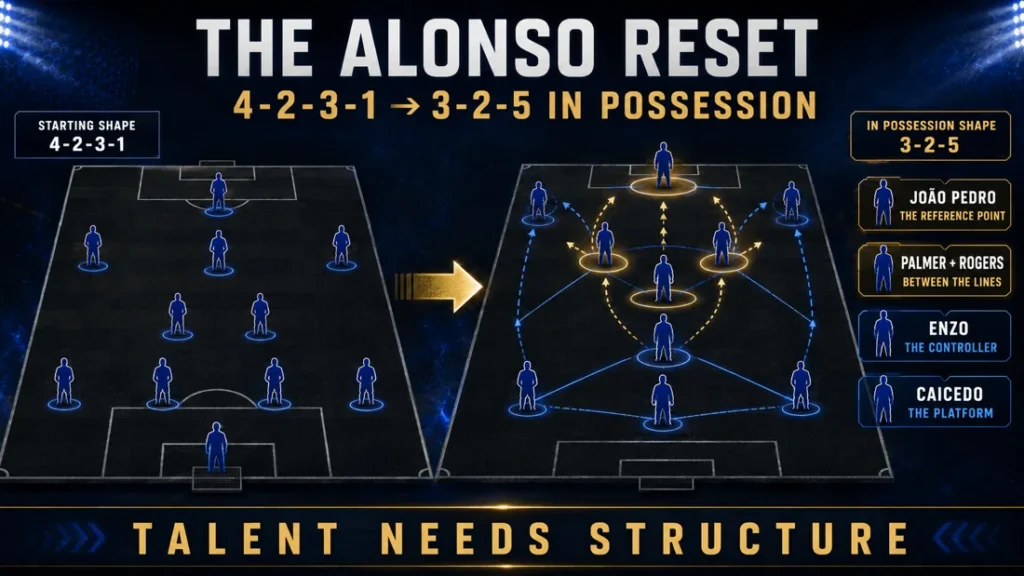
Alonso has several options. A 4-2-3-1 can become a back three in possession, while his previous work makes a 3-4-2-1 another realistic possibility.
Moises Caicedo can provide the defensive platform. Enzo Fernandez can control possession higher up the pitch, while Cole Palmer, Rogers, Estevao and João Pedro give Alonso several players capable of receiving between the lines.
The challenge will be balance.
Chelsea have spent several seasons collecting attacking talent. Alonso must now create clearly defined roles rather than simply finding room for the biggest names.
Morgan Rogers Changes the Attack
Morgan Rogers may be Chelsea’s most important summer signing.
The England international arrives from Aston Villa after developing into one of the Premier League’s leading young attacking players. He contributed to 40 goals during 85 Premier League appearances for Villa and helped Unai Emery’s side win the Europa League last season.
His value to Alonso goes beyond goals and assists.
Rogers can carry the ball through midfield, receive under pressure, attack the box and operate from the left, centrally or behind a striker.
That versatility creates interesting combinations with Palmer.
Chelsea do not need Rogers to replace Palmer. They need him to reduce their dependence on Palmer.
Palmer still scored 11 goals in all competitions despite an injury-disrupted campaign, but Chelsea often appeared too dependent on him producing something exceptional in possession.
Rogers gives Alonso another player capable of taking responsibility in the final third.

João Pedro Is Chelsea’s Reference Point
João Pedro was Chelsea’s most productive attacker last season.
He scored 20 goals in all competitions and registered 15 Premier League goals with five assists. He was also voted Chelsea’s Player of the Season.
That makes him the logical reference point for Alonso’s attack.
Pedro can lead the line, drop between midfield and defence or combine with attacking midfielders arriving around him. His movement should suit a system in which Palmer and Rogers attack central spaces.
Chelsea still have significant depth at centre-forward, but the priority should be building combinations around the player who already proved he can deliver consistently.
Quenda and Palestra Give Alonso More Flexibility
Geovany Quenda and Marco Palestra give Alonso two very different options on the flanks.
Quenda arrives after helping Sporting win a domestic league and cup double. The 19-year-old can play as a winger or wing-back on either side, making him especially useful if Alonso changes shape during matches.
Palestra offers greater defensive security and athleticism on the right. He can operate as a full-back or wing-back and reduces the need for Reece James to play every minute.
Together, the pair give Alonso more freedom to switch between a back four and back three without making major personnel changes.
That tactical flexibility could become one of Chelsea’s biggest strengths.
Caicedo Is the Tactical Key
Chelsea have more glamorous attacking names, but Moises Caicedo may be the player Alonso needs most.
Caicedo played 4,604 minutes in all competitions last season, fewer only than Robert Sanchez and Enzo Fernandez among Chelsea outfield players.
His ability to recover possession, defend transitions and receive the ball under pressure gives everyone around him greater freedom.
An Alonso team is likely to ask its midfielders to understand space rather than simply hold fixed positions.
Caicedo is ideal for that.
He can operate as the deepest midfielder, play beside Enzo or move across the pitch to cover an advancing full-back.
If Chelsea are to become more controlled and less vulnerable when attacks break down, Caicedo will be central to the transformation.
No Europe Could Become an Advantage
Missing Europe is unacceptable for Chelsea.
It could also help Alonso.
The club played 59 competitive matches last season across four competitions. The 2026/27 schedule will be significantly lighter.
That means more training time, fewer rotation problems and greater opportunity for Alonso to establish his positional principles.
Domestic cups can still provide minutes for players outside the strongest XI, but Premier League preparation should become much more consistent.
For a new coach trying to rebuild a team’s structure, that is a major advantage.
Chelsea must use it.
The Opening Weeks Will Test Alonso Immediately
Chelsea begin the Premier League season away at Fulham before Brighton visit Stamford Bridge.
Then comes a trip to champions Arsenal.
Opening five league opponents: Fulham (A), Brighton (H), Arsenal (A), Hull City (H), Brentford (A).
There are opportunities for points, but also several useful early tests.
Fulham and Brentford will challenge Chelsea physically. Brighton will test Alonso’s press resistance and defensive organisation. Arsenal will provide the first major indication of how close the new Chelsea are to the league’s best side.
The expectation should not be perfection in August.
There must, however, be evidence of a more organised team.
What Would Represent Success?
Champions League qualification should be Chelsea’s minimum serious ambition.
The squad is too talented and too deep for another season around mid-table.
A genuine title challenge would represent an enormous leap from tenth, especially in Alonso’s first season. But finishing inside the top five is realistic if Chelsea find stability.
A domestic trophy would strengthen the sense of recovery.
Without European football, Chelsea should treat both the FA Cup and Carabao Cup seriously.
There are fewer excuses this time.
Soccer Herald Prediction
Predicted finish: 5th
Best-case scenario: Chelsea become Arsenal’s closest challengers and return to the Champions League
Worst-case scenario: Alonso struggles to balance a deep attack and Chelsea remain outside the European places
Key player: João Pedro
Player to watch: Geovany Quenda
Most important signing: Morgan Rogers
Tactical key: Moises Caicedo
Biggest challenge: Turning attacking depth into a coherent system
Season verdict: Chelsea’s tenth-place finish disguised the quality available inside the squad, but quality without stability was not enough. Alonso inherits enough talent to produce a major improvement immediately. Rogers adds another proven creator, João Pedro has established himself as a reliable scorer and Caicedo provides the midfield foundation. With no European football dividing attention, Chelsea have an opportunity few clubs of their size receive: a season largely devoted to domestic recovery.
Chelsea have already assembled the talent. Alonso’s job is to finally make the pieces look like one team.
Sources


