




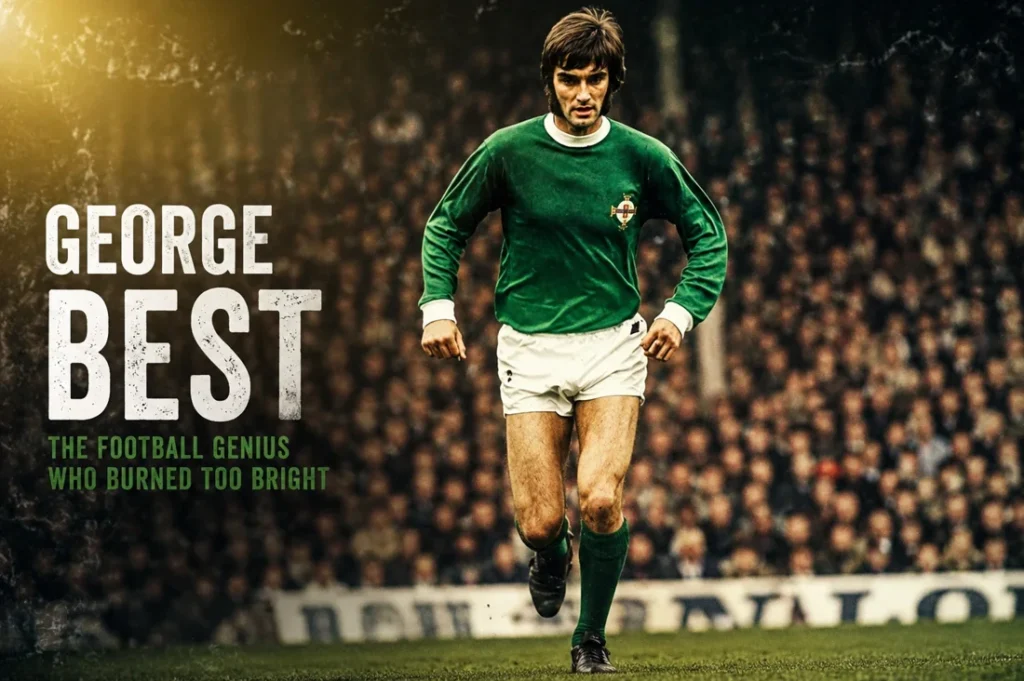
George Best: The Football Genius Who Burned Too Bright
George Best did not just play football. He seemed to loosen it from its rules.
Before the modern winger became a system player, before wide forwards were judged by pressing lanes, expected goals and defensive recoveries, Best gave the position something more dangerous: freedom.
He could start wide, drift inside, appear between the lines, run beyond the striker, or simply take the ball and turn a structured match into a private argument between himself and gravity.
Born in Belfast in 1946, Best became one of Manchester United’s defining figures in the years after Munich. By 1968, he had helped United win the European Cup and became European Footballer of the Year. He was 22. The world was at his feet, and that was partly the problem.
George Best Quick Facts
| Detail | Answer |
|---|---|
| Full name | George Best |
| Born | May 22, 1946 |
| Birthplace | Belfast, Northern Ireland |
| Main club | Manchester United |
| Position | Winger / forward |
| National team | Northern Ireland |
| Major club honour | 1968 European Cup |
| Major individual honour | 1968 Ballon d’Or |
| Style | Dribbling, balance, flair, finishing, freedom |
| Legacy | One of football’s first true global superstars |
Quick Answer: Why Was George Best So Special?
George Best was special because he combined the balance of a winger, the imagination of a playmaker and the finishing instinct of a forward.
He was not just fast. He changed speed.
He was not just skilful. He made defenders commit first, then punished the decision.
At his peak, Best was a tactical problem nobody had a clean answer for. Man-mark him, and he would turn the duel into humiliation. Double up, and he opened space for Bobby Charlton or Denis Law. Give him room, and he would carry the ball through pressure as if the pitch had tilted in his favour.
Was George Best Really One of the Best Players Ever?
Yes. George Best belongs in any serious conversation about the greatest footballers ever, even if his career did not have the longevity of Lionel Messi, Cristiano Ronaldo, Pelé or Johan Cruyff.
His peak was enough to make him immortal.
Best won the European Cup with Manchester United, won the Ballon d’Or in 1968 and became one of the most feared attackers of his generation. But his greatness was not only about trophies. It was about the way he changed a match.
He did it without the international platform enjoyed by many other all-time greats, because Northern Ireland rarely gave him the stage his talent deserved. That is also why Best belongs naturally among the legendary players who never played at a World Cup, a group whose greatness has to be measured beyond the biggest international tournament.
He made defenders nervous before he even touched the ball. That is one of the rarest forms of greatness in football.
The Belfast Boy Who Became a Manchester Myth
The story begins with a famous scouting line.
Manchester United scout Bob Bishop saw Best in Belfast and reportedly sent word that he had found a genius. It is one of those football sentences that sounds too perfect to be true, yet it survived because Best made it feel modest.
He arrived in Manchester as a slight teenager with soft features and hard courage.
English football in the 1960s was not gentle. Pitches were heavy. Tackles were often late. Protection for attackers was limited. The game belonged to men who could accept contact, mud and intimidation.
Best did not avoid those things.
He danced through them.
That is the first mistake people make about him. They remember the hair, the boutiques, the “Fifth Beatle” image, the celebrity glow. They forget the physical bravery.
Best was not a showman playing around the fight. He was a showman inside the fight.
How George Best Played
Best is often called a winger, but that word does not really hold him.
In modern terms, he was part wide forward, part attacking midfielder, part second striker. He could receive with chalk on his boots, but he was never trapped by the touchline. His genius lived in movement after the first touch.
He loved to isolate defenders.
The ball would arrive. The defender would square up. Best would pause.
That pause mattered. It forced the opponent to reveal his weight. One step too far forward, and Best was gone outside. One foot too narrow, and he slipped inside. One moment of fear, and Best owned the duel.
His dribbling was not only decorative. It had purpose.
He carried the ball to break lines before football used that phrase every week. He turned static possession into territory. He attacked the weak side of a defender’s body. He used hips, shoulders and rhythm as much as feet.
That is why he still feels modern.
A lot of old football clips look slower now. Best’s clips do not. The surfaces look older, the kits look heavier, the defending looks more brutal, but his movement still belongs to tomorrow.
The Holy Trinity
Best’s brilliance made most sense inside Manchester United’s great attacking triangle: Best, Denis Law and Bobby Charlton.
Charlton gave United long-range power, timing and authority from deeper zones. Law gave them penalty-box menace, aggression and striker’s instinct. Best gave them chaos.
That balance was crucial.
Best was not simply an individual genius dropped into a team. He was the unpredictable piece that made the structure breathe.
When United attacked, Charlton could pull midfielders out. Law could occupy centre-backs. Best could then receive against a full-back with space to attack.
But if opponents narrowed to stop him, United could switch the threat. If they chased him with two players, he created the very gaps that made Charlton and Law so dangerous.
The beauty was not only in Best beating a man. It was in what the fear of Best did to everyone else.
Wembley, 1968
The great peak came in 1968, against Benfica at Wembley.
Manchester United had carried tragedy for a decade after the Munich air disaster. Busby’s rebuilt team was not just chasing a trophy. It was chasing a form of emotional completion.
Football rarely gives neat endings, but that night came close.
Best scored in extra time as United beat Benfica 4-1 and became the first English club to win the European Cup.
The goal was pure Best. Calm where others rushed. Smooth where others strained. He rounded the goalkeeper not like a man escaping pressure, but like someone completing a sentence he had already written in his head.
That was his gift.
In the most frantic moments, he could make football look quiet.
The First Modern Football Celebrity
Best was not only ahead of his time on the pitch. He was also ahead of football’s ability to protect its stars from fame.
Today, clubs have media departments, player-care teams, brand managers, nutritionists, analysts and security layers. Best had flashbulbs, temptation, newspaper attention and a public that wanted him to be both artist and entertainment product.
He became a celebrity in a way football had barely seen in Britain.
The clothes, the nightlife, the hair, the charisma: all of it made him larger than the sport. But fame did not simply follow Best. It crowded him.
This is the human tragedy in his story.
The same qualities that made him irresistible made him vulnerable. He played as if life should be improvised. Away from the pitch, improvisation became more dangerous.
Best struggled with alcoholism for much of his adult life and died in 2005, aged 59. That fact should be written plainly, but not coldly.
His life was not a morality tale for easy judgement. It was a story of genius, pressure, weakness, charm and damage, all living in the same body.
Why Best Still Matters Tactically
Best matters because he reminds us that tactics are not only shapes.
They are also problems created by players.
A coach can design a structure. A player like Best can bend it.
Put him in a 4-3-3 today and he could play as an inverted winger from the left, carrying inside onto his stronger right foot. Put him on the right and he could isolate full-backs, combine inside, or attack the far post. Put him behind a striker and he could receive on the half-turn and drive through central pressure.
He had the three qualities modern elite attackers still need.
First, he could beat the first defender. That remains priceless.
Second, he could finish. He was not only a dribbler who needed others to complete the move.
Third, he could draw attention. Great attackers do not only use space. They create it by becoming the thing opponents fear most.
That is why Best would translate across eras.
The game has changed, but panic has not.
A defender left alone against a genius still feels the same old fear.
The Sadness of an Unfinished Career
Best’s Manchester United career effectively ended far too early.
He left United in January 1974, when he was still only 27. That number is almost painful.
Twenty-seven should have been the middle of his prime. For many great players, that is when the body, mind and experience finally meet. For Best, it was already the beginning of the afterlife.
He played elsewhere, including in the United States and several other countries, but the purest version of George Best belongs to Manchester United in the 1960s: red shirt, low socks, defenders retreating, Old Trafford leaning forward.
George Best and the Price of Genius
There is a temptation to split Best in two.
The genius and the tragedy. The footballer and the celebrity. The boy from Belfast and the man swallowed by fame.
But the story is more complicated than that.
Best’s football was not separate from his personality. It came from the same nerve. The same appetite for risk. The same refusal to live cautiously. The same instinct to make the ordinary feel too small.
That is why his legend has never faded.
Not because he won everything. He did not.
Not because his career was perfectly managed. It was not.
But because he touched a version of football that people still chase: football as surprise, as beauty, as danger, as a sudden intake of breath from a crowd that knows something impossible may be about to happen.
George Best burned too bright.
But for a while, he lit the whole game.
Final Verdict
George Best remains one of football’s great attacking geniuses: a winger who was more than a winger, a scorer who was more than a scorer, and a superstar before football understood what superstardom could cost.
His career was not long enough. His life was not peaceful enough.
But his best football still feels alive.
And that is the deepest measure of him.
Decades later, defenders are still turning.
Best is still gone.
Sources
National Football Museum: George Best Hall of Fame Profile


