



Lionel Messi’s Future in Doubt After Father Jorge’s Death
Lionel Messi has spent almost his entire life knowing what comes next.
Another training session. Another match. Another tournament. Another defence designed specifically to stop him, and another attempt to find the space nobody else can see.
Now, at 39, he faces a question football cannot answer for him.
Does he still want to play without his father watching?
Jorge Messi died in Rosario on August 7 at the age of 68 after a long illness. Five days later, Lionel spoke publicly about the loss and admitted that he has serious doubts about how much longer he wants to continue playing.
For years, Messi retirement speculation has been driven by age, contracts, World Cups and the inevitable question of when one of football’s greatest careers must finally end.
This time is different.
The uncertainty has been created not by football, but by grief.
Jorge was Messi’s father, representative and adviser. But those descriptions barely explain his place in the story.
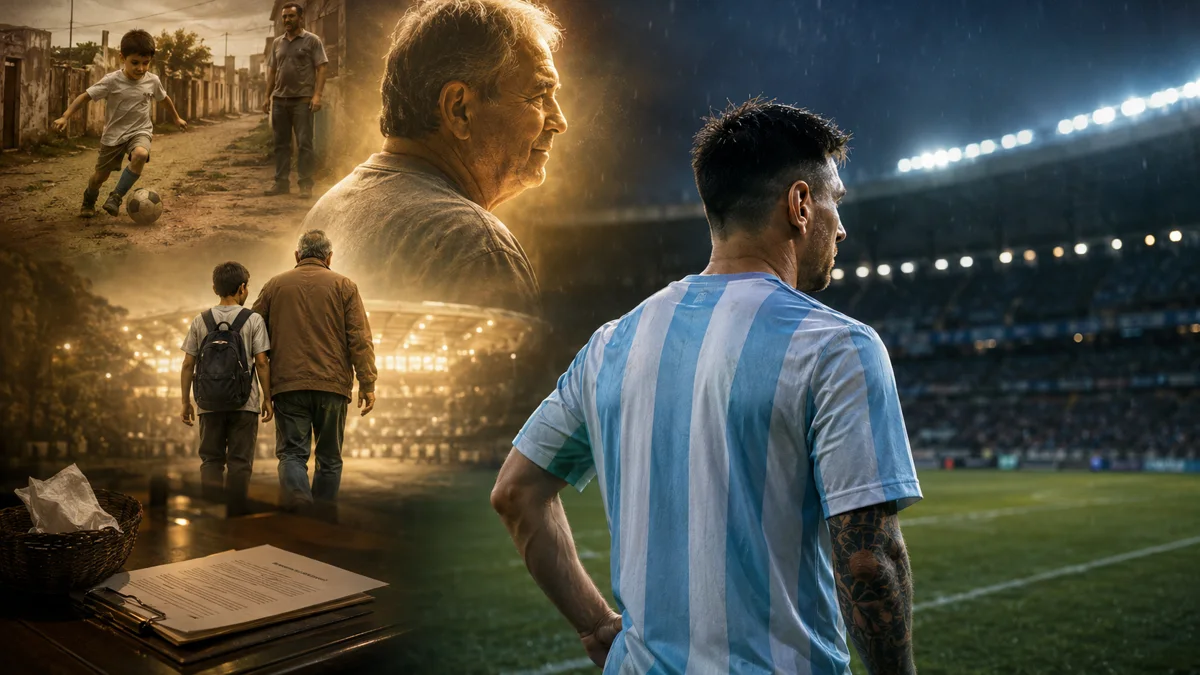
Before the Ballon d’Ors, Barcelona, Argentina’s World Cup triumph and the move to Miami, there was a father standing outside a modest home in Rosario watching a four-year-old child chase a football.
There were expensive medical treatments.
There was a journey across the Atlantic.
There was homesickness.
There was a club that hesitated.
And eventually there was a paper napkin.
For perhaps the first time in Lionel Messi’s career, the man who helped him navigate almost every important decision will not be there for the next one.
The Afternoon Jorge Realised Leo Was Different
Long before anybody in Europe had heard the name Lionel Messi, Jorge had already seen something unusual.
The scene could hardly have been further removed from the stadiums his son would eventually fill.
It was 1991, outside the family home on Lavalleja Street in Rosario. The road was still unpaved. Lionel was four.
His older brother Rodrigo had the ball. Leo chased him, suddenly threw himself toward it and took it cleanly from him.
Nobody had taught him how.
The family noticed.
Jorge remembered that moment years later because it was one of the first times he understood that the smallest boy in the family possessed something difficult to explain. He saw it again when Leo controlled the ball, played with children much older than him and seemed to understand movements children his age normally did not.
There is another small detail from those years that now feels unusually warm.
For Lionel’s first birthday, Jorge had already given him a Newell’s Old Boys shirt.
He could not have known where football would eventually take his son. He was simply a football-loving father giving a child the colours of the club his family loved.
Jorge himself had spent time in Newell’s youth system before work and family responsibilities took his life in another direction.
Years later, one Messi would live the football dream the other had never been able to pursue.
His First Coach Was His Father
Football was not introduced to Leo by an academy director, an international scout or a famous coach.
It was part of family life.
Messi played with his brothers, his cousins and children from the neighbourhood. His maternal grandmother Celia was among those who most fiercely encouraged the tiny boy to play, despite his size.
Jorge was also one of his earliest coaches at Grandoli, the neighbourhood club only a short distance from the family home.
That detail feels more significant now.
Decades before he would sit across tables discussing enormous contracts, commercial agreements and transfers, Jorge was already standing on the touchline watching Leo play when the only thing at stake was the next children’s match.
And that relationship never completely disappeared.
Even after Messi became the most famous player in the world, he still cared deeply about what his father thought of his performance.
Jorge’s role expanded beyond recognition as the career grew, but underneath the negotiations and business there remained something far simpler: a son finishing a football match and wanting to know what his father thought.
The Problem Football Talent Could Not Solve
There was one obstacle Lionel’s left foot could do nothing about.
He was not growing as expected.
Medical examinations established that he required growth hormone treatment. The injections themselves could help. Paying for them consistently was the real difficulty.
For a working family in Argentina, the cost was substantial.
Jorge worked in the steel industry. Celia worked too. They had four children and an ordinary household to support.
The situation produced a cruel contradiction.
Their son possessed extraordinary football talent, but talent alone could not guarantee that his body would develop enough for him to fulfil it.
Jorge began looking for solutions.
Newell’s could not provide a permanent answer. River Plate showed interest, but the fundamental problem remained.
Barcelona eventually offered another possibility.
Looking back, the move now appears inevitable, almost as though Messi and Barcelona had always been destined to find one another.
For the family living through it, nothing was inevitable.
Lionel was only 13.
Barcelona was on another continent.
Rosario was home.
Jorge and Celia had to decide whether protecting their son meant keeping him close or taking the enormous risk of sending him thousands of kilometres away.
It was not simply a football decision.
It was a family gamble.
Jorge Walked 75 Kilometres After Barcelona Said Yes
Among all the stories surrounding Messi’s journey to Barcelona, one of the warmest has almost nothing to do with football itself.
After an agreement was finally reached that opened the Barcelona path for Lionel, Jorge reportedly fulfilled a deeply personal act of gratitude.
He walked around 75 kilometres to the sanctuary of the Virgin of San Nicolás in Argentina.
It is the kind of detail easily lost beneath a career eventually measured in goals, records and trophies.
At that point, none of those things existed.
There was only a father who had spent months worrying about treatment, money and his son’s future, then discovering that a door might finally have opened.
His response was to walk.
The image says more about the family’s circumstances than another paragraph about contracts ever could.
Before Messi became a global football industry, his story was still intimate enough for one father to feel that a long pilgrimage was the appropriate response because his son had been given a chance.
The Napkin That Changed Football History
Barcelona saw the talent.
The problem was turning admiration into commitment.
The club hesitated, and Jorge could not allow that uncertainty to continue indefinitely.
His son was far from home, required medical support and needed a clear future. Compliments about his ability were no longer enough.
Then came the most famous napkin in football history.
On December 14, 2000, Carles Rexach met Horacio Gaggioli and Josep Minguella at the Pompeia tennis club in Barcelona.
With formal paperwork unavailable, Rexach wrote a commitment to sign the 13-year-old Argentine on a paper napkin.
The document carried the signatures that finally gave the Messi family something concrete.
More than two decades later, the napkin was sold at auction for £762,400.
Its value is almost comic when compared with the object itself.
A paper napkin — something designed to be used once and discarded — became the physical symbol of a decision that would change Barcelona, Argentina and modern football.
The romance of the story can sometimes obscure Jorge’s role.
Barcelona had seen the player.
Jorge helped force the situation toward an answer.
He was prepared to consider leaving rather than allow his son’s future to remain trapped between admiration and promises.
Without the talent there is no story.
Without the father demanding certainty, perhaps there is no napkin either.
A 13-Year-Old Boy Far From Rosario
Signing for Barcelona did not magically remove the difficult part.
Messi was still a child.
He had left friends, familiar streets, Newell’s and almost everything he associated with home.
Barcelona could give him medical treatment and elite football development.
It could not give him Rosario.
Homesickness became part of those early years. Much of the family’s life remained anchored in Argentina while Lionel’s football life increasingly belonged to Spain.
Jorge became the parent most closely attached to that new existence.
That matters when looking back.
The public remembers La Masia, Ronaldinho, Xavi, Andrés Iniesta and the extraordinary Barcelona team that would eventually form around Messi.
But before the trophies there was uncertainty.
Before Camp Nou adored him, there was a shy Argentine teenager trying to understand a foreign city while carrying expectations far larger than his age.
Jorge was there through much of that transition, not simply negotiating what happened next but helping his son endure the life that came with it.
The Father Who Never Left the Touchline
As Lionel’s career exploded, Jorge’s responsibilities changed.
He became his son’s representative and helped manage the increasingly complex world surrounding the player.
The scale grew almost beyond recognition.
Contracts, sponsorships, Barcelona, Paris, Miami, international tournaments and one of the most valuable sporting careers ever created.
But those later years can distort the relationship if they are allowed to become the whole story.
Jorge did not enter Messi’s career when the money arrived.
He was already there when there was no guarantee football would provide anything.
He had been coach before agent.
Driver before negotiator.
Father before manager.
Even after the business became enormous, Lionel continued to value his judgement. After matches, Messi still wanted to know what his father thought of how he had played.
Perhaps that is why the present moment feels so different from earlier retirement debates.
The voice that had been there after so many matches is gone.
The 2026 World Cup Was Already About Jorge
Only now is the full emotional weight of Messi’s final World Cup becoming clear.
Argentina reached the 2026 final and lost to Spain after extra time. Messi later revealed that his father’s illness had been one of the major reasons he pushed himself to play the tournament at all.
Jorge wanted him there.
His condition had worsened before the competition, and for Messi the tournament became something more personal than another attempt to win a trophy.
During Argentina’s opening match against Algeria, Messi became visibly emotional after scoring.
At the time, he explained only that he was dealing with something away from football.
Now the context feels different.
The world was watching another Messi World Cup.
Messi was thinking about his father.
The tournament added another chapter to Lionel Messi’s record across six World Cups, but for the player himself, one final chance to give Jorge another memory may have mattered more than any record.
Argentina came within one match.
They could not finish it.
Why This Retirement Question Is Different
Messi has walked away before.
After Argentina lost the 2016 Copa América final, he announced that his international career was over.
He returned.
There were unfinished things.
Eventually there was a Copa América.
Then the 2022 World Cup.
Then another World Cup run in 2026.
There was always another target somewhere on the horizon.
This is different because there is no trophy that solves grief.
No tactical adjustment can change it. No new contract, rehabilitation programme or coach can provide a simple next objective.
Messi has not announced his retirement.
That distinction is essential.
But on August 12 he publicly admitted that he is questioning how long he wants to continue after losing the man who had been beside him from the beginning.
At 39, he no longer needs football to establish his place in history.
The question is whether football still gives him enough joy to continue when one of the people most closely connected to that joy is no longer there.
A Career Built by More Than One Messi
Great players eventually become single-name stories.
Pelé.
Maradona.
Cruyff.
Messi.
The surname becomes enough.
But careers never begin that way.
There is always somebody driving to training.
Somebody finding money for treatment.
Somebody arguing for an opportunity.
Somebody deciding that a frightening move might be worth the risk.
Somebody staying beside a homesick teenager.
Somebody asking how the match went before the rest of the world begins analysing it.
For Lionel Messi, Jorge was that person.
The trophies belong to the son.
The goals belong to the son.
The dribbles, passes, finals and impossible nights belong to the son.
But somewhere inside that career is a steelworker from Rosario who watched a four-year-old child steal a football from his older brother and realised something unusual might be happening.
Somewhere inside it is a father searching for a way to pay for medical treatment.
Somewhere inside it is a journey from Argentina to Spain.
And somewhere inside football history is still that napkin.
A tiny piece of paper carrying an enormous promise.
Jorge Messi helped make sure the promise was kept.
Now Lionel Messi must decide what comes next without him.
For once, there may be no one beside him who already knows the answer.
Sources
Reuters — Messi pens emotional tribute to late father and questions his future in football
El País — Jorge Messi, the man who guided Lionel Messi to the top of world football
Bonhams — The napkin agreement that brought Lionel Messi to Barcelona


