



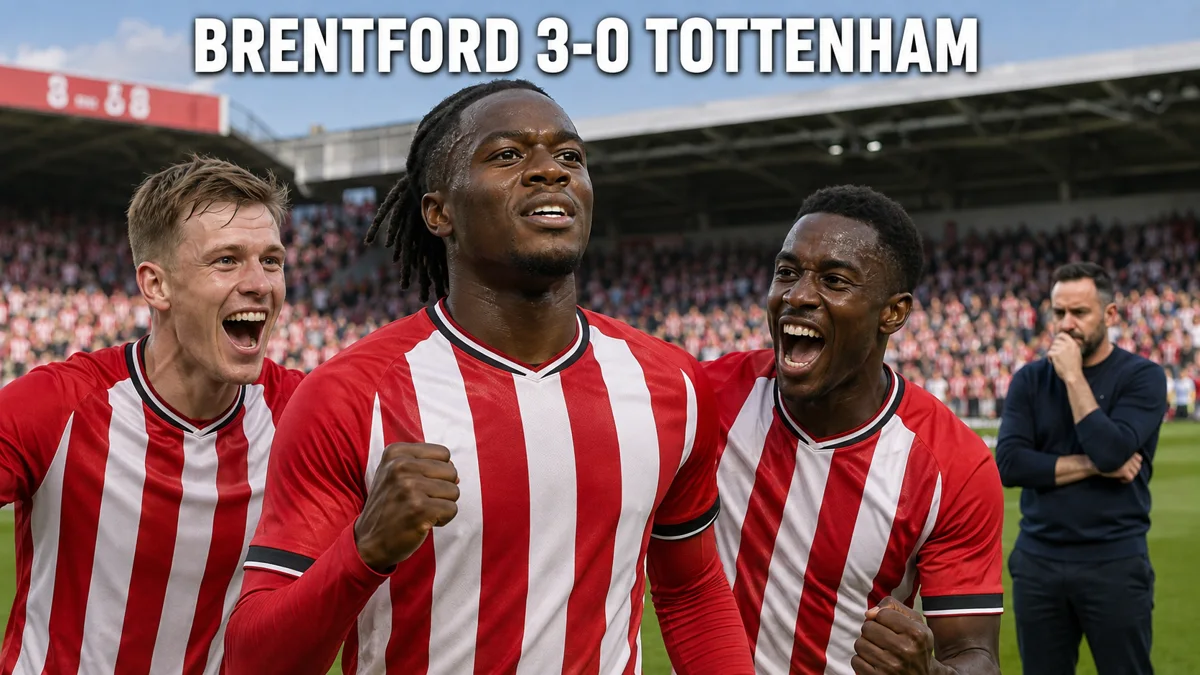
Brentford 3-0 Tottenham: Highlights & Tactical Analysis
Brentford’s 3-0 win over Tottenham Hotspur on August 22, 2026, was not simply an opening-day victory. It was a complete demonstration of what can happen when an organised team meets one that is still searching for its structure.
Keane Lewis-Potter opened the scoring after 12 minutes, Vitaly Janelt added a second before half-time and Michael Kayode completed the victory shortly after the restart.
Brentford were sharper in possession, stronger in the duels and far more coordinated without the ball. Tottenham had more possession but rarely controlled where the match was being played.
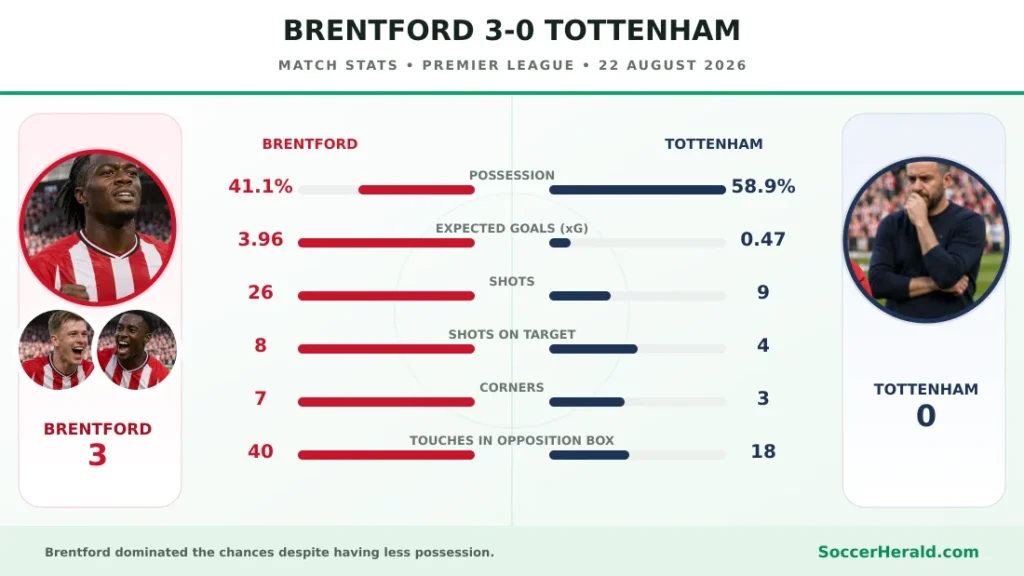
The final score could have been heavier. Igor Thiago missed a penalty, while Brentford finished with 3.96 expected goals compared to Tottenham’s 0.47.
Brentford 3-0 Tottenham Match Summary
Date: August 22, 2026
Competition: Premier League
Venue: Gtech Community Stadium
Result: Brentford 3-0 Tottenham Hotspur
Goals: Keane Lewis-Potter 12’, Vitaly Janelt 33’, Michael Kayode 49’
Expected goals: Brentford 3.96, Tottenham 0.47
Key moment: Igor Thiago missed a penalty in the 55th minute
Brentford controlled the match from the opening exchanges and did not allow Tottenham a shot on target during the first half.
Mamadou Sangaré produced an outstanding Premier League debut, creating the opening goal and playing an important role in the third. Tottenham’s expensive new midfield never found the rhythm required to escape Brentford’s pressure.
Brentford 3-0 Tottenham Highlights
Watch the match highlights and all three Brentford goals below.
How Brentford Scored Three Against Tottenham
Keane Lewis-Potter Makes It 1-0
The opening goal showed the difference between the two teams.
Sangaré moved forward from midfield, combined with Dango Ouattara and continued his run into Tottenham’s penalty area. Ouattara returned the ball, allowing Sangaré to find Lewis-Potter with a controlled cutback.
Lewis-Potter arrived from the left and finished first time.
Tottenham’s problem was not simply that one defender had been beaten. Their midfield pressure disappeared as soon as Brentford completed the initial combination.
Sangaré was then allowed to run directly at a defensive line that had no protection in front of it.
Brentford moved the ball quickly and with a clear destination. Tottenham reacted only after the decisive space had already appeared.
Vitaly Janelt Punishes Tottenham’s Second-Ball Problem
The second goal began when Richarlison failed to secure possession inside Tottenham’s half.
Brentford recovered the ball and attacked before Spurs could rebuild their shape. Mathias Jensen was given space to shoot, Antonín Kinský pushed the effort into the centre and Janelt converted the rebound.
The save was poor, but the problem was structural. Tottenham had too many players ahead of the ball, nobody pressured Jensen and Janelt’s run was not tracked.
Brentford needed only one recovery and one unchallenged shot to punish them.
Michael Kayode Ends the Contest
Brentford’s third goal came from a rehearsed corner routine.
Janelt delivered towards the far side, Nathan Collins headed the ball back into a central position and Sangaré struck towards goal. Kinský saved, but Kayode reacted first and scored from close range.
Tottenham defended the initial delivery without completing the action. Kayode’s goal in the 49th minute effectively ended the contest.
Six minutes later, Brentford should have scored again. Rodrigo Bentancur brought down Kevin Schade inside the penalty area, but Thiago’s spot-kick struck the post.
Brentford’s Pressure Removed Tottenham’s Midfield
Brentford did not press Tottenham continuously at maximum intensity.
They were more selective than that.
Thiago positioned himself between Tottenham’s central defenders, while the wide players closed passing lanes towards the full-backs. Behind them, Janelt and Sangaré were ready to move forward whenever Tonali or Bergvall received with their backs to goal.
The objective was to make Tottenham’s first pass predictable.
When Spurs played short, Brentford compressed the central areas. When they played longer, Collins and Ajer competed for the first ball while the midfield attacked the second.
Tottenham therefore struggled to create the kind of controlled build-up Roberto De Zerbi usually wants.
The visitors could circulate possession across the defensive line, but they rarely progressed through Brentford’s pressure with enough speed to expose the space behind it.
This was the football anticipated in our Brentford 2026/27 season preview. Keith Andrews has built a team that understands when to press, when to defend compactly and when to attack directly.
Sangaré Gave Brentford More Than Physical Power
Sangaré was the most influential player on the pitch.
His contribution to the opening goal demonstrated why Brentford broke their transfer record to bring him from Lens. He did not simply win possession or cover space. He carried the ball forward, combined under pressure and entered the penalty area at the right moment.
His positioning also caused Tottenham problems.
When he remained deeper, Brentford had enough strength around the second ball. When the opportunity appeared, he moved beyond the midfield and forced Spurs defenders to make decisions they were not prepared to make.
Tottenham’s midfield contained more expensive and more established Premier League names. Sangaré still looked like the player who understood the match best.
That should matter beyond one result.
Brentford narrowly missed European qualification last season because they sometimes lacked control against stronger midfields. Sangaré appears capable of giving them physical authority without reducing their attacking ambition.
Tottenham’s Possession Was False Control
Tottenham had more of the ball but rarely controlled the match.
Possession was often accumulated between the goalkeeper, centre-backs and deepest midfielders. Brentford were comfortable allowing passes in areas that presented little immediate danger.
The problem appeared when Tottenham attempted to move forward.
The distances between midfield and attack were too large, Richarlison was isolated and the wide players received without enough support. When possession was lost, the visitors were poorly positioned to stop Brentford’s transition.
Tottenham failed to register a first-half shot on target. Their full-match xG of 0.47 reflected how little threat their possession produced.
Mikey Moore forced Caoimhín Kelleher into a good save after half-time, but the chance arrived when the contest was already 3-0.
Possession without progression gave Tottenham numbers. It did not give them authority.
Kinský Was Exposed but Not Alone
Kinský’s handling contributed directly to the second and third goals, with both saves returning the ball to dangerous central areas.
However, Tottenham also failed to prevent the shots or track the players following them. Brentford consistently anticipated the next phase more quickly.
Kinský made the visible mistakes. The slower reactions around him revealed a collective problem.
How Brentford Exposed De Zerbi’s Build-Up
De Zerbi’s build-up depends on attracting pressure before finding a free midfielder who can turn and accelerate the attack.
Brentford prevented that sequence from developing.
Tonali frequently dropped towards the defensive line, but he rarely received in a position that allowed him to face forward. Gallagher and Bergvall were placed higher, leaving Tottenham without a reliable connection through midfield.
When Spurs attempted to escape with a longer pass, Richarlison struggled to secure possession. Brentford could then recover the ball against a team already stretched by its own build-up structure.
Tottenham’s £237 million summer rebuild was designed to give De Zerbi the technical quality required for this style of football. The profiles may fit the idea, but the coordination is not yet there.
Tonali could not dictate the tempo. Gallagher and Bergvall were replaced at half-time. The defensive line lacked protection and the attack remained disconnected.
After the match, De Zerbi admitted that Tottenham were not yet functioning as a team and had not competed properly in the physical parts of the game.
Tactical understanding requires time. Competing for duels, tracking runners and reacting to danger should not.
What Tottenham Must Fix Before Newcastle
Tottenham must first reduce the spaces between their midfield and defence.
Their press cannot work if the first line moves forward while the players behind it remain passive. Brentford repeatedly passed or ran through the resulting gaps.
De Zerbi also needs a clearer route into attack. Richarlison was isolated, while Tottenham’s possession rarely created opportunities for the wide players to attack defenders one against one.
The final problem is reaction speed.
Against Newcastle’s physical midfield and direct runners, the same weakness could become even more damaging.
One defeat does not define Tottenham’s season. The manner of this defeat, however, cannot be dismissed as an ordinary opening-day problem.
Brentford’s European Ambition Looks Real
Brentford finished ninth last season and missed European qualification only on goal difference.
Their opening performance suggested that disappointment has strengthened rather than damaged them.
Andrews retained the team’s aggression and tactical discipline while adding a midfielder capable of improving their work in possession. Lewis-Potter and Kayode provided goals from full-back positions, while Janelt connected midfield pressure with penalty-area movement.
Thiago did not score and even missed a penalty, yet Brentford still produced three goals and almost four expected goals.
That is an important development for a team that depended heavily on his 22 Premier League goals last season.
The Premier League 2026/27 hub will change repeatedly over the coming months, but Brentford have already provided the opening weekend with one of its clearest statements.
They are not trying to survive. They are trying to reach Europe.
Final Verdict
Brentford won because they were better prepared for every type of match the afternoon produced.
They were better during organised possession, more aggressive when the ball became loose and more dangerous when Tottenham’s shape broke apart.
Sangaré gave them control and penetration. Janelt gave them intelligence around the second ball. Lewis-Potter and Kayode turned aggressive positioning into goals.
Tottenham had more possession but almost none of the match.
The afternoon began with questions about whether Brentford could take the next step towards Europe. It ended with a more immediate question about Tottenham.
After another expensive rebuild, how much of the old weakness is still there?
Sources
Brentford FC: Brentford 3-0 Tottenham match report


