



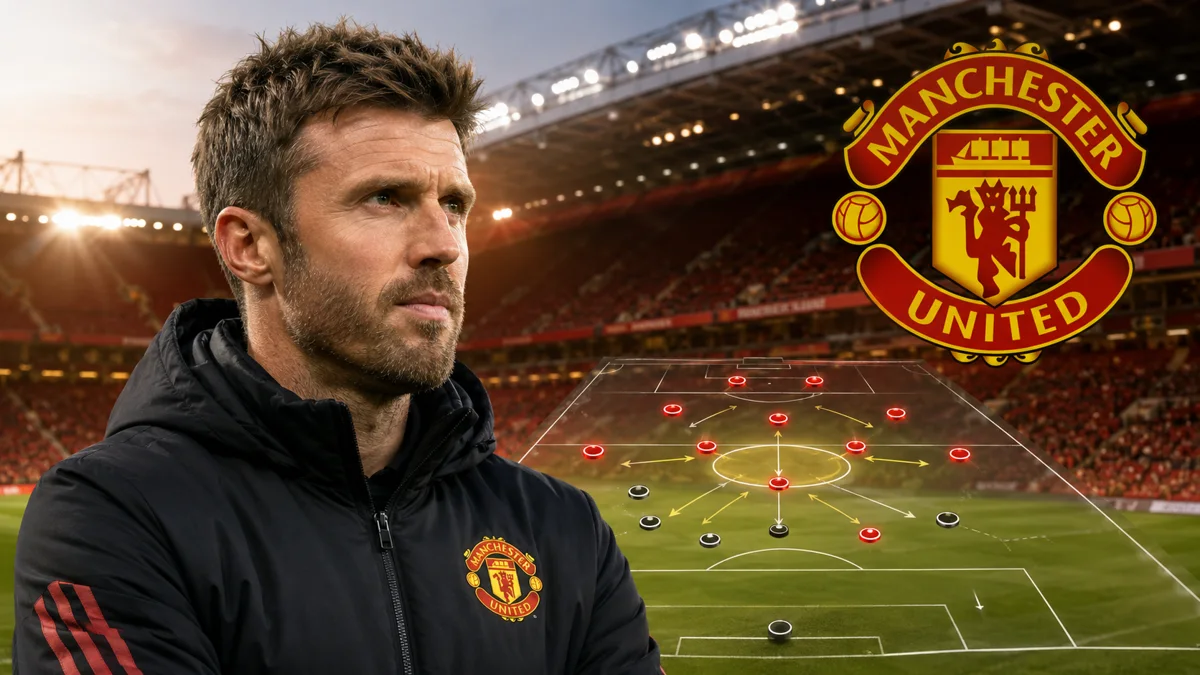
Michael Carrick Tactics: How He Rebuilt Manchester United
Michael Carrick’s tactics did not revive Manchester United through a radical new formation.
They worked because he removed confusion.
Carrick restored a back four, returned Bruno Fernandes to a true attacking role and gave the team a compact structure without the ball. United became easier to understand, harder to play through and far more dangerous when space appeared.
The results were immediate. After replacing Ruben Amorim in January 2026, Carrick won 12 of his 17 Premier League matches, lost only twice and guided United to third place with 71 points. What began as an interim rescue earned him a contract until 2028.
Now comes the more difficult part.
Carrick must prove that a system built to stabilise a damaged season can survive a full campaign, Champions League football and opponents who will increasingly allow United to have the ball.
Quick Answer: What Are Michael Carrick’s Tactics?
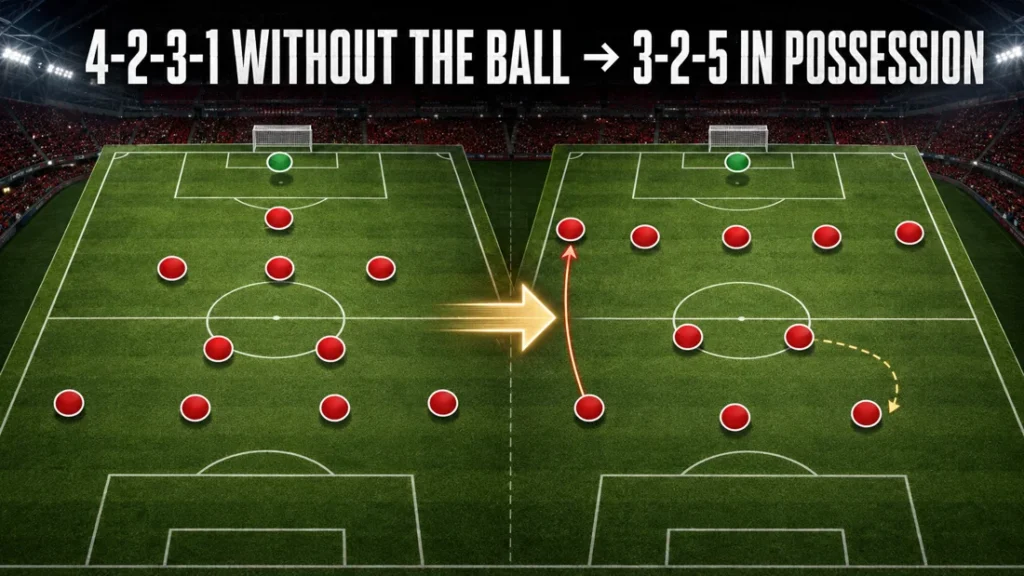
Michael Carrick primarily uses a flexible 4-2-3-1. United can become a 3-2-5 in possession, with one full-back advancing and the other helping form a back three. Without the ball, they often defend in a compact 4-4-2, protecting central areas before attacking quickly after regaining possession.
The most important changes were positional rather than revolutionary: Bruno Fernandes moved higher, Kobbie Mainoo returned to midfield, the wingers received clearer defensive responsibilities and the forwards were placed closer together.
That simplicity gave United balance. It also revealed the next challenge: Carrick’s side must become more creative against deep defensive blocks without losing the protection that powered their recovery.
From Interim Solution to Permanent Manchester United Manager
Carrick returned to Old Trafford as head coach on January 13, 2026, initially until the end of the season.
His first two matches changed the mood around the club.
United beat Manchester City 2-0 at Old Trafford and then defeated Arsenal 3-2 at the Emirates. The performances were different, but the principles were already visible: defend the centre, remain compact, use familiar roles and accelerate when possession changes.
The revival continued.
Carrick’s final record was 12 wins, three draws and two defeats from 17 league matches. United finished third, secured Champions League qualification and ended the season on 71 points.
That run persuaded the club to make his appointment permanent on a two-year contract running to June 2028.
The decision was based on more than results. United looked like a team again.
Carrick understood the scale of the club before becoming its manager. He made 464 first-team appearances for United, won five Premier League titles and later worked on the coaching staff under Jose Mourinho and Ole Gunnar Solskjaer.
His spell at Middlesbrough then gave him the experience of building his own team. There, he favoured a 4-2-3-1, short passing connections and central overloads. Those ideas followed him back to Manchester, although he initially used them in a more pragmatic way.
Michael Carrick’s 4-2-3-1 Explained
The formation on the team sheet is only the starting point.
Carrick’s United do not remain in one fixed shape throughout a match. The 4-2-3-1 provides clear reference points, but the structure changes according to the phase of play.
In possession, one full-back can move forward while the other remains deeper alongside the centre-backs. That creates a three-player defensive base.
The double pivot stays ahead of that line, giving the player in possession short passing options and providing protection if the ball is lost. Higher up the pitch, the two wingers, Bruno and the centre-forward occupy five attacking lanes.
The result can resemble a 3-2-5.
Carrick does not require constant rotation for its own sake. His teams use short passes to attract pressure, but the objective is to find the free player and move forward. Once the first line of pressure is beaten, United can switch play quickly or release a runner behind the defence.
This suits a squad containing fast and direct attackers.
Bryan Mbeumo can threaten the space behind a full-back. Matheus Cunha can receive between the lines before carrying the ball forward. Benjamin Sesko can attack crosses, run beyond the centre-backs or provide a central target when United play more directly.
The structure gives each of them a clearer route towards goal.
Why United Defend in a 4-4-2
Carrick’s greatest early improvement came without the ball.
When United drop into their defensive shape, Bruno can move alongside the striker. The wingers recover into midfield, creating two compact lines of four.
This 4-4-2 is designed to close the middle.
The two forwards screen passes into the opposition pivot. The midfield line protects the space in front of the centre-backs. Opponents are encouraged to move the ball towards the wings, where United can press against the touchline or defend a cross with greater numbers inside the penalty area.
That approach was central to the victories over City and Arsenal.
United did not need to dominate possession. They needed to control where the opposition could use it. Once the ball was recovered, the distances between their attacking players were short enough to launch a counterattack.
Carrick also showed tactical flexibility during matches. He was prepared to protect a lead with a back five when circumstances demanded it, rather than treating the 4-2-3-1 as a rule that could never be broken.
That pragmatism matters.
His system gives United an identity, but it does not force the same solution on every game.
Bruno Fernandes Became a No. 10 Again
No player benefited more clearly from Carrick’s arrival than Bruno Fernandes.
Under Amorim, Bruno was often asked to begin deeper in midfield. That allowed him to receive the ball frequently, but it also left United’s best creator too far from the forwards.
Carrick moved him closer to goal.
From the central attacking role, Bruno can still drop towards the ball, but he is no longer responsible for building every move from its first pass. He has the freedom to drift towards the right, combine with the winger and deliver early crosses towards Sesko.
The change was visible in the numbers.
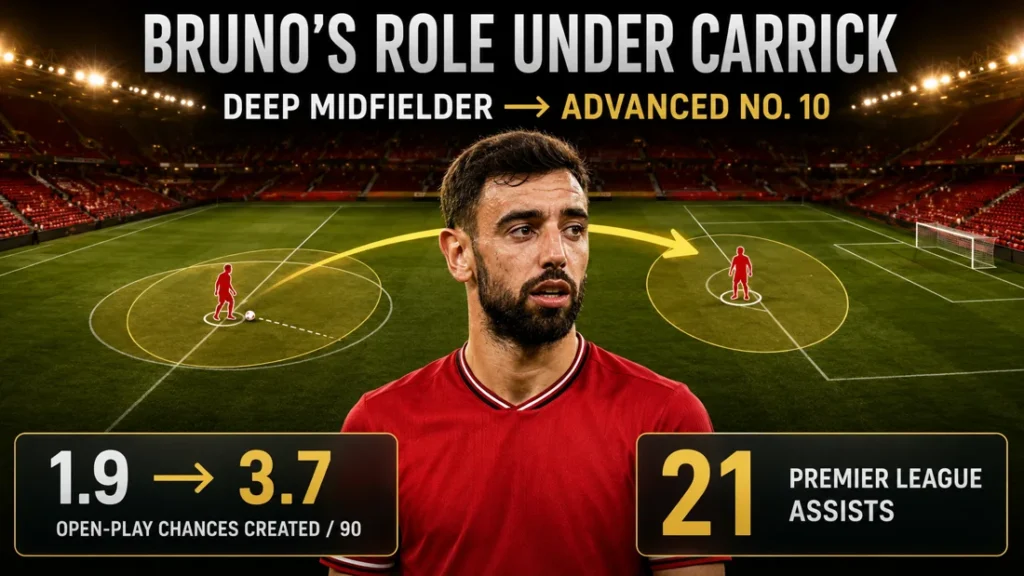
Premier League analysis in early March showed that Bruno’s open-play chances created had risen from 1.9 to 3.7 per 90 minutes in the eight league matches following Amorim’s departure. His successful open-play crosses increased from 0.3 to 1.4 per 90.
He finished the campaign with 21 Premier League assists, setting a new single-season competition record.
Carrick did not improve Bruno by giving him more responsibility. He improved him by giving that responsibility a more dangerous location.
How Carrick Helped Benjamin Sesko
Sesko’s first months in England were difficult.
He scored only twice in 16 appearances under Amorim and often appeared isolated. United could reach the final third without creating the type of service that suited their striker.
The shift to 4-2-3-1 changed the relationships around him.
Bruno operated closer to the penalty area. The wide players delivered more crosses. Cunha and Mbeumo occupied defenders rather than leaving Sesko alone between two centre-backs.
By early March, Sesko had scored six goals in seven league appearances. He eventually finished with 11 Premier League goals and 12 in all competitions, sharing United’s overall top-scorer position with Mbeumo.
There is still room for significant growth.
Sesko must become a more consistent starter and improve his influence when opponents defend close to their own goal. Yet Carrick has already created a framework that uses his height without reducing him to a traditional target man.
United can cross towards him, but they can also release his pace into space or use his movement to open a route for Bruno and Cunha.
The Double Pivot Gives Carrick’s System Its Balance
The front four attract most of the attention, but Carrick’s system depends on the two midfielders behind them.
One must help the team escape pressure. The other must protect transitions, cover advancing full-backs and prevent opponents from attacking an exposed defensive line.
Kobbie Mainoo became especially important during the 2025/26 recovery.
His ability to receive near his own penalty area, turn away from pressure and connect with a centre-back simplified United’s build-up. Carrick did not ask the defenders to perform complicated midfield rotations. Mainoo could offer the goalkeeper a short option, draw an opponent and help move the ball towards the free side.
Casemiro provided experience and defensive instinct alongside him, but his departure created a need for a new midfield structure.
Youri Tielemans and Andrey Santos give Carrick different qualities for 2026/27. Tielemans can control tempo and pass through midfield lines. Santos offers mobility, ball-winning and the energy to defend larger spaces.
The combination is promising, but it must still be tested.
United’s double pivot cannot become so focused on possession that the team lose their counterpress. If both midfielders advance at the same time, the 3-2-5 can quickly become a poorly protected front five.
That is the area where Carrick’s tactical evolution may be decided.
Why Carrick’s United Were So Effective in Big Matches
United’s strongest performances under Carrick came against opponents prepared to attack them.
City and Arsenal pushed players forward, tried to control possession and left space behind their pressure. That gave United exactly the type of match their structure was designed to exploit.
The compact 4-4-2 protected the centre. Mainoo and Casemiro competed for second balls. Bruno waited in a position from which one forward pass could release Mbeumo, Cunha or Sesko.
United could therefore be cautious without becoming passive.
The distinction is important. A passive team simply retreats and survives. Carrick’s best performances combined defensive patience with a clear attacking exit.
However, title contenders cannot rely on opponents creating space for them.
Promoted teams and lower-table visitors are more likely to defend deep, slow the match and ask United to construct attacks against ten players behind the ball. Those games will test the detail of Carrick’s possession structure far more than an open contest at the Emirates.
The Two Questions Carrick Must Answer in 2026/27
Carrick’s first question concerns deep blocks.
United must learn to move opponents without forcing low-percentage passes or hopeful crosses. Tielemans can improve circulation, while Bruno’s movement can create overloads, but the team will need width, patience and well-timed runs inside the full-backs.
The second question is workload.
Carrick’s 17-match recovery came after United had already been eliminated from both domestic cups and had no European football. He could prepare for one league match at a time and rely on a relatively stable core.
Champions League football changes everything.
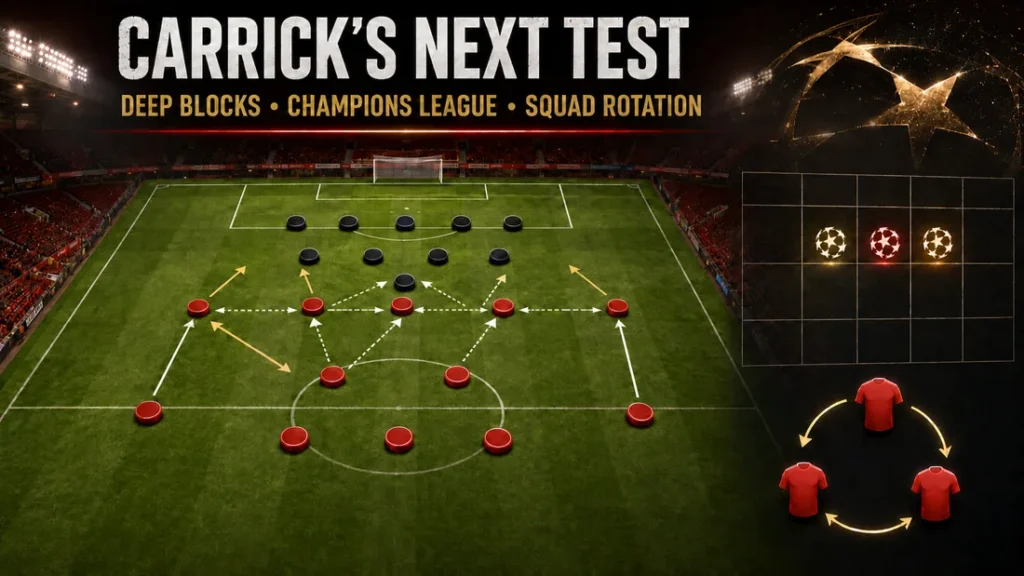
There will be less training time, more travel and a greater need to rotate. The distances that make the 4-4-2 compact depend on physical intensity. If tired players arrive half a second late, the central protection disappears.
This is why United’s squad depth matters as much as the starting formation.
Read our full Manchester United 2026/27 season preview for a wider assessment of the squad, key players and Premier League outlook.
Can Michael Carrick Challenge for the Premier League Title?
Carrick has already shown that he can organise Manchester United, improve important players and win difficult matches.
That is enough to make another top-four finish a realistic expectation.
A genuine title challenge requires more evidence.
United must show they can control matches against deep opponents, protect the squad through Europe and respond when the initial plan fails. Carrick must also maintain the emotional clarity that made his interim spell so effective once defeats and injuries create pressure.
The encouraging part is that his football does not depend on one trick.
United can build patiently, attack transitions, cross towards Sesko or use Bruno between the lines. They can defend in a compact block and change to a back five when protecting a result.
The concern is whether all those options can become one repeatable identity across 50 or more matches.
Final Verdict
Michael Carrick rebuilt Manchester United by making the team understandable again.
The back four restored familiar defensive relationships. The double pivot protected the centre. Bruno returned to the spaces where he could decide matches. Sesko received better service, while the wide attackers gained clearer routes towards goal.
The 4-2-3-1 was not revolutionary.
Its success came from timing, balance and the willingness to give talented players roles that suited them.
Carrick’s 12 wins in 17 league matches proved that the rescue was real. They did not prove that the same model will survive an entire season with Champions League demands and opponents increasingly prepared to deny United transition space.
That is his next test.
Carrick has already restored the shape. Now he must prove it can survive the schedule.
Michael Carrick FAQs
What formation does Michael Carrick use?
Michael Carrick primarily uses a 4-2-3-1. It can become a 3-2-5 in possession and a compact 4-4-2 when Manchester United defend.
Is Michael Carrick Manchester United’s permanent manager?
Yes. Manchester United made Carrick their permanent head coach in May 2026 and gave him a contract running until June 2028.
What was Michael Carrick’s Manchester United record in 2025/26?
Carrick won 12, drew three and lost two of his 17 Premier League matches after taking charge in January 2026. United finished third with 71 points.
How did Carrick improve Manchester United?
Carrick restored a back four, moved Bruno Fernandes higher, returned Kobbie Mainoo to midfield and organised United into a compact 4-4-2 without the ball. Those changes made the team more balanced and dangerous in transition.
Sources
Manchester United: Carrick continues as United head coach


