




Albert Riera and Red Star: Is the 82% Tactical Fit Real?
Albert Riera has arrived at Red Star with an unusually precise number attached to his appointment: 82%.
A recent analysis published in Serbia, based on work attributed to German experts, rated the tactical compatibility between Riera and the Red Star squad at 82%. It also produced separate scores for pressing, transitions, attack, midfield and defence.
The conclusion is interesting. The precision is harder to accept.
Without a publicly available model showing how those categories were weighted, an 82% fit should not be treated as a scientific measurement. There is no obvious reason why one midfield should score 81 rather than 83, or why one pressing model should be worth exactly 92%.
But that does not mean the broader conclusion is wrong.
Soccer Herald approached the question from a different direction: what defines Albert Riera’s tactics, and how naturally can Red Star’s current squad perform the tasks his football demands?
Our assessment is based on five areas: possession and build-up, pressing and transitions, positional suitability of the squad, domestic-game compatibility and European sustainability.
The result is an independent tactical fit score of 84/100.
That is not an 84% probability that Riera will succeed.
It is simply an assessment of how well his football appears to match the team he has inherited.
And the most interesting part is that a different method leads to almost the same conclusion.
What Does Albert Riera Actually Want From His Teams?
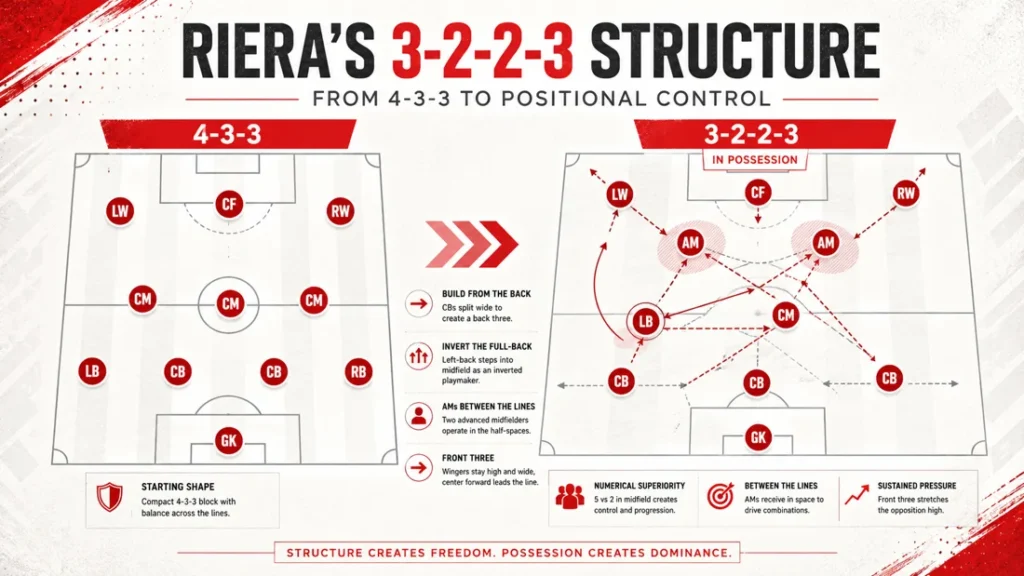
Riera’s football starts with possession, but possession alone does not explain it.
At Olimpija Ljubljana, his team averaged around 61% possession, approximately 565 passes per game and an 86% passing accuracy, while becoming one of the most dominant sides in Slovenia.
The important part was not simply how often Olimpija had the ball.
It was where players positioned themselves around it.
Riera’s teams repeatedly tried to create numerical superiority during the first phase of build-up. A midfielder could drop closer to the centre-backs, a full-back could move inside, and another midfielder could advance between the opposition’s midfield and defensive lines.
The objective was to create a free player.
Once that player received the ball, the next movement had already started.
A winger could move inside. A midfielder could attack the space behind him. A full-back could provide width, while the player on the opposite flank remained isolated against one defender.
Riera therefore uses possession to move the opponent before attacking the space the opponent leaves behind.
That is highly relevant to Red Star.
In most Serbian SuperLiga matches, Red Star cannot wait for space to appear naturally. Opponents are often prepared to defend deep, concede possession and protect the penalty area.
Red Star have to manufacture the space themselves.
That makes Riera’s preference for positional rotations and controlled territorial dominance a logical fit.
Why Red Star’s Squad Fits Riera
The strongest part of the fit may be midfield.
Red Star have players such as Timi Max Elšnik, Rade Krunić, Mirko Ivanić, Vasilije Kostov and other technically comfortable midfield options capable of receiving under pressure and operating in more than one zone.
That matters because Riera does not ask his midfielders simply to occupy fixed positions.
His No.6 can become part of the first build-up line.
One No.8 can drop towards the ball.
Another can remain between the lines.
A winger can move into the half-space and temporarily occupy a zone normally associated with a midfielder.
Those movements require players who understand space rather than merely the position written next to their name on the team sheet.
Elšnik is particularly interesting because of his ability to receive centrally, play forward and control tempo.
Ivanić naturally understands the spaces between midfield and defence.
Kostov could also benefit from a structure in which timing, positioning and technical security are valued as much as athleticism.
That does not mean every midfielder will automatically thrive.
Riera’s model requires constant movement without destroying the structure. A player who vacates one zone must know who is replacing him.
When those rotations are coordinated, a team looks fluid.
When they are not, it simply looks disorganised.
That will be one of Riera’s first major coaching tasks.
Could Elšnik Become an Inverted Left-Back?
One tactical possibility deserves particular attention.
Timi Max Elšnik could, in theory, be used as a hybrid left-back who moves into midfield when Red Star have possession.
There is no indication yet that Riera plans to use Elšnik there, so it should not be presented as an expected selection.
Structurally, however, it makes sense.
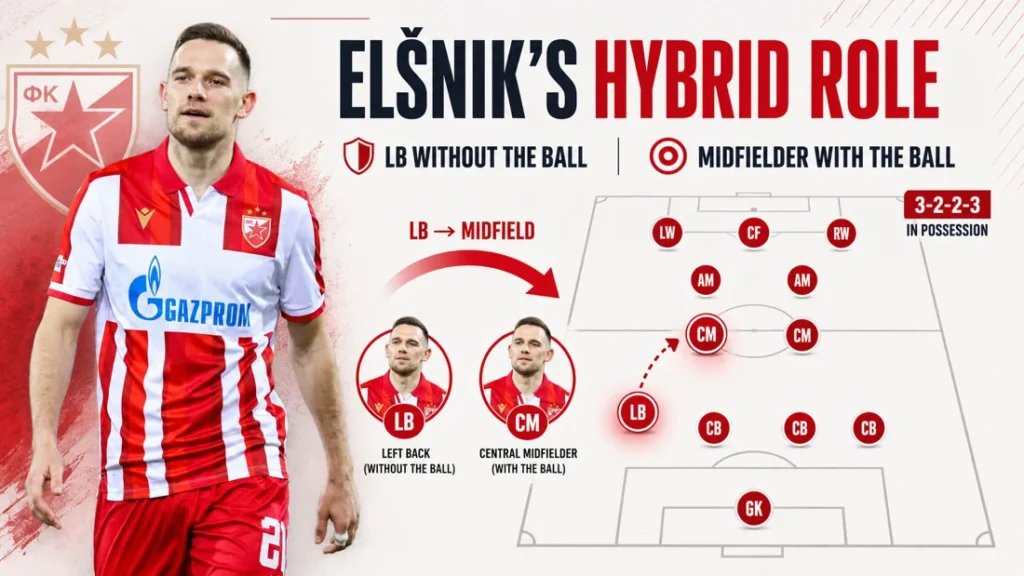
Riera has previously used shapes that begin as a back four but transform when possession is established.
At Celje, a nominal 4-3-3 could become a 3-2-2-3, with one full-back moving inside alongside a central midfielder.
The principle would be more important than the position written on the team sheet.
Without the ball, Elšnik could occupy the left side of a back four.
With the ball, he could step into midfield.
The structure could resemble:
Back three
CB — CB — RB
Two deeper midfielders
Elšnik — DM
Two advanced midfielders
AM — AM
Front three
LW — ST — RW
Elšnik would therefore not be asked to behave like a conventional attacking full-back constantly sprinting along the touchline.
He would effectively become another midfielder once Red Star established control.
That would use qualities he already possesses instead of asking him to learn the attacking behaviour of a traditional full-back.
It would also allow the opposite full-back to behave differently, creating the asymmetry that appears frequently in Riera’s positional structures.
Again, this remains a tactical possibility rather than a prediction.
But it illustrates how Riera can change the function of a player without necessarily changing the personnel.
Why Riera’s Pressing Fits Red Star
The original analysis gave Riera and Red Star a very high compatibility score for pressing.
That part of the argument is easier to understand.
Riera wants his teams to react immediately when possession is lost.
The nearest players move towards the ball.
Passing lanes are compressed.
The pitch becomes smaller.
The objective is to stop the opponent making the first clean pass that turns a defensive transition into a counterattack.
If the ball is recovered, the logic immediately reverses.
The pitch becomes large again.
Wingers move away from the ball, advanced players attack the newly opened spaces and Red Star can attack before the opponent has reconstructed its defensive block.
That is particularly valuable in Serbia.
Against an opponent spending long periods close to its own penalty area, the best chance may not come from the original attack.
It may come five seconds after possession has been lost and immediately won back.
That combination of controlled possession and aggressive counterpressing is one of the strongest reasons Riera appears to fit Red Star.
How Arnautović Changes Riera’s Pressing
Marko Arnautović creates a slightly different challenge.
The issue is not whether he has the technique to play in a possession-based team.
He does.
The question is whether a 37-year-old centre-forward should be expected to lead an extreme pressing game for 90 minutes.
Probably not.
That means Riera may have to adapt his pressing structure to Arnautović rather than demand that Arnautović reproduce the physical workload of a younger forward.
The striker can screen central passing lanes and direct the opposition towards one side while younger players around him provide the more explosive pressure.
That would preserve his qualities in possession and around the penalty area without asking him to become something he is not.
It is a small example of the larger challenge facing Riera.
The best version of this appointment will not come from forcing every Red Star player into a rigid tactical template.
It will come from adapting his principles to the strongest qualities already present in the squad.
Breaking Low Blocks May Be the Biggest Domestic Benefit
Red Star do not need a coach who can merely produce high possession numbers.
They need one who can turn possession into chances.
That distinction matters.
Against a deep defence, endless circulation around the penalty area achieves very little if defenders are never forced to make difficult decisions.
Riera’s positional game tries to create those decisions.
A winger moving inside can drag a full-back with him.
That opens the outside channel.
An advanced midfielder can attack the space.
The full-back can overlap or remain deeper depending on the structure.
The opposite winger can stay wide and become available for a switch.
The point is not that every attack follows the same pattern.
The point is that every movement should force a defender to respond.
That makes Riera an unusually logical coach for Red Star’s domestic environment.
The Serbian champions are expected to attack teams who do not want the ball.
Riera is comfortable coaching exactly that type of match.
Why Riera’s Red Star Could Be Vulnerable in Europe
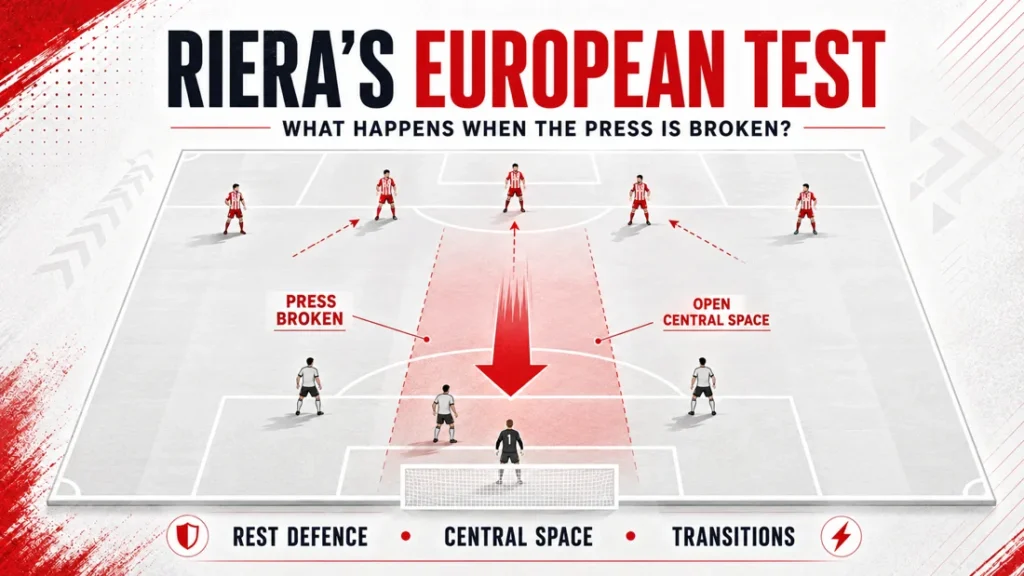
This is where the analysis becomes much less comfortable.
Riera’s biggest advantage in Serbia could become his biggest risk in Europe.
When Red Star dominate possession, they may attack with a structure resembling:
Front line
LW — ST — RW
Advanced midfield
AM — AM
Base
DM — inverted LB
Rest defence
CB — CB — RB
Five players can therefore be positioned ahead of the deeper structure.
That is not automatically dangerous.
It becomes dangerous if the players behind the attack are badly positioned when possession is lost.
This is the concept of rest defence.
Some of the most important defensive work happens before Red Star actually lose the ball.
The deeper players have to anticipate the transition.
Can they control the opponent’s first forward pass?
Can they prevent the second pass that releases the runner?
Is the central channel protected?
Who covers the space behind the advanced wide player?
Who tracks the striker sprinting into the area behind the defensive line?
Against many Serbian opponents, Red Star may recover possession before those questions become serious.
European teams are far more capable of escaping the first pressure.
One vertical pass can remove several Red Star players from the defensive phase.
A second can transform controlled possession into a three-against-three counterattack.
That is where Riera’s European season could ultimately be decided.
Not by possession percentage.
Not by total passes.
Not even by PPDA.
It could be decided by how well the three, four or five players behind Red Star’s attacking structure control the space when the first press is beaten.
Riera’s Celje showed that he is willing to remain ambitious in European competition. His side continued to play possession football and reached the Conference League quarter-finals.
That is encouraging.
But Red Star will ultimately be judged at a higher level and under far greater pressure.
The challenge is to remain aggressive without becoming reckless.
If Riera can build a strong rest-defence structure, his model could travel.
If he cannot, the same football that suffocates opponents in Serbia could leave Red Star dangerously exposed against faster and more technically secure European teams.
Soccer Herald’s Tactical Fit Score
Rather than producing a long list of ultra-precise sub-scores, Soccer Herald assessed the fit through five broad areas.
The overall score is an editorial assessment informed by the five categories rather than a simple average of them.
| Area | Score |
|---|---|
| Possession & build-up | 93/100 |
| Pressing & transitions | 88/100 |
| Squad profiles | 86/100 |
| Domestic fit | 95/100 |
| European sustainability | 72/100 |
| Overall tactical fit | 84/100 |
Overall tactical fit: 84/100
The strongest categories are relatively easy to explain.
Riera wants to dominate possession, and Red Star have to dominate possession.
He wants technically capable midfielders, and that is one of the stronger areas of the squad.
His positional structures are designed to manipulate low defensive blocks, something Red Star face almost every week.
The lower European score reflects a very different environment.
When Red Star are no longer the physically or technically superior team, Riera’s aggression becomes harder to sustain and the spaces behind the attack become more dangerous.
That is not evidence that his model cannot work in Europe.
It is simply the area in which the compatibility remains least proven.
Is the 82% Tactical Fit Actually Realistic?
As a precise mathematical figure, the original 82% should still be treated cautiously.
Without the complete methodology, weighting system and underlying data, it cannot be independently verified.
But the football logic behind the conclusion is persuasive.
Soccer Herald did not begin with the objective of proving that 82% was correct.
Our assessment used different categories and focused on Riera’s tactical principles, Red Star’s player profiles and the very different demands of Serbian and European football.
It happened to produce a similar result.
That is more interesting than the numerical agreement itself.
The interesting part is not that two different assessments arrive at roughly the same number. It is why they do.
Riera’s football asks Red Star to do more intelligently what they already have to do every week: dominate the ball, compress the pitch and attack a low defensive block.
The real uncertainty begins only when Red Star are no longer the stronger team.
Europe will tell us whether the fit is merely good — or genuinely exceptional.
Sources
Kurir — Albert Riera and Red Star Tactical Compatibility Analysis
Eintracht Frankfurt — Albert Riera: A Man of Conviction
Total Football Analysis — Albert Riera’s Olimpija Tactical Analysis


