



Manchester City 2026/27 Season Preview: Maresca After Pep
Manchester City have spent the last decade knowing exactly who they are.
That certainty has gone.
Pep Guardiola left this summer after 10 years, six Premier League titles, a Champions League and a transformation that changed not only City but English football. Enzo Maresca now inherits the most difficult version of an elite job: taking over a successful team whose identity became inseparable from the man who built it.
City are not rebuilding from failure.
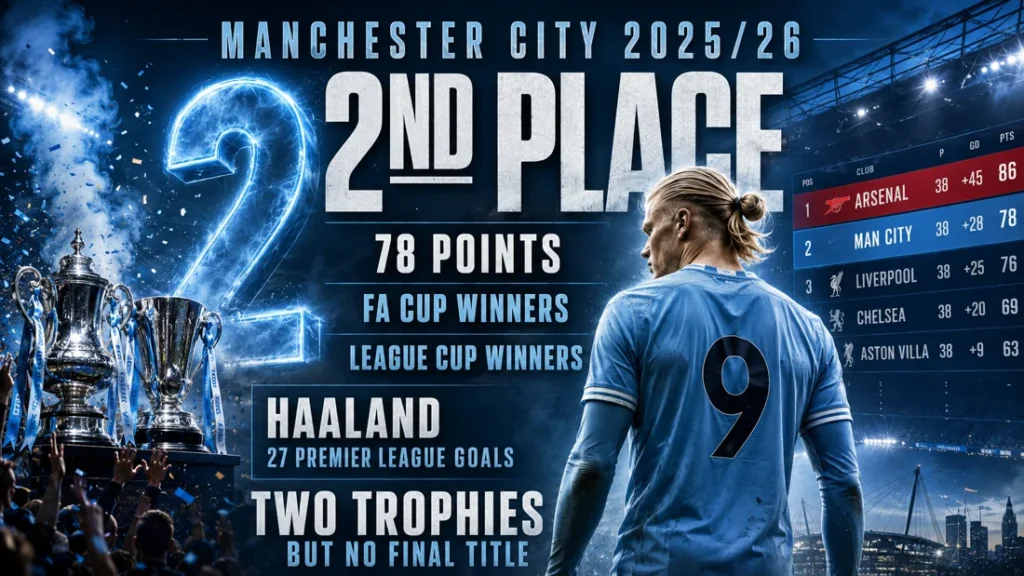
They finished second with 78 points last season, challenged Arsenal for the title and won both the FA Cup and League Cup. Erling Haaland collected another Golden Boot with 27 Premier League goals.
But Guardiola is gone. Bernardo Silva and John Stones have gone. Rodri could be next after City accepted Barcelona’s reported bid.
The next Manchester City has to be built while the old one is still recognisable.
Quick Answer
Manchester City begin 2026/27 under Enzo Maresca after finishing second to Arsenal in the Premier League and winning both domestic cups last season.
Maresca offers continuity rather than revolution. He worked under Guardiola during City’s Treble-winning campaign and shares many of the same principles around positional play, possession and territorial control.
But his midfield is changing dramatically.
City have broken their transfer record to sign Elliot Anderson from Nottingham Forest for a deal worth up to £116 million, while Rodri is on the verge of leaving for Barcelona after City accepted a reported £65.4 million offer.
With Haaland still leading the attack, this remains one of the Premier League’s strongest squads.
The question is whether continuity after Guardiola is actually possible.
City Came Close Without Winning the League
By almost any normal standard, 2025/26 was an excellent season.
City finished second with 78 points and ended the campaign with two trophies, beating Arsenal in the League Cup final before adding the FA Cup at Wembley.
But City have not operated by normal standards for years.
Arsenal’s 85 points denied Guardiola one final Premier League title, although Haaland’s 27 league goals and the continued development of players such as Jeremy Doku and Marc Guéhi showed that the squad itself had not collapsed.
The era ended anyway.
Maresca Is Continuity With a Different Voice
City could have reacted to Guardiola’s departure by seeking a radically different manager.
They chose the opposite.
Maresca understands positional football, controlled possession and the importance of manipulating opposition structures before accelerating through them. He also understands the City environment after previously working on Guardiola’s staff.
That should shorten the adaptation period.
But Maresca cannot simply recreate Guardiola.
His teams have often placed even greater emphasis on structured build-up, carefully defined positional zones and creating numerical superiority close to the ball.
The early warning arrived at Wembley.
Arsenal beat City 3-0 in the Community Shield, exposing problems on the right side and controlling a midfield missing Rodri. As we explained in our Arsenal 3-0 Manchester City Community Shield analysis, the result does not define the season, but it showed how much work remains.
Maresca needs time.
Manchester City rarely give managers the luxury of lowering expectations while they find it.
Rodri’s Exit Changes the Midfield
Replacing Guardiola is difficult enough.
Potentially losing Rodri at the same time makes the problem deeper.
Manchester City have accepted Barcelona’s reported £65.4 million bid, although the transfer is not yet officially complete. As covered in our Rodri to Barcelona transfer analysis, the midfielder has travelled to Catalonia with the move now close to completion.
There is no direct replacement for what he provides.
Rodri could dictate possession, protect transitions and control the emotional tempo of a match from one position.

Maresca will probably have to distribute those responsibilities.
Anderson is central to that plan.
Elliot Anderson Is the £116m Bet on the Future
City have spent more on Elliot Anderson than on any player in their history.
The deal with Nottingham Forest could reach £116 million, surpassing the £100 million paid for Jack Grealish.
The price is enormous.
The tactical logic is easier to understand.
Anderson brings ball-winning, carrying, progressive passing and the physical ability to cover large spaces. That versatility should give Maresca several options.
He could play as one of two deeper midfielders, move higher as an aggressive No.8 or become part of the counter-press immediately after possession is lost.
That final role may be particularly important without Rodri.
City will still push numbers ahead of the ball, but Anderson’s ability to cover ground quickly could become one of the mechanisms that protects the space left behind their attacks.
He should not be judged as “the new Rodri.”

City are changing the midfield rather than replacing one player with another.
That distinction could define their season.
Haaland Remains the Great Constant
Managers change.
Midfield structures change.
Erling Haaland keeps scoring.
His 27 Premier League goals last season earned another Golden Boot, while he finished with 38 goals across all competitions.
That gives Maresca something few new managers inherit.
A guaranteed reference point.
The tactical question is how quickly City can feed him.
Maresca’s possession game should create long periods around the opposition penalty area, while Doku and Antoine Semenyo can attack from wide positions and Rayan Cherki can find passes between defensive lines.
Haaland does not need City to reinvent the final action.
He needs them to reach it often enough.
Phil Foden Has a Point to Prove
Phil Foden enters the season in an unusual position.
He remains one of City’s most gifted players, but his 2025/26 campaign never completely returned to the extraordinary heights of his best years.
He still produced 10 goals and seven assists across 50 appearances.
The problem was consistency.
Maresca may offer him a reset.
Foden can operate as an advanced midfielder, narrow winger or one of the players moving around Haaland between the lines.
With Bernardo gone and Rodri potentially following, City need another established player to assume greater creative responsibility.
Foden should be one of them.
City’s Defence May Be Better Than It Looks
The Community Shield defeat naturally created concern, but City’s defensive options remain strong.
Marc Guéhi has already settled after his January arrival. Abdukodir Khusanov emerged as one of last season’s major positives, while Ruben Dias remains the defensive leader and Rayan Aït-Nouri provides attacking quality from the left.
The challenge is structural rather than simply individual.
Maresca wants his full-backs and midfielders positioned aggressively during possession.
If the spacing is wrong, City can be exposed before their centre-backs have time to organise.
Without Rodri, controlling those transitions becomes even more important.
That is where Anderson’s athleticism may matter as much as his passing.
The Opening Month Will Reveal Plenty
City begin at home against Bournemouth on August 23 before travelling to Crystal Palace five days later.
Coventry then visit the Etihad before the first Manchester derby of the season at Old Trafford on September 13. Sunderland follow at home.
It is not a brutal opening schedule.
That makes it useful for Maresca.
City have an opportunity to build rhythm before the calendar becomes more demanding.
Liverpool away arrives in October, while the first league meeting with Arsenal comes at the Emirates later in the autumn.
By then, we should know whether this is Guardiola’s City with a different coach or the beginning of something genuinely new.
Soccer Herald Prediction
Predicted finish: 2nd
Best-case scenario: Maresca makes the transition look almost seamless, Anderson transforms the midfield and Haaland leads City back to the Premier League title.
Worst-case scenario: Rodri’s departure leaves a structural hole, the new midfield takes too long to settle and City lose ground to more established title contenders.
Key player: Erling Haaland
Player to watch: Elliot Anderson
Potential difference-maker: Phil Foden
Defensive leader: Marc Guéhi
Biggest tactical question: Can City control transitions without Rodri?
Season verdict: Manchester City still have championship-level talent everywhere.
Haaland guarantees goals. Foden, Cherki, Doku and Semenyo give Maresca different ways to create around him, while Guéhi and Khusanov provide a younger defensive foundation.
Anderson may be the most important piece of all.
He cannot reproduce Rodri’s control by himself, but his mobility, ball-winning and ability to close large spaces could become essential to protecting City when possession breaks down. If Maresca cannot rebuild that transition security collectively, the quality further forward may not matter enough.
This season cannot be treated as business as usual.
Guardiola has gone. Bernardo has gone. Stones has gone. Rodri could soon follow.
That is too much accumulated knowledge and control to disappear without consequences.
City’s ceiling remains the title.
For now, second feels more realistic because Arsenal enter the season with greater continuity while Maresca has to replace both a legendary manager and potentially the heartbeat of his midfield.
Manchester City spent a decade perfecting Guardiola’s football.
Now they have to discover what comes after it.
Sources
Reuters: Maresca faces daunting task as Manchester City turn page


