



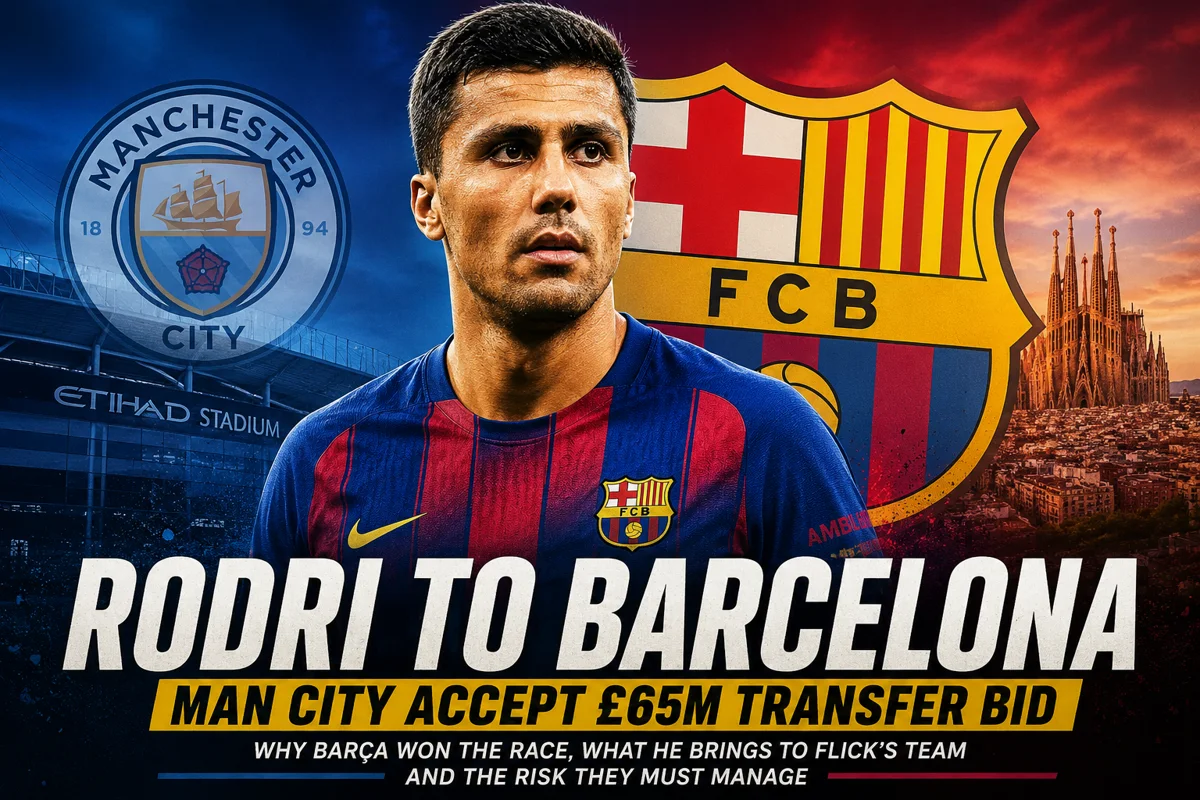
Rodri to Barcelona: Man City Accept £65m Transfer Bid
Rodri is on the verge of becoming a Barcelona player after Manchester City accepted a £65.4 million bid for the Spain midfielder, bringing one of the summer’s biggest transfers to the brink of completion.
The 30-year-old has arrived in Catalonia ahead of a medical on Tuesday after making clear his desire to join Barcelona. City had previously rejected two lower offers before accepting Barça’s third bid.
An official announcement is still to come.
At El Prat airport, Rodri described playing for Barcelona as “a dream.”
It is an unusually appropriate word.
For Barcelona, this is not simply the acquisition of another elite midfielder. It is an attempt to solve a problem that has followed the club since Sergio Busquets left: how to dominate matches without becoming vulnerable whenever possession disappears.
For Manchester City, it is something very different.
It is the end of an era.
Quick Answer: Is Rodri Joining Barcelona?
Manchester City have accepted Barcelona’s £65.4m bid, with Rodri set for a medical after agreeing to make the move to Catalonia.
The deal is not yet officially complete, but Rodri has already travelled to Barcelona and City have accepted the offer.
The situation has changed dramatically since Soccer Herald examined the possibility of a Rodri transfer to Real Madrid.
Back then, the question was whether Madrid could convince him to return to Spain.
Now the destination appears clear.
Barcelona Have Bought Control
There is a temptation with Rodri to start with the trophies.
There are plenty of them.
Four Premier League titles, the Champions League, the 2024 Ballon d’Or and a central role in Spain’s latest World Cup triumph.
But trophies explain what Rodri has won.
They do not quite explain why Barcelona want him.
Rodri’s greatest quality is his ability to make complicated football look simple.
He receives the ball under pressure and gives the next player time. He recognises danger before it becomes a counterattack. He understands when possession should accelerate and when a match needs to slow down.
Most importantly, he knows where to stand.
That sounds almost insultingly basic until you watch what happens when a team does not have somebody capable of doing it.
Barcelona already possess midfielders who can create.
Pedri can manipulate space with his first touch and passing. Gavi can increase the emotional and physical intensity of a match. Dani Olmo can receive between the lines. Marc Bernal and Marc Casadó offer younger alternatives deeper in midfield.
Rodri provides the platform beneath them.
Barcelona are not spending more than £65 million because they need another midfielder who wants the ball.
They are spending it because they need somebody who understands what must happen around the ball.
Why Barcelona Won the Race for Rodri
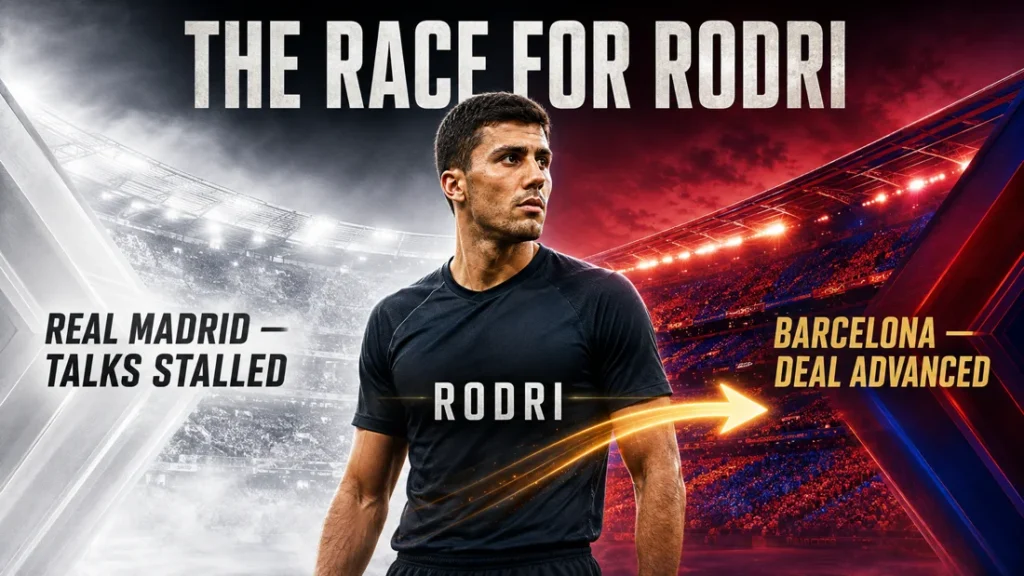
Barcelona were not the only Spanish giant interested.
Real Madrid had been in talks over Rodri and, for a period, a move to the Bernabéu appeared entirely plausible. Soccer Herald had already explored why Madrid’s changing midfield made him such an intriguing target.
But those discussions failed to produce an agreement.
Barcelona then accelerated.
Reports indicated that Rodri spoke with Hansi Flick and sporting director Deco as Barça pushed harder to bring him back to Spain, while subsequent reporting suggested the midfielder ultimately preferred the Barcelona move.
It does not appear to have been simply a question of money.
Madrid had reasons for caution. Rodri is 30, his recent injury record matters and the club had already committed significant resources elsewhere.
Barcelona had a more immediate problem to solve.
Frenkie de Jong’s injury created an obvious opening, while Rodri could step into a midfield structure built around possession, positional discipline and aggressive counter-pressing.
There is also a certain footballing symmetry to the move.
Rodri became the world’s leading holding midfielder under Pep Guardiola, whose own footballing education is inseparable from Barcelona.
Now Rodri is heading towards the club from which so much of that philosophy originated.
Madrid were interested.
Barcelona made their move decisive.
Rodri and Pedri Could Transform Barcelona’s Midfield

The most fascinating partnership is Rodri and Pedri.
They do not need to occupy the same spaces.
That is precisely why it could work.
Rodri can remain behind the ball during longer attacking sequences, becoming the central reference for circulation while also protecting Barcelona against transitions.
Pedri can then receive higher.
Instead of repeatedly dropping towards the centre-backs to establish possession, he can spend more time turning in midfield, connecting with Lamine Yamal and attacking the spaces around the penalty area.
That could have significant consequences for Yamal.
As explained in Soccer Herald’s Lamine Yamal profile, Barcelona’s right winger is most dangerous when he receives possession with defenders already forced into difficult decisions.
Rodri can help create those situations without playing the final pass.
Imagine Barcelona building from the back.
The centre-backs separate.
Rodri appears centrally.
Pedri moves beyond the opposition’s first midfield line.
If the press follows Rodri, space opens behind it.
If the press stays deeper, Rodri controls possession.
That is the dilemma elite holding midfielders create.
Their positioning changes where pressure can begin.
Why Rodri Makes Sense for Hansi Flick
Hansi Flick’s football contains an interesting contradiction.
His teams want control, but they rarely want sterile control.
Barcelona press high, push numbers forward and attempt to recover possession quickly enough to keep opponents trapped.
That can make them devastating.
It can also make them vulnerable.
When several attacking players are positioned beyond the ball, one inaccurate pass can transform an attack into a defensive emergency.
Rodri is particularly valuable in those moments.
He is not primarily a recovery midfielder who solves every transition by sprinting 30 metres towards his own goal.
He tries to prevent that sprint from becoming necessary.
His positioning can close the opponent’s first forward passing lane. His anticipation helps him compete for loose balls. When necessary, he knows when a counterattack simply has to be stopped.
Barcelona’s attacking structure can therefore become safer because Rodri understands which spaces cannot be abandoned.
That was also central to Soccer Herald’s analysis of why Rodri’s fitness became Manchester City’s biggest long-term concern.
City were never dependent only on his passing.
They depended on his ability to make ambitious positioning around him possible.
Barcelona are buying the same privilege.
He Is Not Sergio Busquets 2.0
The comparison is unavoidable.
Barcelona have spent years searching for midfield stability after Busquets, and Rodri is Spanish, positionally intelligent, press-resistant and capable of controlling possession from the base of midfield.
But Barcelona should not ask him to become Busquets.
Rodri is a different footballer.
Busquets was extraordinary at receiving possession in tiny spaces and moving the ball before pressure fully arrived.
Rodri is more physically imposing.
He can protect possession with his body, compete aerially, defend larger spaces and become an attacking threat around the penalty area.
His winning goal against Inter in the 2023 Champions League final remains the most famous example.
The Barcelona version of Rodri should not be an imitation of their past.
It should be an adaptation of Barcelona’s traditional midfield principles to modern football.
Why Manchester City Accepted the Bid
This is where the transfer becomes uncomfortable for City.
Rodri had entered the final year of his contract and Manchester City had been unable to convince him to renew.
Once the player made clear that he wanted Barcelona, the calculation changed.
City could keep one of their most important players for another year and risk losing him for nothing, or accept a major fee for a 30-year-old midfielder and accelerate a rebuild that had already begun.
After rejecting two lower offers, City accepted Barcelona’s £65.4m bid.
Financially, the logic is understandable.
Footballistically, replacing him may prove far harder.
Manchester City Must Replace a Function, Not a Player

City were already preparing for change.
Their £116 million move for Elliot Anderson was never simply about adding another midfielder.
As Soccer Herald argued when examining why Manchester City spent £116m on Elliot Anderson, the broader issue was constructing a younger midfield capable of surviving the transition beyond Rodri.
Anderson offers running power, progression and physical coverage.
He is not another Rodri.
That distinction is important.
Trying to find an identical replacement may be impossible.
City may instead have to redistribute Rodri’s responsibilities.
One midfielder progresses possession.
Another provides defensive security.
A full-back moves inside.
A centre-back steps forward.
What Rodri once did alone may now require a structure.
That is the true cost of losing an exceptional player.
You do not simply replace his name on the team sheet.
You have to replace the conditions he created for everybody else.
Rodri’s Injury Record Is Barcelona’s Biggest Risk
For all the excitement, this is not a risk-free transfer.
Rodri is 30 and his body has carried an enormous workload across club and international football.
An ACL injury cost him most of the 2024/25 season, further physical problems affected the following campaign, and he underwent back surgery after the World Cup this summer.
Barcelona therefore cannot treat this as though they are signing a 24-year-old midfielder entering his physical peak.
Workload management will matter.
Rotation will matter.
Bernal, Gavi, Casadó and Barcelona’s other midfielders should not become irrelevant simply because Rodri arrives.
Indeed, the smartest way to use Rodri may involve asking him to play less often than Manchester City once felt forced to.
Barcelona are buying his control.
They also have to protect it.
The Transfer Changes Two European Giants
The most interesting transfers tell us something about both clubs.
This one tells us plenty.
Barcelona believe their young team is ready for an experienced midfielder capable of giving its talent a stable platform.
Manchester City believe the time has arrived to move beyond one of the central figures of their most dominant era.
Rodri, meanwhile, has chosen his own moment.
Seven years after arriving in Manchester, he leaves having become something greater than the holding midfielder City originally bought from Atlético Madrid.
He became the player around whom control seemed to revolve.
City could press higher because Rodri was there.
They could commit more players forward because Rodri was there.
They could turn difficult matches into repetitive waves of possession because Rodri was there.
Barcelona want that feeling for themselves.
Final Verdict
Rodri to Barcelona is not simply one of the biggest transfers of the summer.
It could alter the tactical identity of two European giants.
Barcelona are acquiring a midfielder capable of providing the security their attacking talent needs. Rodri can protect Pedri, connect the buildup, improve Barcelona’s rest defence and give Flick another way to control matches when relentless pressing is not enough.
Manchester City are losing something harder to quantify.
Not just a defensive midfielder.
Not just a Ballon d’Or winner.
They are losing the player who spent years making risk look safe.
There is also something fitting about the destination.
Real Madrid spent weeks considering Rodri.
Barcelona ultimately made him feel necessary.
At this stage of a career, perhaps that matters.
City have accepted the money.
Rodri has chosen Barcelona.
The medical and official announcement are still to come, but one of the defining midfielders of Manchester City’s greatest era is now on the verge of beginning the final major chapter of his career in Catalonia.
Barcelona are not merely buying Rodri.
They are buying control.
Sources
The Guardian — Rodri calls it a dream to play for Barcelona as he flies in for medical
The Guardian — Barcelona step up Rodri interest after Real Madrid talks stall
ESPN — Barcelona agree personal terms as Rodri chooses Barça over Real Madrid


