



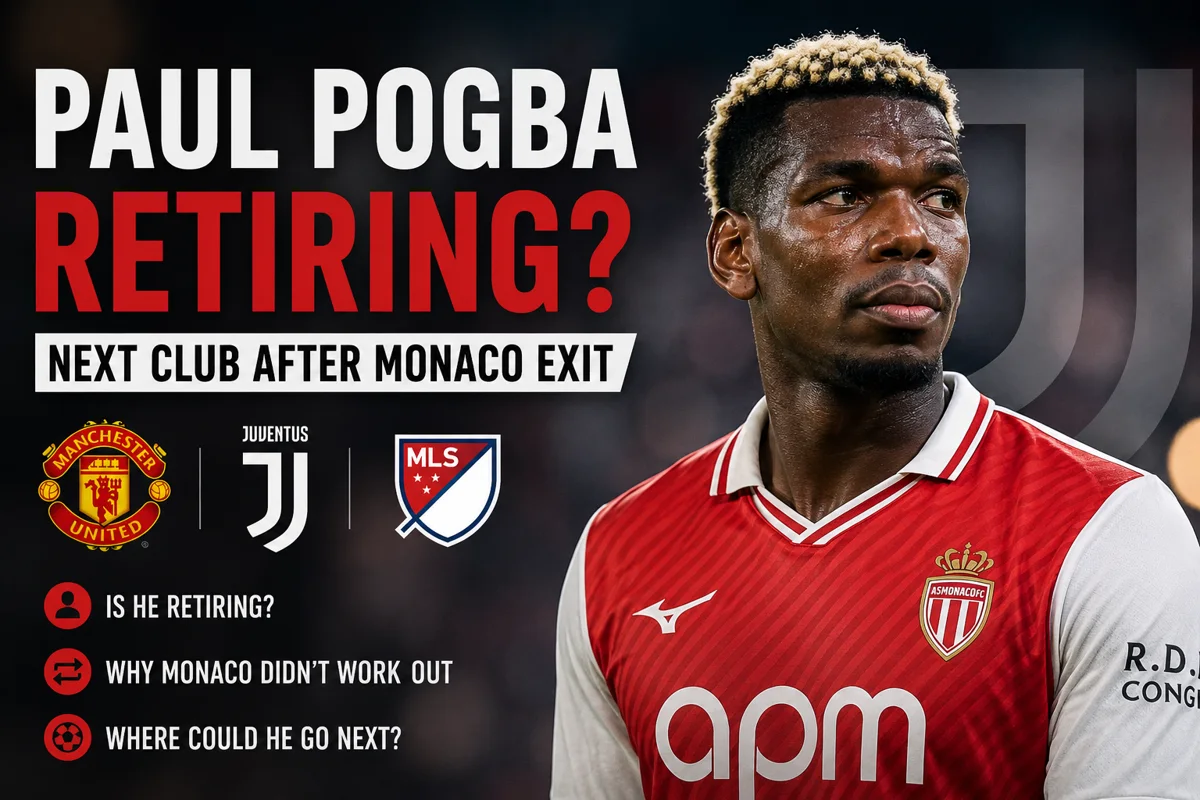
Is Paul Pogba Retiring? Next Club After Monaco Exit
Paul Pogba is a free agent again, and the question surrounding one of the most recognisable midfielders of his generation is no longer simply where he will play next.
It is whether he will play again at all.
Paul Pogba has not announced his retirement. As of August 20, 2026, the 33-year-old is without a club after mutually ending his contract with AS Monaco, bringing his attempted comeback in France to an early conclusion.
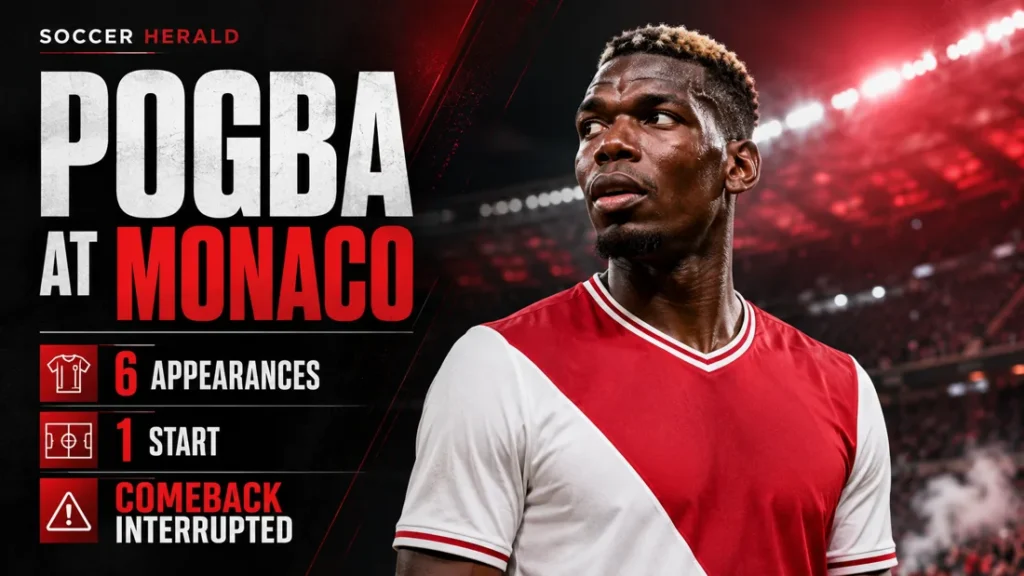
Monaco was supposed to give Pogba the environment to rebuild his career after his doping suspension and years of physical problems. Instead, persistent injuries restricted him to only six competitive appearances, including one start, before another setback disrupted preparations for the new season.
That makes his next decision unusually important.
Pogba is no longer simply choosing between clubs. He must find an environment capable of giving him the medical support, patience and carefully controlled minutes required to prove that he can still play professional football consistently.
Is Paul Pogba Retiring?
No.
There has been no official retirement announcement from Paul Pogba.
Monaco confirmed that the club and player had agreed to terminate his contract early, one year before it was due to expire in June 2027. That decision immediately triggered speculation about whether Pogba’s playing career could be approaching its end, but leaving Monaco and retiring from football are two very different things.
At 33, Pogba is not necessarily too old to continue.
The bigger question is whether his body will allow him to.
His Monaco comeback never developed into a sustained run of football. Injuries repeatedly interrupted his progress, while a thigh problem created another obstacle ahead of the 2026/27 campaign.
So the clearest answer is simple:
Paul Pogba is not retired, but his future as a professional footballer is more uncertain than ever.
Why Did Paul Pogba Leave Monaco?
Pogba joined Monaco with one obvious objective: to play regularly again.
The move made sense for both sides.
For Pogba, returning to France offered a relatively familiar environment in which to rebuild his fitness and reputation after an extraordinary period away from competitive football.
For Monaco, the potential reward was considerable.
Even after years of interruptions, Pogba’s technical qualities were never difficult to identify. His passing range, ability to break lines and capacity to control possession could still offer something unusual if he became physically reliable.
The problem was that Monaco rarely had the opportunity to use those qualities.
Pogba made only six competitive appearances and started once. His comeback remained a sequence of small steps rather than the beginning of a sustained return.
Another physical setback ahead of the new season eventually changed the calculation.
The issue was not whether Pogba still understood the game or possessed elite technique.
It was availability.
Monaco could not build a meaningful role around a player who could not remain on the pitch long enough to establish rhythm.
What Happened to Paul Pogba at Monaco?
Pogba’s Monaco move was supposed to complete a comeback that had already taken years.
Expectations initially had to be modest.
Nobody realistically expected the midfielder who arrived at Monaco to immediately resemble the player who starred for Juventus, Manchester United and France.
The first objective was simply to get him playing competitive football again.
Even that proved difficult.
His appearances remained limited and injuries repeatedly interrupted his progress. Rather than gradually moving from substitute appearances towards regular starts, Pogba remained stuck in the rehabilitation phase of his comeback.
That matters when judging what happened.
A player can still look technically impressive in training. He can produce moments during short appearances that remind supporters of his old level.
But professional football demands repetition.
Can the player train throughout the week?
Can he start a match?
Can he recover?
Can he do it again several days later?
Monaco never received convincing enough answers to those questions.
Eventually, the uncertainty surrounding Pogba’s physical condition outweighed the potential value of keeping him under contract.
Why Was Paul Pogba Banned and When Did He Return?
Pogba’s current situation cannot be separated from the suspension that removed him from competitive football for an extended period.
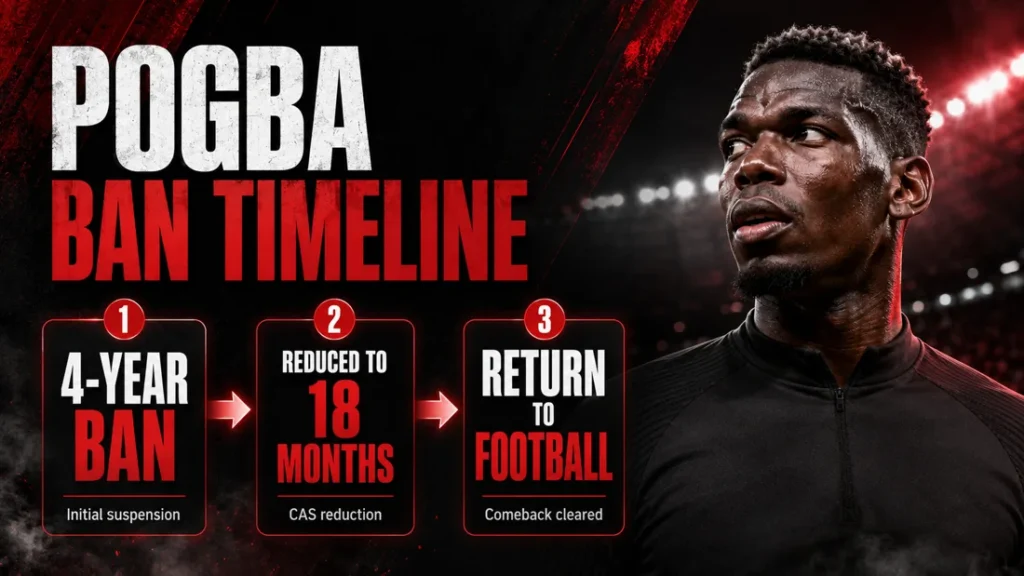
He was initially handed a four-year ban following an anti-doping rule violation.
The Court of Arbitration for Sport later reduced the suspension to 18 months, giving Pogba an opportunity to return far earlier than the original sanction would have allowed.
That decision potentially saved his career.
A four-year absence at his age could effectively have ended his chances of returning to elite football. The reduced suspension instead created a realistic path back.
But becoming eligible to play and becoming physically ready to play are not the same thing.
Pogba had already experienced significant injury problems before the suspension. After such a long period without regular competitive football, rebuilding the physical base required of an elite midfielder was always going to be difficult.
Monaco provided the opportunity.
His body never allowed the comeback to gather enough momentum.
Paul Pogba Next Club: What Are His Options?

Pogba is now a free agent and can be signed without a transfer fee, but that does not make the decision straightforward.
Any club considering Pogba must first decide whether he can become physically dependable enough to justify a place in the squad.
That makes some types of moves more realistic than others.
A Lower-Pressure European Club
Staying in Europe would allow Pogba to test whether he can still operate within a high-level tactical environment.
But the right club would need realistic expectations.
Pogba probably cannot join a team that immediately needs him to start 40 or 50 matches.
He requires squad depth around him, controlled training loads and the ability to increase his minutes gradually rather than being forced into a major role immediately.
If he could survive that process, a European comeback would provide the strongest evidence that his career still has meaningful life left in it.
Major League Soccer
MLS could be an intriguing alternative.
Pogba remains one of football’s most recognisable names, which would make him commercially attractive, while a club willing to manage his workload carefully could potentially benefit from his passing and creativity.
It would not, however, automatically represent an easy physical environment.
Long-distance travel, varying climates and a demanding schedule create challenges of their own.
For Pogba, the medical plan would be every bit as important as the football project.
The Middle East
Another possibility is a move outside Europe.
Such a transfer could give Pogba the opportunity to continue playing without the same pressure to prove that he can still perform at the highest level of European football.
It may become particularly attractive if extending his career becomes more important than chasing another Champions League-level opportunity.
But even there, the fundamental question would remain unchanged.
A club can offer Pogba a contract.
It cannot guarantee that his body will allow him to fulfil it.
Could Paul Pogba Return to Manchester United?
A return to Manchester United would create enormous attention.
The footballing logic is far less obvious.
United already experienced both the extraordinary talent Pogba could provide and the difficulty of constructing a consistently balanced midfield around him.
At 33, after years of injuries and interrupted football, he would have to return in a completely different role.
He could no longer be treated as the transformational midfielder United brought back from Juventus.
Any move would have to be built around limited minutes, experience and specialist use.
The emotional appeal is obvious.
The sporting case is much harder to make.
Could Paul Pogba Return to Juventus?
Juventus would carry similar nostalgia.
Turin was where Pogba became one of Europe’s most exciting midfielders, but his second spell at the club was already overwhelmed by injuries before the doping case effectively ended that chapter.
A third attempt would therefore require both sides to believe that the circumstances have changed dramatically.
That seems difficult.
Rather than trying to recreate another part of his past, Pogba may be better served finding a completely new environment built around the player he is now.
What Type of Player Could Pogba Be Now?
Perhaps the biggest mistake Pogba and his next club could make would be trying to recreate the footballer he once was.
The younger Pogba could dominate enormous areas of the pitch.
He carried the ball through midfield, attacked the final third, played difficult passes and possessed the physical power to survive transitions in both directions.
That version may no longer be realistic.
A successful comeback would probably require Pogba to become more economical.
Fewer long carries.
Less box-to-box running.
More time receiving in deeper positions.
More emphasis on passing range and controlling possession.
In the right midfield structure, Pogba could potentially become a specialist rather than an all-action midfielder.
That would place more physical responsibility on the players around him while allowing Pogba to concentrate on the qualities that made him exceptional in the first place.
The objective should not be to rediscover peak Pogba.
It should be to discover whether a different Pogba can still help a team.
When Could Paul Pogba Sign for a New Club?
Because Pogba is a free agent, he does not necessarily have to wait for a traditional transfer window to negotiate his next move, although registration rules will depend on the league and competition involved.
There is little reason for him to rush.
The priority must be proving that he is physically ready to return.
Any interested club is likely to examine his medical history carefully before offering a contract, particularly after the difficulties he experienced at Monaco.
That could also influence the structure of his next deal.
A short-term agreement with performance-related incentives would reduce the risk for a club while giving Pogba another opportunity to prove his fitness.
At this stage of his career, the reputation on his CV is unlikely to be the deciding factor.
Medical tests will matter more.
Is Paul Pogba’s Career Over?
Not officially.
And it is still too early to say that it should be.
Pogba has experience very few footballers possess. He has won the World Cup, played for some of Europe’s biggest clubs and performed at the highest level for both club and country.
None of that guarantees another successful comeback.
But it explains why another club may still decide that the potential reward is worth the risk.
The challenge is that Pogba is no longer trying to prove that he belongs among the world’s best midfielders.
He is trying to prove something much more basic.
That his body can still support a professional football career.
If he can find the right environment and finally build a sustained period of fitness, there could still be another chapter.
If the next attempt ends with another cycle of rehabilitation and setbacks, the retirement question will become increasingly difficult to avoid.
Final Verdict: Is Paul Pogba Retiring?
Paul Pogba has not retired.
His Monaco contract has ended by mutual agreement and he is currently without a club, but there has been no announcement that he is ending his playing career.
The next few months should provide a much clearer answer about what remains possible.
The question is whether Pogba can stay healthy long enough to play.
At 33, he does not need another grand comeback story.
He needs training.
Then minutes.
Then another match.
Sources
AS Monaco — Official statement on Paul Pogba’s departure


