



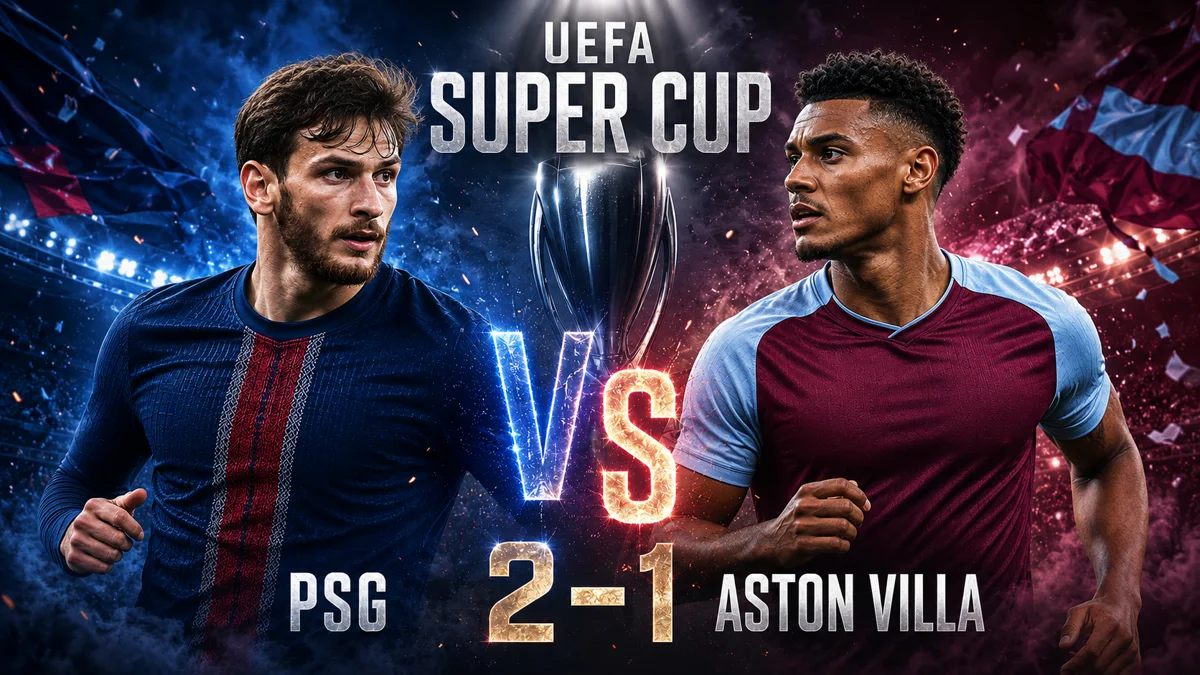
PSG 2-1 Aston Villa: Super Cup Highlights and Analysis
Paris Saint-Germain began another European season exactly where the previous one had ended: with a trophy in their hands.
PSG beat Aston Villa 2-1 in Salzburg to retain the UEFA Super Cup, but the scoreline tells only part of the story. Luis Enrique’s European champions had the greater individual quality and eventually found the decisive moments, yet Unai Emery’s Villa made them work considerably harder than many expected.
Khvicha Kvaratskhelia opened the scoring after 20 minutes. Seventeen-year-old Brian Madjo equalised just before half-time, becoming the youngest scorer in UEFA Super Cup history. Désiré Doué then restored PSG’s lead in the 61st minute after VAR overturned an initial offside decision.
It finished PSG 2-1 Aston Villa.
For Paris, another trophy.
For Villa, defeat — but also evidence that they are increasingly comfortable on the biggest European stage.
PSG vs Aston Villa: Quick Answer
PSG beat Aston Villa 2-1 to win the 2026 UEFA Super Cup in Salzburg. Kvaratskhelia put Paris ahead in the 20th minute before 17-year-old Madjo equalised on the stroke of half-time. Doué scored the winner after 61 minutes from Ousmane Dembélé’s through ball, with VAR confirming the goal after it had initially been ruled offside.
Kvaratskhelia Gives PSG the Lead
For the opening 20 minutes, the match had the slightly awkward rhythm of an early-season final.
PSG wanted possession. Villa wanted structure.
Luis Enrique used Vitinha, João Neves and Warren Zaïre-Emery in midfield, with Kvaratskhelia and Doué among the players charged with breaking Villa’s defensive shape.
Emery’s side were less interested in competing for sterile possession than in controlling where PSG could use it. Villa stayed compact centrally and tried to prevent Paris from progressing cleanly through the middle.
That worked for a while.
Then Kvaratskhelia changed the geometry of the game.
Doué found the Georgian on the left side of the penalty area. Kvaratskhelia moved inside Matty Cash and smashed his finish beyond Marco Bizot to give PSG the lead.
PSG 1-0 Aston Villa — Khvicha Kvaratskhelia
The goal captured one of the central problems of defending against this PSG team.
A defensive structure can be correct. The distances can be right. The passing lanes can be protected.
Then one elite attacker wins a one-against-one duel and the entire structure becomes irrelevant.
That individual quality has increasingly been married to collective control under Luis Enrique. It was also evident during PSG’s Champions League run, including the tactical patterns explored in our PSG vs Arsenal final analysis.
But Villa did not disappear after falling behind.
Instead, they became more dangerous.
Brian Madjo Changes the Match
The most striking thing about Brian Madjo was not simply that he scored.
It was that his goal did not arrive from nowhere.
The 17-year-old had already caused PSG problems, twice heading wide before hitting the post shortly before his equaliser. He kept occupying Willian Pacho and the PSG defence rather than allowing Paris to compress the pitch without consequences.
There was something refreshingly uncomplicated about Villa’s approach.
They did not need to reproduce PSG’s positional football. They needed to ask a different question.
Madjo became that question.
When John McGinn received the opportunity to deliver from the left late in the first half, the teenager attacked the six-yard area. Under pressure from Pacho, he steered his volley into the roof of the net.
PSG 1-1 Aston Villa — Brian Madjo
Suddenly Salzburg sounded different.
Villa had arrived as Europa League winners but still as clear outsiders against a PSG side that had won consecutive Champions League titles. Yet at half-time they were level.
Madjo, at 17 years and 212 days, became the youngest scorer in UEFA Super Cup history.
It was also his Aston Villa debut.
There are debuts that introduce a player to a new club.
This one introduced a player to Europe.
Why Aston Villa Were Causing PSG Problems
Villa’s best periods came when the game became less orderly.
That sounds counterintuitive for an Emery team, because few coaches are more associated with detailed preparation. But the disorder suited Villa.
They were not trying to dominate PSG through long sequences of possession. They wanted the match to become vertical when Paris lost control.
McGinn attacked space. Emiliano Buendía looked for pockets between midfield and defence. Madjo provided a direct target and forced PSG’s centre-backs to defend facing their own goal rather than simply stepping forward.
The result was that PSG could dominate passages without completely controlling the match.
That distinction matters.
Possession tells you who has the ball.
Control tells you what happens when possession changes.
Villa repeatedly threatened that second moment.
It was another reminder of why Emery’s team enter the new campaign with greater expectations after winning the Europa League. Our Aston Villa 2026/27 season preview examined that change in status: Villa are no longer simply trying to reach Europe. They are learning how to behave once they get there.
Against PSG, they looked comfortable with the surroundings.
Luis Enrique Changes the Game
The decisive tactical intervention came at half-time.
Luis Enrique removed Maghnes Akliouche and introduced Ousmane Dembélé.
On paper, it was one elite attacker replacing another.
On the pitch, it changed PSG’s threat.
Dembélé gave Paris another player capable of moving away from the ball and attacking the defensive line, while Doué could drift into areas where Villa found him more difficult to track.
Villa actually created the first major chance of the second half, with McGinn forcing Matvey Safonov into a save.
Then PSG produced the decisive move.
Dembélé received possession and immediately looked forward. Doué attacked the gap, raced onto the through ball and curled his finish beyond Bizot.
The assistant referee raised the flag.
VAR checked.
Goal.
PSG 2-1 Aston Villa — Désiré Doué
There was something appropriate about Doué deciding the final.
He had created Kvaratskhelia’s opener. Now he had scored the winner.
For a player whose positional flexibility has become increasingly important to Luis Enrique, it was another reminder that defining him simply as a winger misses much of his value. Our profile of Désiré Doué’s position and role at PSG explains how naturally he moves between wide and central attacking spaces.
Against Villa, that movement became decisive.
Villa Refused to Accept the Script
There was still almost half an hour remaining, and Villa kept coming.
That may have been the most encouraging part of their performance.
A weaker side might have accepted the hierarchy of the evening after PSG regained the lead. The Champions League holders had survived Villa’s strongest period, introduced Dembélé and moved ahead again.
The conventional script suggested Villa should gradually disappear.
They did not.
Villa enjoyed plenty of possession late in the match and forced PSG to protect their penalty area rather than simply search for a third goal. Paris ultimately defended the lead with greater control than they had shown earlier in the evening.
That is another element of Luis Enrique’s PSG worth noticing.
For years, Paris were defined primarily by what happened when their stars had the ball.
This version increasingly understands what to do without it.
The distances became smaller. The defensive line remained composed. Paris stopped chasing another spectacular moment and protected the advantage they already had.
That is what mature European teams do.
PSG Are Becoming Accustomed to Winning
When the trophy was finally lifted, there was less surprise than satisfaction.
That itself says something about how PSG’s identity has changed.
They won their first UEFA Super Cup against Tottenham in 2025 and returned a year later to defeat Aston Villa, becoming only the third club after AC Milan and Real Madrid to retain the trophy.
PSG were not brilliant throughout the night.
Villa created too many problems for that description.
But dominant teams rarely play at their maximum in every final. What separates them is often the ability to survive difficult periods and still produce the decisive action.
Paris did exactly that in Salzburg.
Brian Madjo Leaves With More Than a Goal
Villa travelled home without the trophy, but Madjo gave them another reason to be optimistic.
His performance mattered beyond becoming the youngest scorer in Super Cup history.
He competed physically, repeatedly reached dangerous positions and continued attacking the penalty area after earlier opportunities had gone begging.
That persistence was important.
Missing one chance did not stop him attacking the next.
Eventually PSG ran out of warnings.
One extraordinary European night does not establish a career, and Villa will need to manage the attention that follows. But as introductions to senior European football go, Madjo could hardly have asked for more.
What the UEFA Super Cup Told Us
For PSG, the lesson was reassuring.
Their attacking depth remains extraordinary. Kvaratskhelia can decide matches individually, Dembélé can change their rhythm from the bench and Doué increasingly looks comfortable carrying responsibility rather than merely offering promise.
Their preparation was limited after a World Cup summer, yet Paris still found enough quality and control to win another trophy.
For Villa, the conclusion may be just as important.
They lost, but they did not spend 90 minutes behaving like underdogs.
European progress is not simply about qualifying for bigger competitions. It is also about reaching the point where playing the continent’s strongest sides no longer feels unusual.
Villa looked disappointed at the final whistle because they had given themselves reason to believe they could win.
That disappointment was probably the greatest compliment to their performance.
Final Thought
PSG showed again why they remain one of the benchmarks of European football.
They had enough individual quality to create the decisive moments and enough defensive maturity to protect them.
Aston Villa showed something different.
They showed they belonged.
And somewhere between those two stories stood Brian Madjo, 17 years old, making his debut and scoring against the European champions.
PSG took the trophy home.
Villa may have taken home belief.
The season has barely begun, but both could prove important.
Sources
UEFA: Paris 2-1 Aston Villa — European champions win back-to-back Super Cups
Reuters: PSG retain UEFA Super Cup with 2-1 win over Aston Villa


