



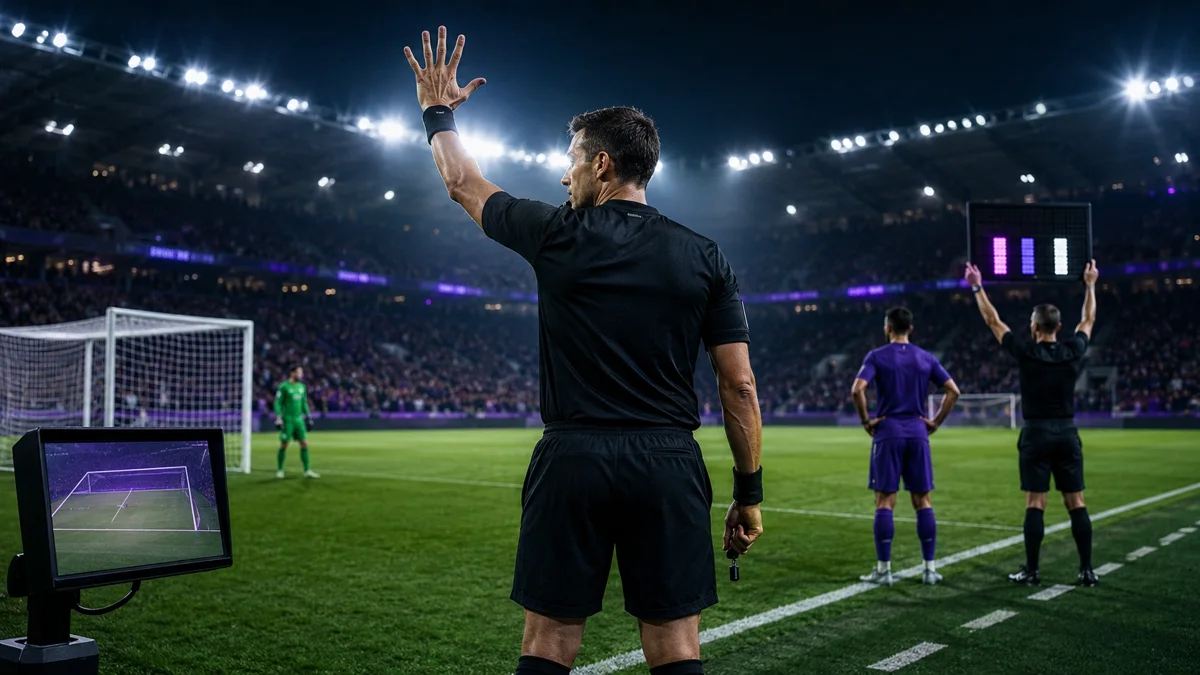
Premier League New Rules 2026/27: Full Guide
The Premier League new rules for 2026/27 will change how players take throw-ins and goal-kicks, how quickly substitutes must leave the pitch, how long injured players remain off the field and which red-card decisions VAR can correct.
The theme is clear. The Premier League wants less time-wasting without reducing the competition’s traditional tolerance for physical contact.
With the season beginning on Friday, August 21, here is every major change and what supporters should expect to see.
Soccer Herald’s Premier League 2026/27 opening weekend predictions cover all ten matches from the first round.
What Are the New Premier League Rules for 2026/27?
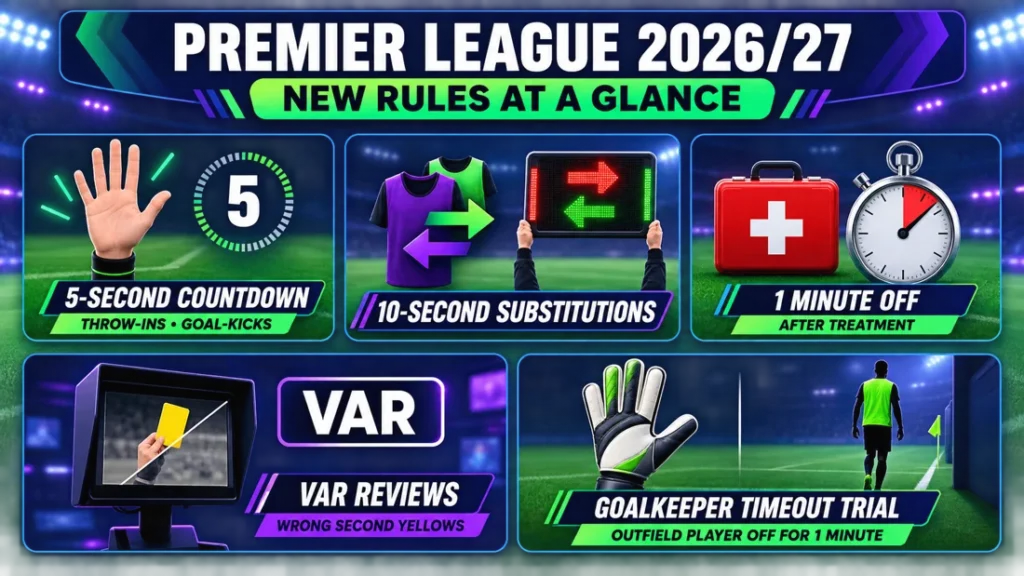
The biggest changes are a five-second countdown for delayed throw-ins and goal-kicks, a ten-second limit for substituted players to leave, a mandatory one-minute absence after most injury stoppages, VAR reviews for clearly incorrect second yellow cards and a trial targeting goalkeeper tactical timeouts.
The five-second countdown will not begin automatically whenever the ball goes out. It starts only when the referee believes a team is deliberately delaying the restart.
| Situation | New rule | Consequence |
|---|---|---|
| Delayed throw-in | Visible five-second countdown | Throw-in awarded to the opposition |
| Delayed goal-kick | Visible five-second countdown | Opposition receive a corner |
| Slow substitution | Player must leave within ten seconds | Substitute waits until the first stoppage after one minute |
| On-field injury treatment | Player stays off for one minute after the restart | Team temporarily continues with ten players |
| Clearly wrong second yellow | VAR can review the resulting red card | Second yellow and dismissal can be overturned |
| Goalkeeper tactical timeout | An outfield player must leave temporarily | Team temporarily reduced to ten players |
The Five-Second Rule for Throw-Ins and Goal-Kicks
The most visible change will be the countdown for delayed restarts.
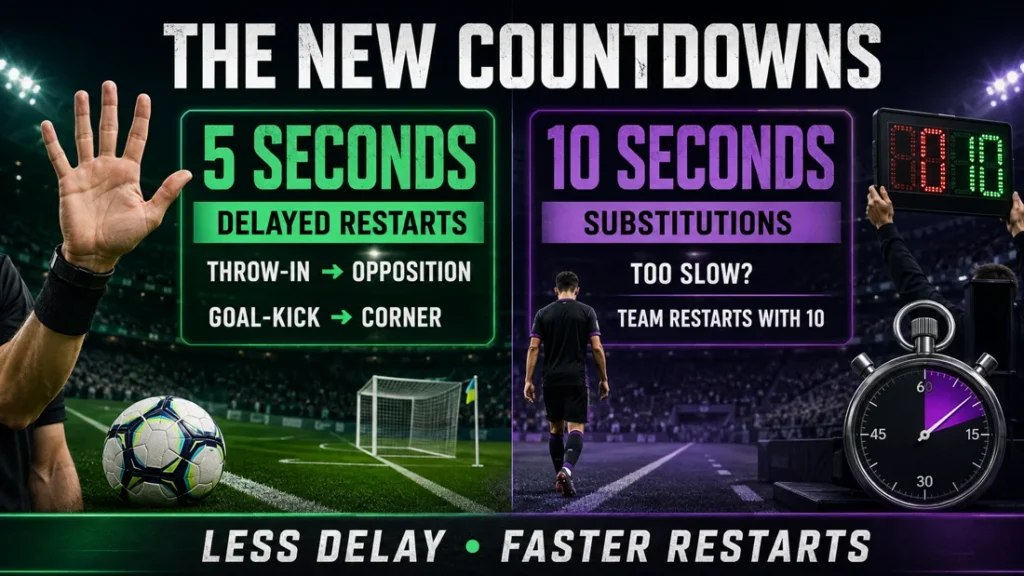
If the referee decides that a team is deliberately wasting time before a throw-in or goal-kick, the referee will blow the whistle, signal for play to resume and begin a visible five-second countdown with a raised hand.
The clock does not begin as soon as the ball leaves the pitch. Referees decide when a normal delay becomes deliberate time-wasting and can warn a player before beginning the countdown.
The countdown can even begin before a player collects the ball. Slowly retrieving it, standing in the wrong position for a throw-in or repeatedly moving it around the goal area can all be treated as deliberate delay.
If the five seconds expire at a throw-in, possession changes hands and the opposition take it from the same position.
If the delay occurs at a goal-kick, the opposition receive a corner.
That is the more serious punishment. A goalkeeper trying to remove a few seconds could instead give the opposition a direct opportunity to attack the penalty area.
There is no automatic yellow card. A caution is expected only if the player or a teammate continues delaying the new restart after possession has changed.
Substituted Players Have Ten Seconds to Leave
Players being substituted must leave the field within ten seconds of the substitution board being shown.
They are still expected to use the nearest boundary line unless the referee directs them elsewhere for safety, security or injury reasons. The referee may visibly count down the final five seconds.
If the player has not left when the ten seconds expire, the substitution still goes ahead. It cannot be cancelled and the manager cannot select a different replacement.
The incoming substitute, however, cannot enter immediately.
Play restarts with the team temporarily reduced to ten players. The substitute can enter only at the first stoppage after one full minute has elapsed and after receiving the referee’s permission.
The rule also applies to multiple changes. All departing players must be off the pitch within ten seconds of the final substitution being indicated.
Referees can make exceptions when an injury prevents a player from leaving quickly or when the nearest exit would create a safety problem. A player who is already crossing the line when the countdown ends should also be allowed to complete the change normally.
Injured Players Must Stay Off for One Minute
An outfield player whose injury stops the match or requires medical staff to enter will generally have to leave and remain off for one minute.
The Premier League previously used a 30-second period. That has now been doubled.
The minute does not begin when the player leaves the field. It begins only after the match restarts, making the total absence longer than 60 seconds.
The player can return only with the referee’s permission. If the ball is in play, they must re-enter from the touchline. During a stoppage, they can return from any boundary line.
The rule gives medical staff more time to assess injuries away from active play while reducing the incentive to manufacture tactical interruptions.
When Does the One-Minute Rule Not Apply?
A player will not normally have to serve the one-minute absence when:
- a goalkeeper is injured
- a goalkeeper and an outfield player collide and both need treatment
- two players from the same team collide
- there is a serious injury, particularly a suspected concussion or medical emergency
- the injury results from an offence for which an opponent is booked or sent off
- a penalty is awarded and the injured player will take it
The rule is designed to discourage avoidable delays, not to rush medical decisions or punish someone injured by serious foul play.
VAR Can Overturn a Clearly Wrong Second Yellow Card
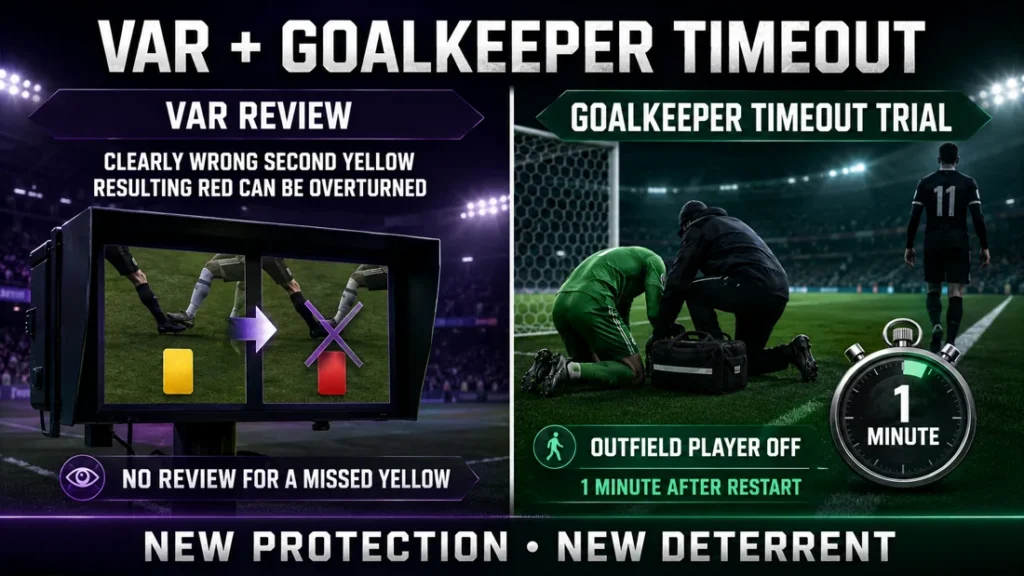
VAR can now review a clearly incorrect second yellow card that results in a player being sent off.
Previously, VAR could intervene for a direct red card but not a dismissal caused by a second caution.
If the referee awards a second yellow and the decision is clearly wrong, VAR can recommend a review. The caution and resulting red card can then be overturned.
VAR cannot search for missed second-yellow offences.
If an already-booked player commits another possible yellow-card challenge and the referee allows play to continue, VAR cannot intervene simply to recommend another caution.
The distinction is simple: VAR can remove a clearly incorrect second yellow that produces a red card, but it cannot award a second yellow that the referee missed.
The high threshold for intervention remains. The on-field decision should stand unless the evidence shows a clear and obvious error.
The Goalkeeper Tactical Timeout Trial
The Premier League will also trial a measure aimed at stopping goalkeepers from using apparent injuries to create tactical breaks.
When play stops because a goalkeeper requires treatment, the manager must nominate an outfield player to leave the pitch. That player must remain off for at least one minute after play restarts.
Premier League research found that 85 percent of surveyed stakeholders considered goalkeeper tactical timeouts a problem.
There are exceptions for situations including a foul on the goalkeeper that produces a free-kick, a collision between the goalkeeper and an outfield player and an injury involving bleeding.
This measure is a trial rather than a permanent universal law. Its effectiveness and unintended consequences will be monitored during the season.
Referees Will Focus More on Holding and Goalkeeper Contact
Not every change is a new law. The Premier League has also issued priorities covering holding, contact with goalkeepers, hair-pulling and simulation.
Referees will look more closely at defenders who block or hold an opponent without trying to challenge for the ball, particularly at set-pieces. The instruction does not demand a penalty for every contact. The action must clearly affect the opponent’s ability to reach or play the ball.
Attackers face similar scrutiny. Contact should be penalised when an attacker makes no attempt to play the ball and prevents the goalkeeper from moving towards it.
Hair-pulling will receive a more proportionate punishment. A deliberate action involving excessive force or brutality will result in a red card. An incident without excessive force can instead bring a yellow.
Referees will also continue punishing clear simulation while maintaining a “less is more” approach to handball. The aim is to separate legitimate contact from deliberate obstruction.
Which Optional IFAB Rules Will the Premier League Not Use?
The Premier League will not adopt every optional IFAB measure. VAR will not review incorrectly awarded corners, while an ordinary yellow card for simulation will not become reviewable, although mistaken identity can be corrected.
There will be no separate general hydration-break rule because the league already allows drinks breaks when the temperature exceeds 30 degrees Celsius at kick-off. It will also retain its three-step procedure for reported discriminatory abuse instead of adopting the optional red-card protocol for players covering their mouths.
These decisions reflect the league’s reluctance to expand VAR into more areas of the game.
Other 2026/27 Law Changes to Know
The accidental double-touch rule for penalties has been formally clarified. If a taker accidentally touches the ball twice and it enters the goal, the kick is retaken. If it does not enter, the defending team receive an indirect free-kick.
There is also no DOGSO caution when the referee plays advantage and the attacking team scores from the same move. The goal becomes sufficient punishment because the offence failed to prevent it.
Will the New Rules Reduce Time-Wasting?
The changes may influence behaviour because the punishments affect the match immediately. Added time returns lost seconds but does not remove the tactical value of breaking an opponent’s rhythm.
Delay a goal-kick and the opposition can receive a corner. Take too long over a substitution and the team may restart with ten players. Request treatment for a minor problem and the player may remain outside while the opposition attack.
The possible weakness is consistency. Referees must decide when normal preparation becomes deliberate delay, creating arguments over why one incident triggered a countdown while another did not.
The opening weeks will show whether officials can apply the rules firmly without making every restart feel mechanical.
Premier League New Rules 2026/27 FAQ
Does the Five-Second Rule Apply to Every Throw-In?
No. The countdown begins only when the referee decides that a team is deliberately delaying the restart.
Can VAR Award a Second Yellow Card?
No. VAR can overturn a clearly incorrect second yellow that resulted in a red card, but it cannot give a second yellow that the referee missed.
How Long Must an Injured Player Remain Off the Pitch?
The player must usually remain off for one minute after play restarts. The countdown does not begin when the player first leaves.
What Happens if a Substituted Player Takes Too Long?
The substitute cannot enter until the first stoppage after one minute of play has elapsed. The substitution cannot be cancelled or changed.
Can VAR Review Wrongly Awarded Corners?
IFAB has made this an option, but the Premier League will not use it in 2026/27.
What Fans Should Expect This Season
The Premier League has not rewritten football. Most changes address something more familiar: the steady removal of playing time through delayed restarts, substitutions and tactical stoppages.
A delayed goal-kick can now become a corner. A slow substitution could leave a team defending with ten players. A second yellow that once ended a match may be corrected by VAR.
The purpose is not simply to add more rules.
It is to make delay more costly than continuing to play.
Sources
Premier League: How the Laws of the Game Are Changing in 2026/27


