



Nottingham Forest 2026/27 Season Preview: Glasner Brings Order
Nottingham Forest spent much of last season proving how quickly progress can turn into chaos.
A year after finishing seventh and returning to Europe, Forest ended 2025/26 in 16th place with 44 points. They won 11 Premier League matches, lost 16 and survived by only five points.
Yet the league table tells only part of the story.
Forest also reached the Europa League semi-finals, Morgan Gibbs-White produced another outstanding campaign and the squad retained enough quality to suggest relegation should never have become such a serious concern.
The bigger problem was instability.
Four permanent managers took charge during the season. Now Oliver Glasner becomes the latest man asked to turn an expensive, talented squad into something coherent.
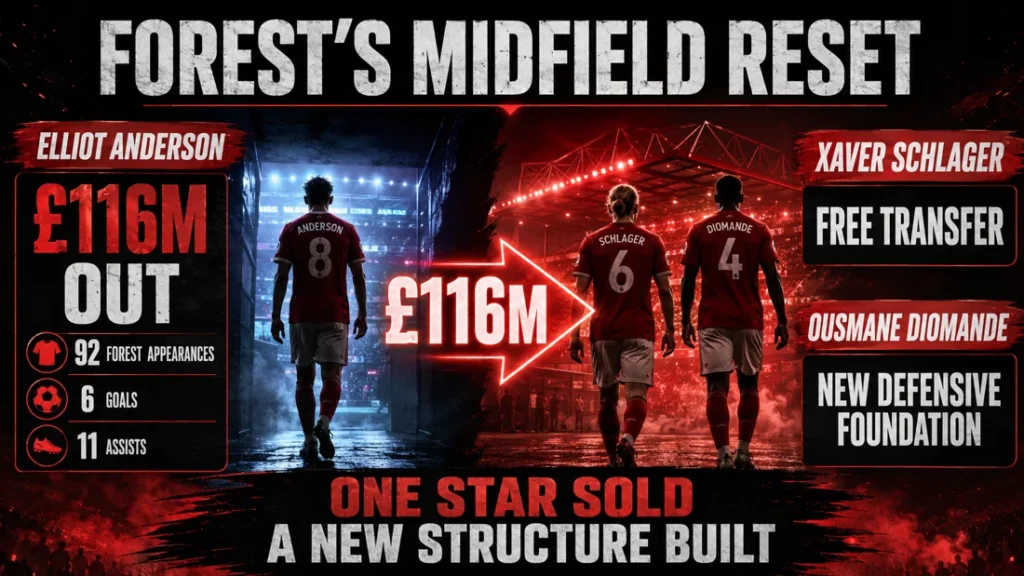
Forest have also sold Elliot Anderson to Manchester City for £116 million, added Xaver Schlager to the midfield and spent around £34 million on Ousmane Diomande.
For the first time in months, there appears to be a clear tactical direction.
The challenge is keeping it.
Quick Answer
Nottingham Forest begin the 2026/27 Premier League season after finishing 16th with 44 points last year.
Oliver Glasner has replaced Vítor Pereira and becomes the club’s fifth permanent head coach in roughly a year.
Forest’s biggest summer departure is Elliot Anderson, who joined Manchester City in a deal worth up to £116 million. Taiwo Awoniyi has also left for Coventry City.
Xaver Schlager has arrived on a free transfer from RB Leipzig, while centre-back Ousmane Diomande has joined from Sporting for around £34 million.
Glasner is expected to use the 3-4-2-1 structure that brought him success at Crystal Palace.
With Morgan Gibbs-White still leading the attack and a strong defensive core in place, Forest should be capable of moving comfortably away from the relegation battle.
Forest Went From Europe to a Relegation Fight
Forest finished 2025/26 with 44 points, 48 goals scored and 51 conceded.
The goal difference was only -3.
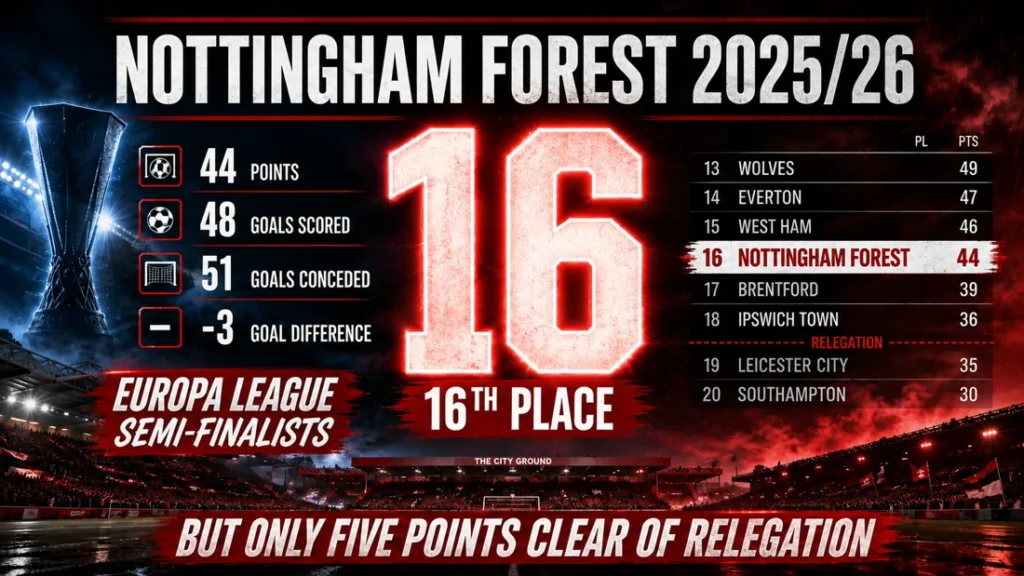
That hardly looks like the profile of a side that spent so much of the season worrying about relegation.
But 16 defeats and constant managerial disruption prevented Forest from building any lasting rhythm.
There was an extraordinary contrast between competitions.
In Europe, Forest reached the Europa League semi-finals before Aston Villa ended the run 4-1 on aggregate.
In the Premier League, survival remained uncertain deep into the spring.
The underlying talent was never the main problem.
Stability was.
Four Managers Made Continuity Impossible
Forest’s managerial sequence told the story of the season.
Nuno Espírito Santo left early.
Ange Postecoglou followed.
Sean Dyche came next.
Vítor Pereira arrived in February, secured survival and guided Forest into the Europa League semi-finals before leaving in July.
Four managers meant four different tactical directions.
Glasner inherits the consequences.
His first job is simply to make Forest coherent again.
Glasner’s 3-4-2-1 Fits This Squad
There are good reasons to believe the appointment can work.
Glasner’s preferred 3-4-2-1 already suits many of Forest’s strongest players.
Ousmane Diomande can join Nikola Milenković and Murillo in a powerful three-man defence.
Ola Aina and Neco Williams have the athleticism to operate as wing-backs.
Two attacking midfielders can then play behind a central striker, giving Morgan Gibbs-White freedom to occupy the spaces where he is most dangerous.
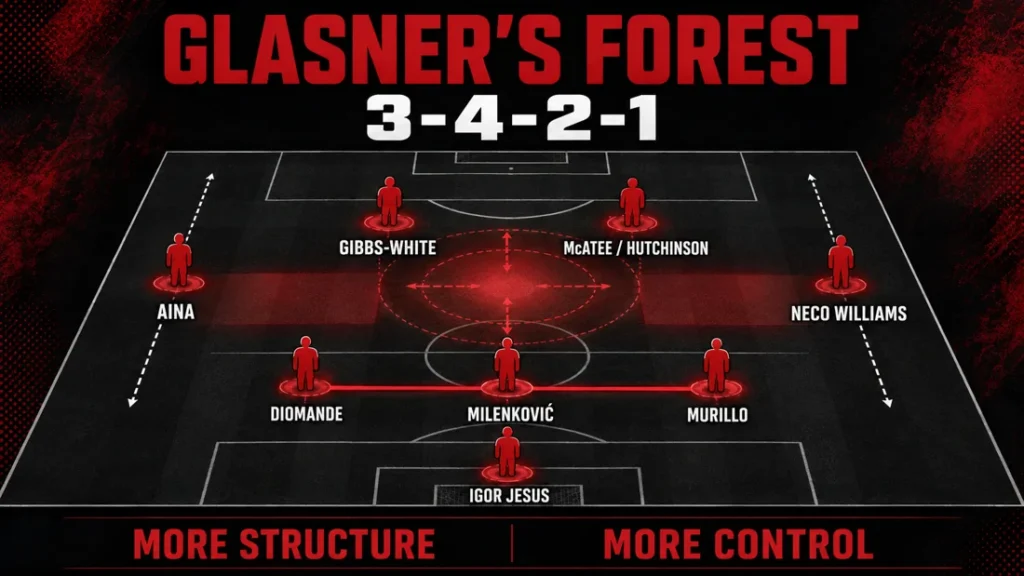
Forest used that structure during pre-season.
The attraction is balance.
Three centre-backs provide protection. Wing-backs create width. Gibbs-White, Omari Hutchinson and James McAtee can operate between the lines rather than being fixed to the touchline.
Glasner does not need to reinvent the squad.
He needs to organise it.
Elliot Anderson Leaves a £116m Question
No Forest player is harder to replace than Elliot Anderson.
Manchester City’s £116 million deal represents an extraordinary piece of business for a player Forest signed from Newcastle for around £35 million two years earlier.
Financially, the logic is obvious.
Tactically, the problem is much harder.
Anderson gave Forest energy, ball progression, defensive work and the ability to carry possession through pressure.
One signing will not reproduce all of that.
Glasner will have to redistribute the responsibility across midfield.
That is where Xaver Schlager becomes important.
Schlager Gives Glasner a Player He Already Trusts
Schlager arrived from RB Leipzig on a free transfer and has previously worked with Glasner at Wolfsburg.
That familiarity matters.
The Austrian midfielder understands the intensity Glasner expects without the ball and can provide aggression in central areas.
He is not an Anderson clone.
He does not have to be.
In a 3-4-2-1, Forest need midfielders who can protect the back three, win second balls and move possession quickly towards the attacking players.
Schlager can do that.
Ryan Yates and Ibrahim Sangaré provide other options, while Forest still have time before the transfer deadline to add another midfielder.
Replacing Anderson may therefore become a collective job rather than a direct substitution.
Diomande Could Transform the Back Three
Ousmane Diomande looks like one of the most natural Glasner signings Forest could have made.
The 22-year-old arrives from Sporting after winning major honours in Portugal and brings pace, physical power and comfort defending aggressively away from his own penalty area.
That last quality is important.
Glasner wants his defensive line to support pressure higher up the pitch.
If Forest lose possession, the centre-backs may be required to defend large spaces.
Diomande has the athletic profile for it.
A back three of Diomande, Milenković and Murillo could become one of the strongest units outside the traditional top-six contenders.
Forest conceded only 51 league goals last season despite the chaos around them.
Greater tactical stability could make that defence significantly better.
Gibbs-White Is Still the Player Everything Runs Through
Anderson may have left.
Morgan Gibbs-White has not.
That gives Glasner an elite attacking reference point.
Gibbs-White produced the best Premier League scoring season of his career in 2025/26 and carried Forest during the relegation battle.
His spring form was particularly important.
The ideal Glasner system should help him further.
Instead of repeatedly dropping deeper to begin attacks, Gibbs-White can operate as one of the two No.10s behind the striker.
From there, he can receive between midfield and defence, press aggressively after turnovers and attack the box more often.
Forest do not need him to solve every phase.
They need him close to goal.
McAtee and Hutchinson Have an Opportunity
Glasner also inherits several talented attacking midfielders whose best football may still be ahead of them.
James McAtee arrived with significant expectations but never fully established himself last season.
Omari Hutchinson showed flashes without becoming an automatic starter.
The new system creates space for both.
In a 3-4-2-1, they can compete for roles behind Igor Jesus alongside Gibbs-White rather than being forced into conventional winger positions.
That may suit McAtee especially well.
His strength is finding pockets around the penalty area and combining quickly.
If Glasner can unlock him, Forest suddenly have far more creativity than their 16th-place finish suggests.
Igor Jesus Has to Lead the Front Line
Taiwo Awoniyi has joined Coventry, while Chris Wood cannot be expected to carry the attack indefinitely.
That increases the importance of Igor Jesus.
The Brazilian showed enough last season to suggest he can lead the line, particularly during Forest’s European campaign.
His pressing should suit Glasner.
So should his willingness to make runs that create space for attacking midfielders behind him.
But Forest scored only 48 Premier League goals last season.
That was the clearest attacking limitation in a team whose defensive record was far more respectable.
Gibbs-White cannot be expected to supply the majority of the improvement again.
Forest need Igor Jesus to become a reliable league scorer.
If he can move into double figures, the entire attack becomes more balanced.
If he cannot, Glasner may again have a team that controls matches better than it finishes them.
The Opening Schedule Is a Real Test
Forest begin at home against Leeds United on August 22.
Then comes Liverpool away.
Tottenham visit the City Ground before Forest travel to Aston Villa and host promoted Coventry City.
That is a revealing first month.
Leeds and Coventry are matches Forest will expect to target.
Liverpool and Villa will test the defensive structure.
Tottenham should show whether Glasner can make the City Ground difficult for stronger opponents again.
The major difference from last season is what comes between those matches.
There is no European football.
Glasner gets full training weeks, fewer rotation problems and far more time to install his 3-4-2-1.
For a squad that spent last season constantly changing direction, that is a major advantage.
Soccer Herald Prediction
Predicted finish: 11th
Best-case scenario: Glasner establishes his 3-4-2-1 immediately, Diomande strengthens an already talented defence and Forest push towards the European places.
Worst-case scenario: Anderson’s influence proves impossible to replace, the attack remains too dependent on Gibbs-White and managerial pressure returns after a difficult start.
Key player: Morgan Gibbs-White
Player to watch: James McAtee
Most important new signing: Ousmane Diomande
Midfield key: Xaver Schlager
Biggest tactical question: Can Forest replace Anderson’s all-round influence without losing control in midfield?
Season verdict: Nottingham Forest are better than a 16th-place team.
Last season’s league position was produced by too much managerial upheaval, inconsistent attacking output and the strain of a long European campaign.
Glasner removes at least one of those uncertainties.
His formation fits the squad. Diomande strengthens the defence. Schlager understands his demands. Gibbs-White remains one of the league’s most dangerous attacking midfielders.
Losing Anderson hurts, but receiving £116 million for one player also gives Forest enormous flexibility.
The biggest reason to expect improvement, however, may be the absence of Europe.
Forest no longer have to balance Thursday nights with Premier League weekends. Glasner gets full training weeks, a cleaner recovery cycle and more time to turn his tactical ideas into habits.
That is why 11th feels realistic rather than another relegation fight.
The attack still needs more goals, and Anderson’s influence will not be easy to replace, but this squad should benefit enormously from having one manager, one system and one competition as its main weekly focus.
And after a season in which Nottingham Forest changed direction almost every few months, structure may be the biggest signing of all.
Sources
Premier League: 2025/26 final table


