



Sunderland 2026/27 Season Preview: Europe Changes Everything
Sunderland spent last season breaking assumptions.
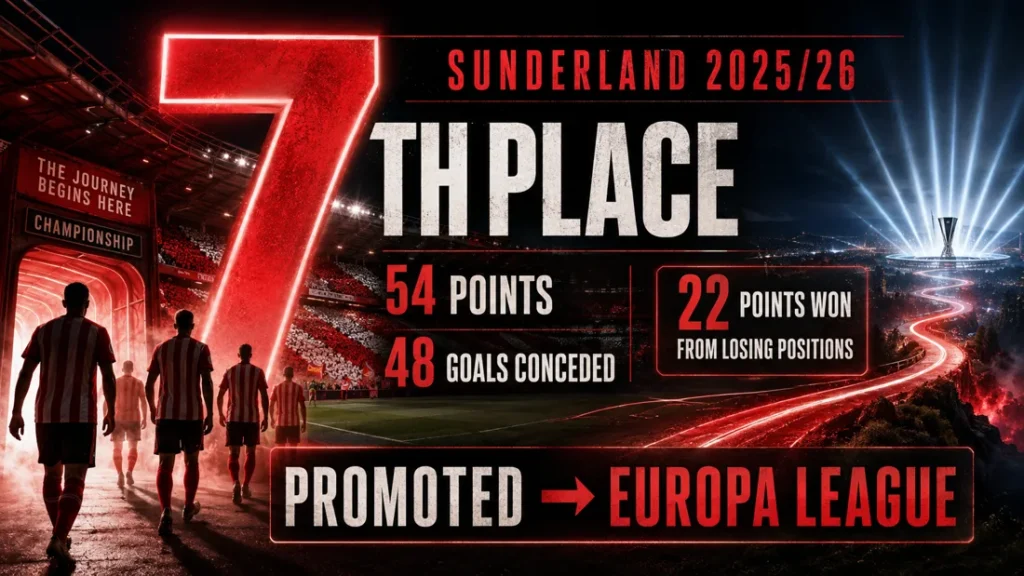
They returned to the Premier League after eight years away and were widely expected to fight relegation. Instead, Régis Le Bris took a newly promoted side to seventh place, 54 points and Europa League qualification.
It was Sunderland’s first European qualification through league position in more than half a century and one of the best Premier League campaigns ever produced by a promoted club.
Now comes a very different challenge.
Sunderland are no longer the surprise package.
They have Premier League opponents who understand them, a Thursday-night European schedule to manage and underlying numbers that suggest last season’s seventh-place finish may be difficult to reproduce.
Their response in the transfer market has also been unusually restrained. Thomas Meunier has arrived on a free transfer from Lille, but there has been no second £150 million-style summer rebuild.
Last season was about proving Sunderland belonged.
This season is about proving the breakthrough can last.
Quick Answer
Sunderland begin the 2026/27 Premier League season after finishing seventh with 54 points, recording 14 wins, 12 draws and 12 defeats.
They scored 42 league goals and conceded 48, qualifying for the Europa League despite finishing with a -6 goal difference.
Régis Le Bris remains in charge after being nominated for Premier League Manager of the Season, while captain Granit Xhaka continues to provide experience around one of the division’s younger squads.
Thomas Meunier is the major summer arrival so far.
The biggest challenge is obvious: Sunderland must balance Premier League football with Europe without losing the compactness and consistency that made them so difficult to beat.
Another seventh-place finish would be extraordinary.
A top-half finish would still represent genuine progress.
Sunderland Produced One of the Great Promoted Seasons
Few promoted teams have adapted as quickly.
Sunderland finished seventh with 54 points and conceded only 48 league goals, immediately establishing themselves as one of the division’s most difficult teams to break down.
The Stadium of Light became central to that success.
Le Bris built a side capable of defending long periods without losing concentration before attacking quickly when opportunities appeared.
Sunderland also recovered 22 points from losing positions, a remarkable reflection of their resilience.
That ability to stay in matches turned survival into European qualification.
The Underlying Numbers Are a Warning
Seventh place was real.
So are the reasons for caution.
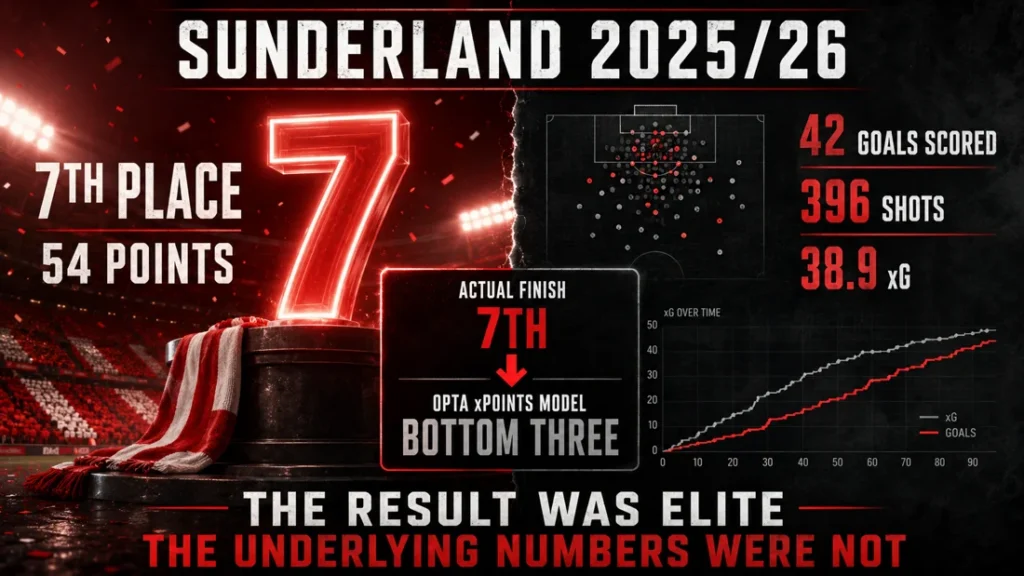
Sunderland scored only 42 Premier League goals, fewer than every other team in the top 10.
They took just 396 shots, the fewest of any club that avoided relegation, while their expected-goals total of 38.9 was better only than Wolves and Burnley.
The biggest warning comes from expected points.
Opta’s model placed Sunderland in the bottom three based on the quality of chances they created and conceded, despite their actual seventh-place finish.
That does not mean last season was lucky.
Good goalkeeping, defensive organisation, game management and the ability to win tight matches are football skills.
But it does mean repeating 54 points without improving the attack will be difficult.
Le Bris Has Built an Identity Worth Protecting
Sunderland’s strength was never spectacular possession numbers.
It was adaptability.
Le Bris could use a 4-2-3-1 with Xhaka and Noah Sadiki controlling central areas, Enzo Le Fée operating higher and Brian Brobbey or Wilson Isidor leading the attack.
Against stronger opponents, Sunderland could become more conservative, add another defender and protect central space.
The principles remained consistent.
Stay compact.
Compete physically.
Avoid opening the middle.
Attack quickly once possession is recovered.
That pragmatism made Sunderland unusually mature for a newly promoted side.
The danger this season is trying to become something more expansive simply because expectations have risen.
Evolution makes sense.
Abandoning what worked does not.
Europe Changes the Squad Problem
One statistic explains Sunderland’s summer challenge better than almost any other.
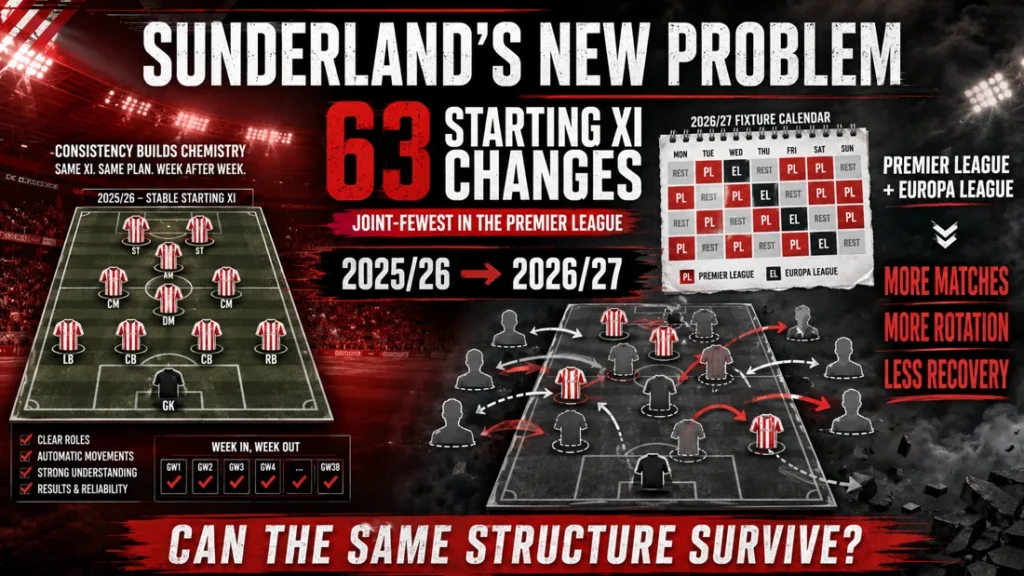
They made only 63 changes to their Premier League starting XI last season, the joint-fewest in the competition.
That level of continuity helped.
It will be almost impossible to repeat with Europa League matches added to the calendar.
Le Bris will need to rotate full-backs, midfielders and attackers while maintaining the collective relationships that made Sunderland effective.
That makes Thomas Meunier a sensible signing.
The experienced Belgian arrives on a free transfer and offers another option across the right side after signing a two-year deal.
He is not a glamorous transformation.
He may be exactly the type of squad addition Sunderland need.
Granit Xhaka Remains the Reference Point
Sunderland’s recruitment has focused heavily on youth.
Xhaka provides the counterweight.
The captain brought Premier League and European experience into a dressing room adapting to the top flight, and his influence was visible almost immediately.
His value goes beyond passing.
He dictates where Sunderland play, helps younger midfielders understand when to accelerate and when to slow matches down, and gives Le Bris a leader capable of managing difficult periods.
His partnership with Sadiki remains particularly important.
Sadiki supplies mobility and defensive range.
Xhaka supplies positioning and control.
With Europe increasing the physical burden, Sunderland will have to manage the 33-year-old carefully.
But when the biggest matches arrive, he remains the player around whom Sunderland’s midfield makes sense.
Enzo Le Fée Needs to Create More
If Sunderland are going to improve one area, it has to be chance creation.
Enzo Le Fée is central to that.
His ability to receive between the lines gives Sunderland a technical link between Xhaka’s deeper passing and the forwards.
No.10 depth remains an obvious concern because Le Fée carried so much of that creative responsibility last season.
If he misses games or loses form, Sunderland do not have an obvious equivalent creator.
Chris Rigg can play higher.
Nilson Angulo can provide individual invention.
But neither offers exactly the same profile.
Sunderland survived last season without creating huge volumes of chances.
Europe will make relying on such fine margins even more dangerous.
Brobbey Could Be Ready for a Bigger Season
Brian Brobbey’s first months in England required patience.
His physical qualities were obvious, but Le Bris often used him from the bench while he adapted to Premier League football.
By the second half of the season, his influence was increasing.
Then came the World Cup.
Brobbey scored with each of his first three shots at the tournament for the Netherlands, becoming only the third player on record since 1966 to score with his first three World Cup attempts.
That matters for Sunderland.
They need more goals.
Brobbey has the power to occupy centre-backs, hold possession under pressure and create space for Le Fée and the wide attackers.
If his World Cup confidence carries into the club season, Sunderland may already possess part of the attacking improvement they need.
The Stadium of Light Has to Remain a Fortress
Last season’s home form gave Sunderland their foundation.
The Stadium of Light became one of the league’s most uncomfortable away days.
That cannot change.
Europa League travel will create tired Sunday afternoons.
Those are precisely the moments when crowd intensity and familiarity become valuable.
Sunderland do not need to dominate at home.
They need to keep turning tight matches into points.
The margins that produced seventh place were small.
Losing that home advantage would expose them quickly.
The Opening Fixtures Test Sustainability Immediately
Sunderland begin away to promoted Ipswich Town on August 22.
Fulham then visit the Stadium of Light before Sunderland travel to Brentford.
Then comes Arsenal at home.
Manchester City away follows a week later.
The first three matches offer a useful opportunity.
Ipswich, Fulham and Brentford are the type of fixtures Sunderland need to take points from before Europa League football begins placing greater pressure on the squad.
Arsenal and City will provide a different test.
Last season Sunderland repeatedly showed they could make elite opponents uncomfortable.
Doing it again will show whether the surprise has become a standard.
Soccer Herald Prediction
Predicted finish: 10th
Best-case scenario: Le Bris successfully rotates through the Europa League schedule, Brobbey provides more goals and Sunderland remain in the European race.
Worst-case scenario: Last season’s expected-points warning becomes reality, the European workload damages their defensive consistency and Sunderland are pulled towards the bottom half.
Key player: Granit Xhaka
Player to watch: Brian Brobbey
Creative key: Enzo Le Fée
Most important new signing: Thomas Meunier
Biggest tactical question: Can Sunderland create more chances without losing the defensive structure that produced seventh place?
Season verdict: Sunderland deserve enormous credit for what they achieved last season.
Seventh place was not supposed to happen.
Europa League qualification was not supposed to happen.
But 2026/27 presents a harder test because Sunderland now have to defend their progress rather than chase it.
The underlying numbers suggest regression is possible. Forty-two league goals are unlikely to support another European finish unless the attacking output improves.
But predicting 10th is not an argument that Sunderland have suddenly become a weaker team.
The biggest difference is workload.
The same compact structure that worked so well last season now has to survive Premier League weekends, Europa League Thursdays, increased rotation and considerably fewer uninterrupted training weeks.
Le Bris cannot rely on the same starting XI nearly as often.
That changes the equation.
There are still plenty of reasons to trust Sunderland.
The manager remains.
The core remains.
Xhaka gives the team leadership, Le Fée gives it creativity and Brobbey could be entering the season with new confidence.
A repeat of seventh would be asking a lot.
Tenth feels more realistic because Europe changes the demands, not because Sunderland’s achievement last season was somehow false.
They have to prove Europe was not the end of the story.
It was the beginning of the next one.
Sources
Premier League: How Sunderland produced one of the best promoted campaigns in Premier League history
Premier League: Sunderland’s summer needs and underlying attacking numbers
Reuters: Sunderland’s 2026/27 outlook and summer transfer approach


