



Hull City 2-0 Manchester United: Goals & Analysis
Hull City’s 2-0 win over Manchester United on August 22, 2026, was not simply the first major shock of the new Premier League season.
It was a collision between two very different types of preparation.
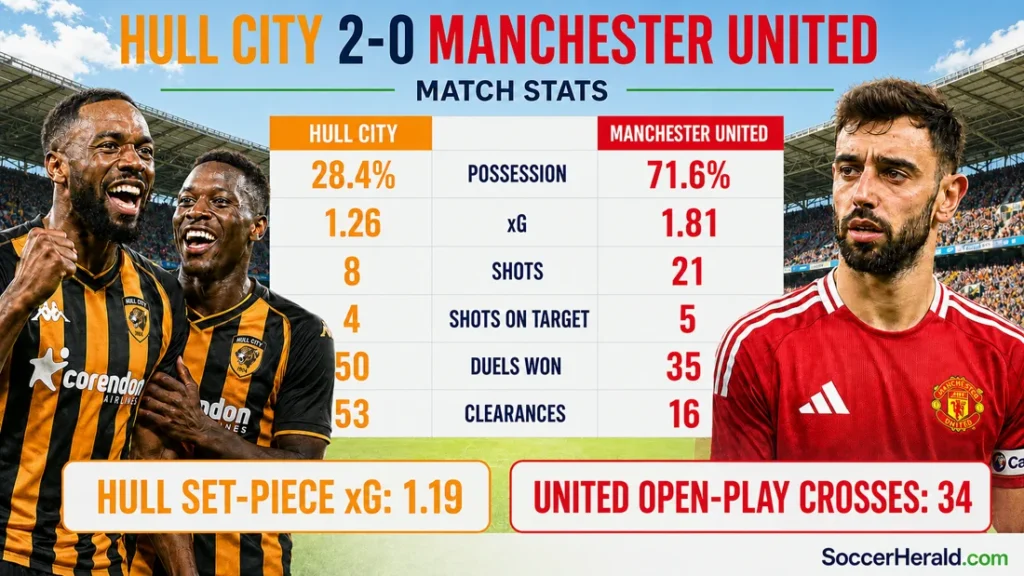
Manchester United arrived with the greater talent, 71.6% possession and the optimism created by Michael Carrick’s revival. Hull arrived with a compact defensive structure, a clear set-piece plan and a stadium that had waited nine years for another Premier League afternoon.
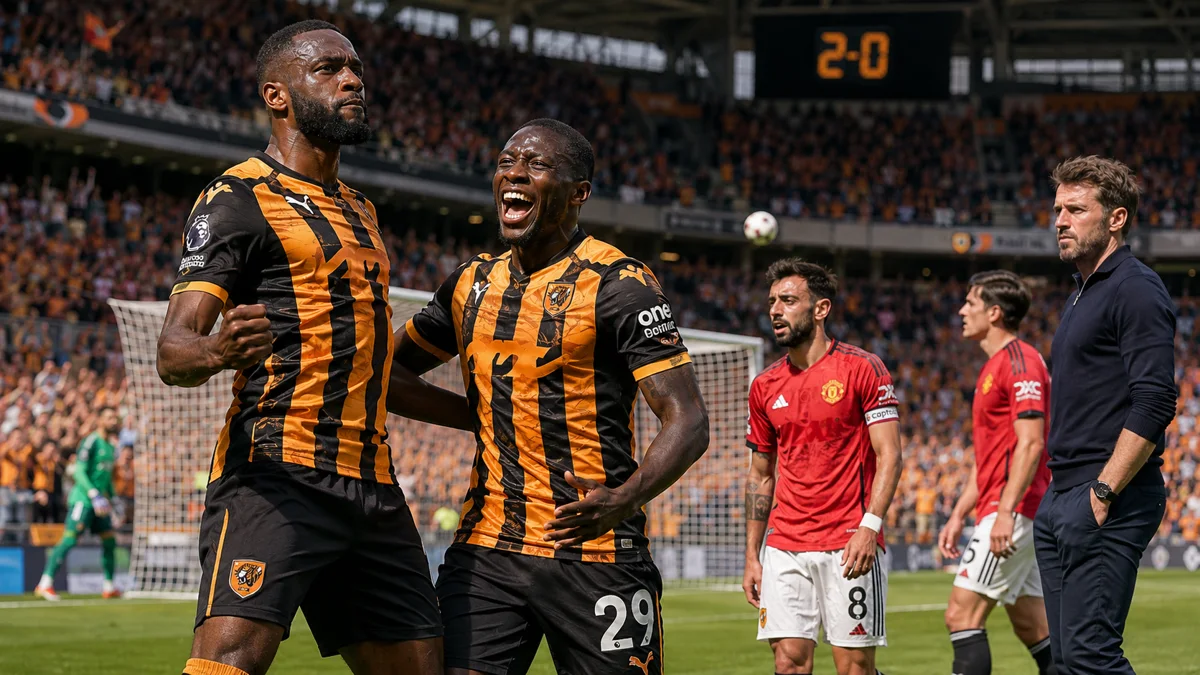
Goals from centre-backs Semi Ajayi and Nobel Mendy gave the newly promoted Tigers a deserved victory at the MKM Stadium.
United finished with 21 shots and 1.81 expected goals, but Hull controlled the areas that mattered. They won the physical contest, protected the centre of the pitch and turned their only corner and one dangerous free-kick into two goals.
For Hull, it was their first Premier League victory over Manchester United and their first league win against them since November 1974.
For United, it was the first time in their history that they had lost an opening league match against a newly promoted side.
Quick Answer
Hull City beat Manchester United 2-0 through Semi Ajayi’s 17th-minute finish and Nobel Mendy’s 38th-minute header.
Sergej Jakirović’s 3-4-2-1 became a disciplined 5-4-1 without the ball, forcing United away from central areas and into 34 open-play crosses.
Hull scored both goals from set pieces, won 50 duels to United’s 35 and made 53 clearances. United dominated possession but rarely controlled the emotional or physical rhythm of the game.
Nine Years Waiting for One Afternoon
There are opening games that feel like the beginning of a season. This felt like the end of a long absence.
Hull had not played Premier League football since May 2017. Their return came against a Manchester United side that finished third last season and entered the new campaign with ambitions extending far beyond Champions League qualification.
On paper, the gap appeared obvious.
Our Premier League opening-weekend predictions expected United to win 2-1. Opta gave Hull only an 11% chance of victory before kickoff.
The stadium did not behave like an 11% stadium.
Every early clearance was celebrated. Every duel won by Matt Crooks or Regan Slater increased the noise. When United attempted to slow the match through possession, Hull’s crowd accelerated it again.
The returning club did not approach the occasion as a ceremony. Hull played as if survival had already begun.
That was consistent with the identity examined in our Hull City 2026/27 season preview: pragmatism, physical strength, defensive commitment and Oli McBurnie as the reference point around which the rest of the attack could operate.
Against United, those qualities became more than a survival plan.
They became a winning one.
Semi Ajayi Punishes United’s First Set-Piece Failure
Hull had already provided a warning before the opening goal.
Ryan Giles sent a dangerous cross towards the United goal, forcing Senne Lammens to intervene. McBurnie also tested the goalkeeper as Hull attacked the space around United’s central defenders.
The breakthrough arrived from the resulting corner in the 17th minute.
Regan Slater’s delivery reached McBurnie at the back post. His stretching effort was pushed against the post by Lammens, but United failed to react to the second ball.
Ajayi did.
The centre-back reached the rebound first and drove it into the net from close range.
It was not a beautifully constructed goal, but it revealed the difference between the teams. Hull attacked the first contact, the rebound and the loose ball. United defended the initial delivery but did not complete the action.
A set piece does not finish when the goalkeeper makes a save. It finishes when the defending team controls the next touch.
United never did.
Watch Semi Ajayi’s goal:
Ajayi’s finish was Hull’s first Premier League goal against Manchester United since Matty Fryatt scored in May 2014.
Before the goal, the Tigers had failed to score with 37 consecutive attempts against United in the competition.
Nine years away from the Premier League disappeared in one violent swing of Ajayi’s right foot.
Nobel Mendy Turns Preparation Into a Second Goal
The second goal was cleaner and even more revealing.
Mohamed Belloumi escaped Youri Tielemans, drawing a foul in a wide position. Slater delivered the free-kick into the penalty area and Mendy attacked it with greater aggression than anyone around him.
His header flew beyond Lammens in the 38th minute.
Two Hull centre-backs had now scored. Two set pieces had damaged United. The pattern could no longer be dismissed as an isolated error.
Hull generated 1.19 of their total 1.26 expected goals from set plays. Their open-play xG was only 0.07.
That does not diminish the performance. It explains it.
Jakirović did not need Hull to build a high-volume attacking game against a technically superior opponent. He needed them to keep the match close, create dead-ball situations and make those situations disproportionately valuable.
That is precisely what happened.
Watch Nobel Mendy’s goal:
Mendy was making his competitive Hull debut.
His first major contribution in English football was to rise above Manchester United’s defence and send the MKM Stadium into a kind of disbelief that quickly became certainty.
Hull were not merely competing.
They were 2-0 ahead.
How Hull’s 5-4-1 Closed the Centre
Hull started in a 3-4-2-1 formation.
Ajayi, John Egan and Mendy formed the back three. Lewie Coyle and Giles operated as wing-backs, while Crooks and Slater protected the centre. Belloumi and Elliot Stroud played behind McBurnie.
Without possession, the structure became a 5-4-1.
The wing-backs dropped alongside the three central defenders. Belloumi and Stroud narrowed into midfield, leaving very little space around Crooks and Slater.
This was important because Carrick’s United normally attempt to transform their 4-2-3-1 into a five-lane attacking structure.
As explained in our detailed look at Michael Carrick’s Manchester United tactics, the aim is to create a 3-2-5 in possession, move Bruno Fernandes closer to goal and place multiple players between defensive lines.
Hull denied those interior spaces.
Whenever United circulated the ball across their defensive line, Hull remained narrow. Whenever the ball moved towards a full-back or winger, the nearest Hull wing-back could step out while the outside centre-back protected the channel behind him.
The hosts were happy to concede possession in areas that did not threaten their goal.
United could have the ball in front of Hull’s block. They could pass sideways. They could send it towards the touchline.
What they could not consistently do was find Fernandes, Matheus Cunha or Bryan Mbeumo in central positions with enough time to turn.
Possession became circulation rather than penetration.
Why United Crossed 34 Times from Open Play
The clearest evidence of Hull’s defensive success was not United’s possession figure.
It was the location from which United were eventually forced to attack.
Carrick’s side attempted 34 open-play crosses, their highest total in a Premier League match for almost eight years. Across all situations, they attempted 39 crosses and completed only nine.
The number reveals the trap.
Hull protected the centre and invited United to move the ball outside. Once it arrived there, the visitors often crossed towards a penalty area containing three centre-backs, two recovering wing-backs and McBurnie when he dropped back for defensive set pieces.
Hull made 53 clearances, including 23 headed clearances.
United started with Cunha as their central attacker rather than Benjamin Šeško. Cunha can move between lines, combine and carry the ball, but repeatedly crossing towards a compact back five did not play to his strongest qualities.
Šeško was introduced alongside Kobbie Mainoo in the 67th minute. By then, Hull were defending a two-goal lead and had complete permission to retreat.
Harry Maguire eventually moved forward as another aerial target, but that only underlined how far United’s original plan had deteriorated.
A team built to create positional superiority had been reduced to sending the ball into a crowded penalty area.
Crooks and Slater Won Hull’s Most Important Battle
After the match, Crooks described himself and Slater as the cheapest midfield partnership in the league.
It was a line delivered with humour, but it contained the emotional centre of Hull’s victory.
Crooks had been released by Manchester United when he was 14. On Saturday, he stood in Hull’s midfield and helped defeat a United side containing significantly more expensive and celebrated players.
Beside him, Slater supplied both decisive set-piece deliveries.
Neither player tried to dominate the match through possession. Their task was different.
They stayed close together, protected the area in front of Hull’s defence and competed for every loose ball produced by McBurnie’s physical battle with Maguire and Ayden Heaven.
Hull won 50 of the match’s 85 duels.
They also won 22 aerial duels to United’s 16.
That difference shaped the atmosphere. Every time United expected to establish control, Hull disrupted them with a tackle, header or second-ball recovery.
Tielemans and Andrey Santos completed passes and helped United retain possession, but they could not impose a stable rhythm. Hull made the midfield feel crowded, physical and uncomfortable.
The game was played at United’s technical level only when Hull allowed it.
United’s 1.81 xG Needs Context
The numbers prevent this result from becoming a simple story about United creating nothing.
They recorded 21 shots, five on target, 41 touches inside the Hull penalty area and 1.81 xG. Hull produced eight shots and 1.26 xG.
United therefore created enough cumulative opportunity to score.
But the quality and timing of those chances matter.
Eight attempts were blocked. Their expected goals on target figure was only 0.60, suggesting that much of the apparent danger was reduced by poor placement, defensive pressure or both.
Bryan Mbeumo had United’s clearest opening in the 78th minute after Cunha finally helped break Hull’s line. Mbeumo reached a central shooting position, but Konstantinos Tzolakis saved.
Bruno also tested the goalkeeper, while Marcus Rashford brought greater directness after replacing Patrick Dorgu at half-time.
Rashford’s appearance carried its own significance. It was his first Manchester United match since December 2024 following his loan spell at Barcelona.
There were brief signs that his pace could stretch Hull’s right side, especially once Šeško entered. There was never enough continuity to transform those moments into a comeback.
United created volume.
Hull controlled the conditions under which that volume was produced.
How Hull Exposed Carrick’s 3-2-5
Carrick was right not to panic afterwards.
One defeat does not erase the work that took United from uncertainty to third place last season. It does not suddenly make the structure ineffective or the summer recruitment misguided.
But the match exposed a problem that opponents will attempt to repeat.
United need a clearer solution against a back five defending close to its own penalty area.
The 3-2-5 structure can create excellent attacking spacing, but occupation of five lanes is not enough on its own. The ball must move quickly enough to force defenders to leave those lanes.
Against Hull, the circulation was frequently too slow.
United needed more third-man combinations around the box, more movement behind the wing-backs and earlier switches of play. Too many attacks finished with a predictable cross rather than a runner entering the area after the defensive line had been moved.
There was also a defensive warning.
Since Carrick returned as head coach, only four Premier League teams have conceded more goals from corners than United’s six.
Ajayi’s goal continued that pattern. Mendy’s header widened it from corners to the broader problem of defending deliveries and second balls.
Carrick said afterwards that one match would not change United’s direction.
That is reasonable.
Direction, however, is not the same as readiness.
What the Victory Means for Hull City
One victory will not decide Hull’s survival chances.
The Premier League will produce weeks when their low block does not hold, when a set-piece delivery misses its target and when elite opponents turn territorial dominance into goals.
But this performance gives Jakirović something every promoted manager needs: evidence.
Hull now know their structure can survive sustained Premier League pressure.
They know McBurnie can provide an outlet against top-level defenders. They know Coyle and Giles can handle the physical demands of the wing-back roles. They know Slater’s delivery can turn limited attacking possession into high-value chances.
Most importantly, the players know their collective discipline can reduce a huge financial and technical disadvantage.
The Premier League 2026/27 hub will change repeatedly as the season develops. Hull will almost certainly spend long periods closer to the relegation battle than the top of the table.
After one match, however, they had already proved they would not treat survival as an apology for being here.
What Manchester United Must Fix Before Ipswich
United’s response begins at home to Ipswich.
The priorities are clear: stronger set-piece defending, quicker circulation and better penalty-area occupation. If crossing becomes the solution, Šeško must be positioned to attack those deliveries.
Carrick’s structure can organise United, but it cannot win the first contact or the next duel for them.
Final Verdict
Hull City’s 2-0 victory was an upset, but it was not an accident.
Jakirović gave his team a realistic game plan. Hull defended in a compact 5-4-1, forced United towards the wings, dominated the physical exchanges and treated set pieces as attacking possessions rather than pauses in the match.
United had more of the ball, more shots and a higher xG total.
Hull had greater clarity.
That distinction explains the result.
For 90 minutes, one of English football’s largest institutions looked trapped inside a newly promoted team’s idea of how the game should be played.
The afternoon began as Hull City’s return to the Premier League.
It ended as Manchester United’s first warning.
Sources
Reuters: Hull Stun Manchester United on Premier League Return
Opta Analyst: Hull City 2-0 Manchester United Match Analysis


