



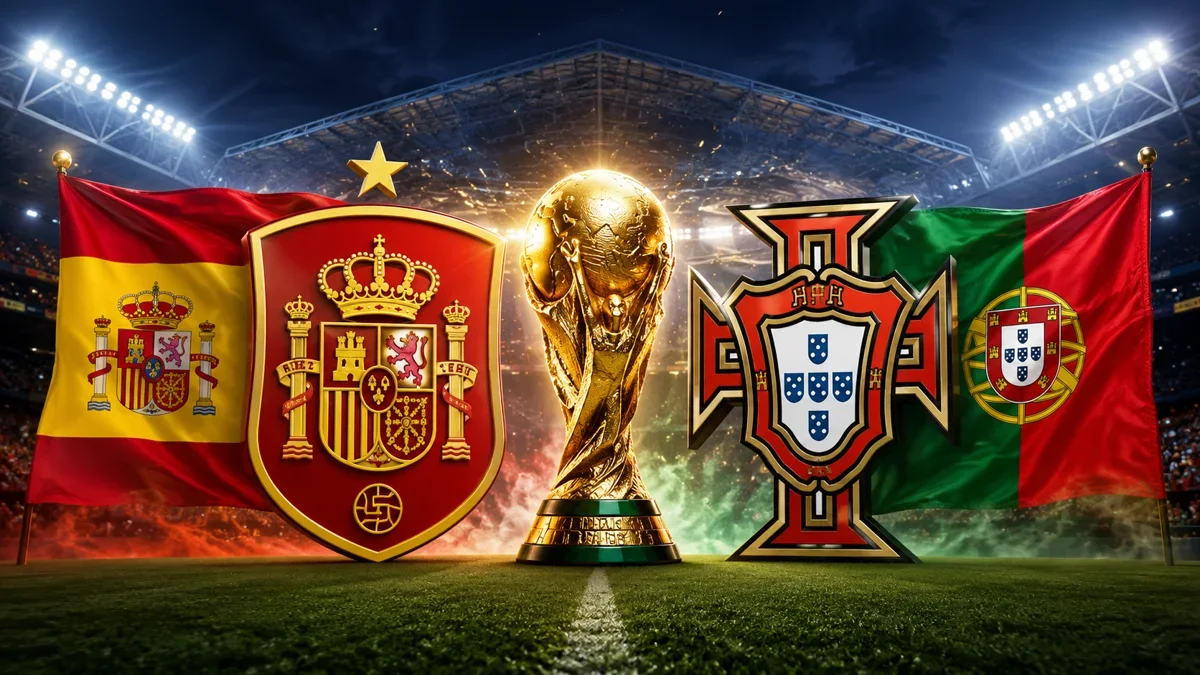
Spain vs Portugal World Cup 2026 Round of 16 Preview
Spain against Portugal is never only a football match.
Portugal vs Spain, also searched as Spain vs Portugal, is one of the biggest World Cup 2026 Round of 16 ties.
It is geography, memory, style, pride and proximity. It is a border turned into a tactical argument. Two football cultures close enough to recognise every gesture, but different enough to make the meeting feel loaded.
For a match this big, the Round of 16 feels almost too early.
Spain arrive from a 3-0 win over Austria that looked like their most complete performance of the tournament. Mikel Oyarzabal scored twice, Pedro Porro added another, and La Roja again protected their goal with the authority of a team that has begun to believe in its own control.
Portugal arrive differently. They beat Croatia 2-1, but not cleanly. Ivan Perisic put Croatia ahead. Cristiano Ronaldo equalised from the penalty spot. Gonçalo Ramos then headed in the stoppage-time winner, keeping Portugal alive and setting up the Iberian derby everyone wanted and feared.
So this is Spain vs Portugal. Control against chaos. Structure against moments. Lamine Yamal and Pedri against Ronaldo, Leão and Bruno.
And somewhere inside it, there is one question that may decide the night: can Portugal break Spain’s rhythm before La Roja take the game away?
Quick Answer: Who Will Win Spain vs Portugal?
Spain vs Portugal is a Round of 16 tie about Spanish control, Portuguese chaos and one decisive question: can Ronaldo, Leão and Bruno break La Roja’s rhythm before Yamal and Pedri take the game away?
Prediction: Spain 2-1 Portugal.
Spain vs Portugal Match Details
| Match | Spain vs Portugal |
|---|---|
| Competition | World Cup 2026 |
| Stage | Round of 16 |
| Date | July 6, 2026 |
| Kickoff time | 15:00 ET / 19:00 UTC |
| Venue | Dallas Stadium |
| Spain route | Beat Austria 3-0 in the Round of 32 |
| Portugal route | Beat Croatia 2-1 in the Round of 32 |
| Next round | Winner reaches the quarter-finals |
The Big Picture
Spain look like a team growing into the tournament at exactly the right time.
Their opening draw against Cape Verde was a warning. It showed that talent alone was not enough, that neat possession could become sterile, and that the World Cup does not reward reputation. Since then, Spain have tightened. They have looked cleaner between the lines, sharper without the ball and more convincing in the final third.
That evolution was already clear in our Spain vs Austria preview, where the central question was whether Austria’s pressure could disturb Spain’s structure. It could not. Spain solved the press, controlled the rhythm and turned the game into a long exercise in positional patience.
Portugal are harder to read.
They have more individual ways to win a match. Ronaldo, Bruno Fernandes, Vitinha, Rafael Leão, Bernardo Silva, João Neves, Nuno Mendes and Gonçalo Ramos give Roberto Martínez several routes to goal. But Portugal have not always looked like one clean idea. They can be fluent, then suddenly loose. They can dominate the ball, then give up space.
That was also the story around their route from the World Cup 2026 Group K Guide. Portugal had the talent to control the group, but the question was always whether their attacking abundance would become balance.
Against Spain, balance matters more than names.
Spain’s Control Is Becoming a Weapon
Spain’s 3-0 win over Austria was not only about the score.
It was about the shape of the match.
Austria wanted pressure, duels and discomfort. Spain gave them angles, short passing lanes and repeated escapes from pressure. The important thing was not just that Spain scored three. It was that Austria were made to chase, reset, chase again and slowly lose the emotional structure of their plan.
That is what this Spain can do when the midfield works.
Rodri gives them security. Pedri gives them rhythm. Dani Olmo gives them vertical touch. Lamine Yamal gives them imbalance from the right. Oyarzabal gives them intelligent movement and finishing without needing the whole game to be built around him.
Spain are not simply keeping the ball to rest. They are using the ball to move opponents into positions they do not want to occupy.
Against Portugal, that matters because Portugal’s defensive spacing can open if their front line does not press together. If Ronaldo starts, Portugal gain presence and penalty-box threat, but Spain may try to play around him in the first phase. If Ramos starts, Portugal gain more pressing energy, but lose some of the historical gravity Ronaldo still carries.
Either way, Spain will try to make Portugal choose.
Press high and risk being played through.
Drop deep and let Spain build pressure.
Portugal’s Win Over Croatia Was a Warning and a Gift
Portugal’s 2-1 win over Croatia was both a warning and a gift.
The warning was obvious. Portugal were not in full control. Croatia led through Perisic. The match became emotionally unstable. Portugal had to rely on a Ronaldo penalty and a late Ramos header to escape.
But tournament teams often need one ugly win. They need a match that reminds them how close the exit door is. Portugal got that against Croatia, and survived it.
That can sharpen a team.
Ronaldo’s penalty also changed the emotional meaning of this run. His first World Cup knockout goal arrived at 41, at a stage of his career where every match feels like it might become the final page.
Ramos’ winner may matter even more tactically.
It showed Portugal do not need every decisive moment to come through Ronaldo. They can still use the bench. They can still change the penalty-box picture late. They can still make a match swing after the 90th minute.
That is Portugal’s danger against Spain.
They may not control the game.
But they may only need one break in the pattern.
The Tactical Battle: Spain’s Right Side vs Portugal’s Left
One of the clearest battles is Spain’s right side.
Lamine Yamal is the obvious focus, but the danger is not only his dribbling. It is what he does to the rest of the pitch. When he receives wide, Portugal have to decide whether to double him. If they do, Spain can find the inside lane. If they do not, he can attack the full-back directly.
Pedro Porro’s role also matters. His goal against Austria will get attention, but his positioning is just as important. If Porro times his movements well, he can support Yamal wide or arrive late when Portugal’s left side is dragged toward the ball.
That could create a major problem for Portugal.
Nuno Mendes has the speed to defend difficult spaces, but he also wants to attack. If he pushes high and Portugal lose the ball, Spain can immediately look for Yamal in the channel. If he stays deep, Portugal lose one of their best ways to carry the ball forward.
That is the kind of small tactical trap Spain like to create.
They do not always beat you with one pass.
They make every option slightly worse until the mistake arrives.
Portugal Need Leão to Stretch the Game
If Portugal want to hurt Spain, Rafael Leão feels essential.
Spain are especially strong when the game is played in front of them, when Rodri can screen, Pedri can manage tempo and the centre-backs can hold their positions.
Leão changes that.
He can carry the ball 40 metres. He can turn a clearance into a counterattack. He can make Spain’s right side think twice before pushing too high. He does not need 15 touches in the first half to matter. He needs two moments where the pitch opens.
That is where Bruno Fernandes and Vitinha become important. Portugal cannot simply clear the ball and hope. They need the first pass after regaining possession to be clean. If Spain counter-press and win it back immediately, Portugal will spend long spells trapped.
But if Portugal break the first wave, Spain can be exposed.
This is the game within the game: Spain want repeated attacks; Portugal want broken attacks.
Spain want rhythm.
Portugal want rupture.
Ronaldo’s Role: Starter, Symbol or Late Weapon?
The Ronaldo question is no longer simple.
He scored against Croatia. He remains Portugal’s biggest figure. He still changes the psychology of defenders inside the penalty area. But against Spain, Portugal must decide how much of the game should be built around him from the start.
If Ronaldo starts, Portugal have a clear target and a player who can turn one penalty-box action into history. Spain’s centre-backs must stay alert for crosses, cut-backs and second balls.
But Spain may also see an opportunity. They may try to control possession through Ronaldo’s pressing zone, forcing Portugal’s midfield to jump higher and creating space behind them.
If Ronaldo is used as a later weapon, Portugal may begin with more running, more pressing and more defensive coverage. But leaving him out of the starting structure in a match this big would carry emotional weight.
That is the tension for Martínez.
This is not just a tactical decision.
It is a decision about time.
What Spain Must Avoid
Spain must avoid believing control is the same as safety.
Against Portugal, possession can lie. A team can have the ball, territory and rhythm, then concede from one Leão run, one Bruno Fernandes pass, one Ronaldo movement or one Ramos header.
Spain must also avoid leaving Rodri isolated in defensive transition. Portugal will try to pull Spain’s full-backs forward and attack the space behind them. If the counter-press is late, Spain could suddenly find themselves defending backwards.
The final danger is overconfidence.
A 3-0 win over Austria looked impressive, but Portugal are a different emotional problem. They have players who do not need a good match to produce a decisive moment.
Spain cannot let the game become comfortable too early.
Comfort is where knockout games begin to betray you.
What Portugal Must Avoid
Portugal must avoid spending the first half as spectators.
If they sit too deep, Spain will build pressure around the box and the match will become exhausting. Portugal need periods where they keep the ball, move Spain sideways and force La Roja to defend for more than a few seconds.
They also need discipline around Yamal.
Too much aggression, and Spain will play behind the challenge. Too much caution, and he will keep receiving in space. Portugal must defend him with timing, not panic.
Most of all, Portugal must avoid turning the game into a series of isolated attacks.
Spain will welcome that.
Portugal need counters, yes.
But they also need control in small doses.
Key Players to Watch
Lamine Yamal
Yamal gives Spain the one thing possession teams always need: a player who can break the pattern. His one-v-one threat can tilt Portugal’s defensive structure and create space for Oyarzabal, Olmo and Pedri.
Rodri
Rodri is Spain’s insurance policy. If he controls second balls and prevents Portugal from running through midfield, Spain can keep the match in their preferred rhythm.
Pedri
Pedri’s importance is not always dramatic, but it is constant. He gives Spain tempo, disguise and the ability to change direction without losing control.
Cristiano Ronaldo
Ronaldo’s goal against Croatia changed the emotional story of Portugal’s tournament. Whether he starts or appears later, Spain must defend him before the cross arrives.
Rafael Leão
Leão may be Portugal’s best open-play weapon in this matchup. If he can carry the ball into space, Spain’s defensive line will face its hardest test of the tournament.
Bruno Fernandes
Bruno is the player who can make Portugal’s transitions precise. His first pass after a regain could decide whether Portugal escape Spain’s pressure or give the ball straight back.
Prediction: Spain 2-1 Portugal
This feels like a match Spain should control, but not one they will control comfortably.
Portugal have too many ways to disturb the pattern. Leão can stretch the pitch. Bruno can find early passes. Ronaldo can still turn one box touch into a headline. Ramos has already shown he can decide a knockout game late.
But Spain look more connected.
Their midfield structure is cleaner. Their defensive record is stronger. Their right side has the kind of balance that can slowly pull Portugal apart. And unlike earlier in the tournament, Spain now look like a team whose possession has purpose rather than habit.
The prediction is Spain 2-1 Portugal.
Not a simple win. Not a statement without suffering. But a win built on control, patience and one decisive spell when Portugal finally spend too long without the ball.
Spain to move on.
Portugal to leave with drama, regret and the feeling that this Iberian derby arrived one round too early.
Sources


