



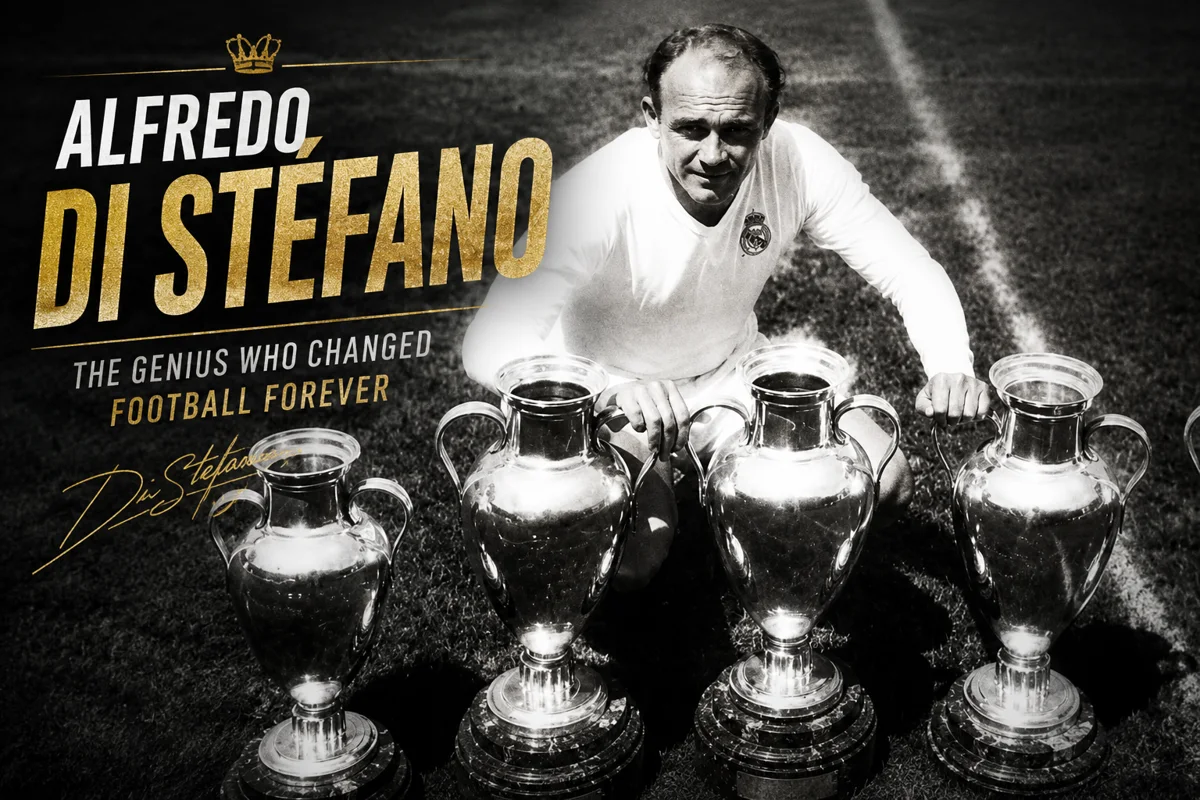
Alfredo Di Stéfano: The Genius Who Changed Football Forever
Alfredo Di Stéfano was not simply one of football’s greatest players. He was one of the players who changed the idea of what greatness could look like.
Before the modern No.10, before the false nine, before pressing forwards, before midfielders were expected to create, score, defend and control the rhythm of a match, there was Di Stéfano.
He did not belong neatly to one position. He was listed as a forward, but that tells only the smallest part of the story. He scored like a striker, passed like an inside forward, covered ground like a midfielder and led the team like a coach on the pitch.
That is why his legacy still feels so modern. Di Stéfano did not just dominate his era. He helped invent parts of the football that came after him.
Alfredo Di Stéfano Quick Facts
| Detail | Answer |
|---|---|
| Full name | Alfredo Di Stéfano Laulhé |
| Main clubs | River Plate, Millonarios, Real Madrid |
| Main position | Forward / inside forward |
| Real Madrid goals | 308 goals in 396 official matches |
| European Cups | 5 with Real Madrid |
| Ballon d’Or wins | 2 |
| International story | Represented Argentina and Spain; also appeared for Colombia |
| World Cup appearances | None |
Quick Answer: Why Was Alfredo Di Stéfano So Important?
Alfredo Di Stéfano changed football because he was one of the first true all-action superstars.
He could drop deep, build attacks, drive forward, score, press, defend and organise the team around him. At Real Madrid, he became the symbol of the club’s first great European dynasty, winning five consecutive European Cups and turning Madrid into the defining club of continental football.
His greatness was not only in the numbers. It was in the way he made a team function.
The Player Who Refused One Position
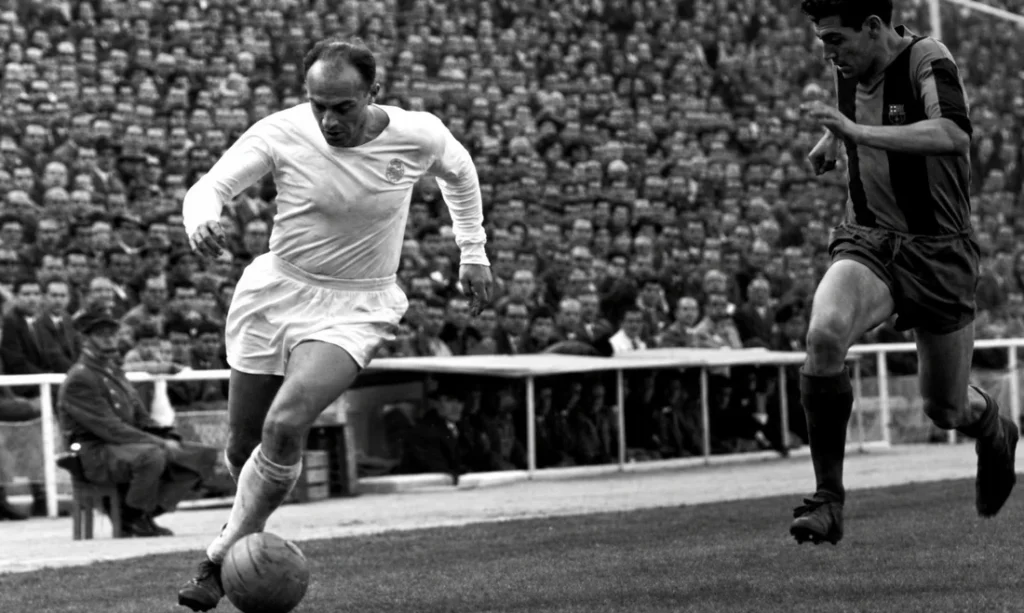
The easiest mistake with Di Stéfano is to describe him only as a striker.
Yes, he scored heavily. Yes, he was ruthless near goal. Yes, Real Madrid list him as a forward, and his record of 308 goals in 396 official matches for the club is extraordinary.
But Di Stéfano’s real genius was not that he stood at the top of the pitch and finished moves. It was that he appeared wherever the game needed him.
If Madrid needed a passing option, he dropped into midfield. If the team needed pressure, he chased back. If the game opened, he attacked the box. If the rhythm became slow, he accelerated it. If the match became chaotic, he imposed order.
That made him more than a scorer. He was the system.
In modern language, people might try to call him a false nine, a second striker, a deep-lying forward, an attacking midfielder or even a total footballer before Total Football had a name. None of those labels is completely wrong, but none is enough.
Di Stéfano was not important because he fitted a role. He was important because the role had to expand to fit him.
Why Di Stéfano Looked Ahead of His Time
Football in the 1950s was not the game we watch now. The pitch was heavier, the tactical language was different and many teams were more rigid in their structure.
Di Stéfano broke that rigidity.
He understood space before football became obsessed with space. He understood pressure before pressing became a coaching industry. He understood that the best player did not always have to wait for service. He could go and create the conditions for the service himself.
That is why his game has aged so well.
Some old greats are remembered mainly for what they did in their own time. Di Stéfano feels different. You can look at him and see the outline of later football: Cruyff’s intelligence, Platini’s control, Maradona’s centrality, Messi’s creative gravity and the modern elite forward who must run, link and defend.
He was not exactly any of them.
But he helped make that kind of footballer imaginable.
The Human Story: From Buenos Aires to Madrid
Di Stéfano’s story began in Buenos Aires, but it became larger than one country.
He played for River Plate, then Millonarios in Colombia, where his reputation grew into something close to myth. By the time Spain’s two giants fought for him, he was not just another South American forward. He was the player who seemed capable of changing the balance of European football.
And that is exactly what happened.
His move to Real Madrid in 1953 remains one of the most important transfers in football history. It was not a clean, simple deal. Barcelona were involved. River Plate and Millonarios had claims. The politics and paperwork around the move became part of the legend.
But the football consequence was brutally clear.
Barcelona missed out. Madrid got him. Spanish and European football tilted.
Some transfers improve a team. Some define a generation. Di Stéfano’s transfer did something rarer: it helped create the modern identity of a club.
Real Madrid were already important. With Di Stéfano, they became something else.
They became Europe’s reference point.
Real Madrid Before and After Di Stéfano
Real Madrid’s European mythology did not begin with Cristiano Ronaldo, Zinedine Zidane or the Champions League era. It began with Di Stéfano.
He arrived in 1953. Within a few years, Madrid were not just winning. They were constructing the idea of European dominance.
The European Cup was a new competition, but Madrid made it feel like their property. From 1956 to 1960, they won the first five editions. Di Stéfano scored in all five finals.
That detail matters.
It means he was not simply part of the machine. He was present at the decisive moment every time. Paris, Madrid, Brussels, Stuttgart, Glasgow. Different opponents, different pressures, same central figure.
The 1960 final against Eintracht Frankfurt became the symbol. Madrid won 7-3 at Hampden Park. Ferenc Puskás scored four. Di Stéfano scored three. It remains one of the most famous European finals ever played.
But the deeper point is not just the scoreline. It is what that team represented.
Madrid were not only collecting trophies. They were selling a vision: technical superiority, attacking ambition, European glamour and the idea that the biggest nights belonged to them.
Di Stéfano was the face of that vision.
The Tactical Core of Madrid’s First Dynasty
The great Madrid side of that era had stars everywhere. Puskás brought finishing genius. Paco Gento brought speed and width. Raymond Kopa added elegance and invention. José Santamaría gave defensive power.
But Di Stéfano connected it all.
He was the player who made the structure breathe. When he dropped, defenders had a problem: follow him and leave space behind, or hold the line and let him dictate play. When he pushed forward, midfielders had a problem: track him and lose shape, or give him time around the box.
That is the mark of a truly transformative footballer. He does not only beat opponents with one skill. He asks them questions they are not built to answer.
Di Stéfano’s movement created uncertainty. His work rate gave Madrid aggression. His passing gave them rhythm. His finishing gave them authority.
A team can survive one of those qualities. It is hard to survive all of them in one player.
Why He Was Called the Complete Footballer

The phrase “complete footballer” gets used too easily now.
For Di Stéfano, it fits.
He was complete because he could influence every phase of a match.
In possession, he could build, combine and finish. Out of possession, he worked. He did not treat defending as somebody else’s job. He understood that control begins before you have the ball.
In transitions, he was devastating. He could move the play forward quickly, but he also knew when to slow it down. That balance is what separates great players from merely spectacular ones.
He was not just fast. He was early. He saw where the game was going before others had reacted.
That is why so many descriptions of Di Stéfano sound tactical even when they are emotional. People remember his personality, authority and hunger, but beneath all that was a football brain of extraordinary clarity.
The World Cup Absence That Complicates His Legacy
There is one strange gap in Di Stéfano’s story: he never played in a World Cup.
For many all-time greats, the World Cup is the stage that frames their legacy. Pelé has 1958, 1962 and 1970. Maradona has 1986. Messi has 2022. Zidane has 1998.
Di Stéfano has no such tournament.
That makes him part of a rare group of legendary players who never played at a World Cup, a list that shows how greatness in football has never depended on one tournament alone.
His international story was unusually complicated. He played internationally for Argentina and Spain, and also appeared for Colombia during the country’s breakaway football period. Yet despite that rare three-country story, timing, eligibility and football politics meant he never played at a World Cup.
That absence makes his legacy different, but it does not weaken it as much as it might seem.
His greatness was built in club football, especially in Europe, at a time when the European Cup was becoming the most important club competition in the world.
In a way, it makes him more interesting.
He is one of the few players whose claim to all-time greatness does not rely on one summer, one trophy or one iconic international tournament. His case rests on something broader: transformation.
Di Stéfano and the Birth of Modern Real Madrid
Every great club has founding myths.
For Real Madrid, Di Stéfano is not just a legendary player inside the museum. He is part of the club’s original European code.
Win. Attack. Lead. Expect the biggest night to be yours.
That culture did not appear from nowhere. It was built through players, presidents, managers, crowds and trophies. But Di Stéfano gave it a human form.
He was demanding. He was direct. He was not a decorative genius. He was a competitive force.
That matters because Madrid’s later identity, from the Galácticos to the Champions League comebacks of the modern era, often rests on the same idea: talent is not enough unless it carries authority.
Di Stéfano had that authority.
He did not just play for Madrid. He taught Madrid what it could be.
Was Alfredo Di Stéfano Better Than Pelé or Maradona?
This is the wrong question, but it is an unavoidable one.
Pelé had the World Cups. Maradona had the single-tournament myth. Messi has the numbers, longevity and final completion of the story. Cristiano Ronaldo has the Champions League era and the physical reinvention of goalscoring.
Di Stéfano sits differently.
He may not be the easiest player to rank because much of his greatness belongs to a different football world. There is less footage. The tactical context was different. The global media machine was smaller.
But if the question is influence, not just fame, Di Stéfano belongs in the highest conversation.
He changed what a superstar could be. He changed Real Madrid. He changed the European Cup. He helped move football away from fixed roles and toward fluid responsibility.
That is not a small legacy. That is one of the biggest legacies in the sport.
Final Verdict: The Genius Who Changed Football Forever
Alfredo Di Stéfano was not merely ahead of his time. He helped drag football toward the future.
He was a forward who refused to stay forward, a scorer who organised, a leader who worked, a superstar who made the team more important rather than less.
Real Madrid’s first European dynasty cannot be understood without him. The idea of the complete attacking footballer cannot be understood without him. The history of club football cannot be told properly without him.
Some players become legends because they win. Di Stéfano did win, relentlessly.
But the deeper reason he still matters is this: he expanded the job description of greatness.
That is why Alfredo Di Stéfano was not just one of the best players ever.
He was one of the players who changed the game itself.
Sources
Real Madrid official profile
UEFA: Di Stéfano on his five European Cup wins
The Guardian: Alfredo Di Stéfano obituary and legacy


