




Cristiano Ronaldo World Cup Record: 11 Goals, No Trophy
Cristiano Ronaldo finished his World Cup career with 10 goals in 27 appearances across six tournaments, but without the trophy he spent more than two decades chasing.
His final World Cup match came on July 6, 2026, when Portugal lost 1-0 to Spain in the round of 16. Mikel Merino’s stoppage-time goal ended Portugal’s campaign and closed one of the longest individual stories in World Cup history.
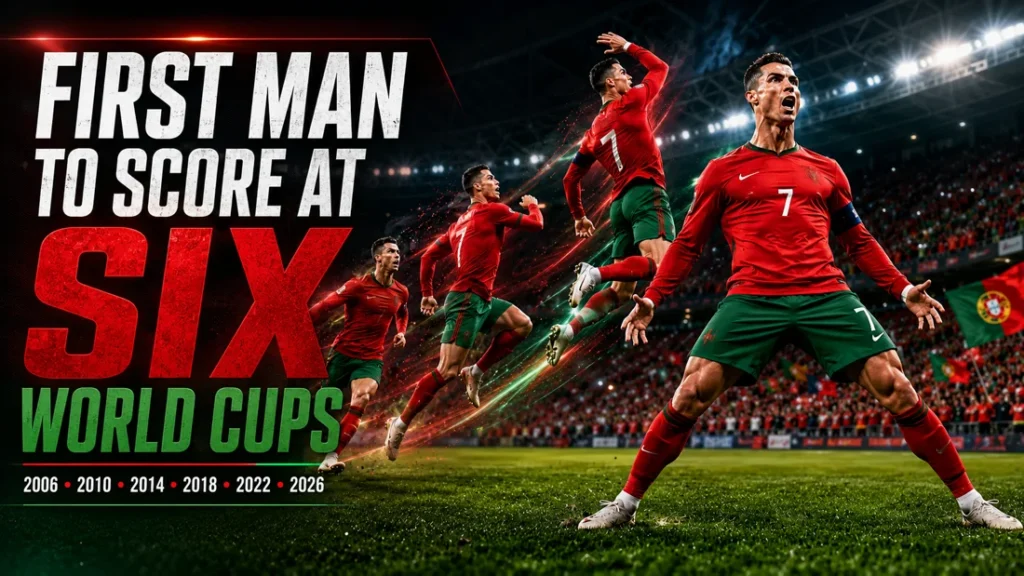
Ronaldo had already confirmed that the 2026 tournament would be his last. He left as the first male player to score at six different World Cups, Portugal’s record scorer at the tournament and one of the defining figures of the modern international game.
Yet the central contradiction remains.
Ronaldo conquered almost every major stage in football. The World Cup was the one stage he could never fully control.
Cristiano Ronaldo’s World Cup Record at a Glance
| Record | Cristiano Ronaldo total |
|---|---|
| World Cup tournaments | 6 |
| World Cup appearances | 27 |
| World Cup goals | 11 |
| World Cup knockout goals | 1 |
| Best finish | Fourth place in 2006 |
| World Cup titles | 0 |
| Goals at World Cup 2026 | 3 |
| Final World Cup match | Portugal 0-1 Spain, July 6, 2026 |
10 goals
Eleventh goal
Ronaldo played at every World Cup from Germany 2006 to the United States, Canada and Mexico in 2026.
He scored at all six editions, a record that reflects both his longevity and his ability to remain relevant as his role changed from explosive winger to penalty-box striker.
How Many World Cup Goals Has Ronaldo Scored Without Penalties?
Cristiano Ronaldo has scored World Cup goals from open play, headers, free kicks and penalties across six tournaments. His non-penalty record provides useful context for judging both his longevity and his overall impact at the competition.
Cristiano Ronaldo finished his World Cup career with 11 goals across six tournaments. Four of those goals came from the penalty spot, leaving him with seven non-penalty World Cup goals.
His complete scoring breakdown shows eight goals with his right foot, two with his left foot and one header. However, the right-foot total includes all four of his converted penalties. His seven non-penalty goals therefore break down into four right-footed finishes, two left-footed goals and one header.
| Type of Goal | Goals |
|---|---|
| Right-footed goals excluding penalties | 4 |
| Left-footed goals | 2 |
| Headers | 1 |
| Non-penalty World Cup goals | 7 |
| Penalty goals | 4 |
| Total World Cup goals | 11 |
Ronaldo scored eight World Cup goals with his right foot in total, but four of them were penalties. His seven non-penalty goals consisted of four right-footed finishes, two left-footed goals and one header. He failed to convert one penalty.
Cristiano Ronaldo’s World Cup Goals by Tournament
| World Cup | Goals | Portugal finish | Defining moment |
|---|---|---|---|
| Germany 2006 | 1 | Fourth place | First World Cup goal against Iran |
| South Africa 2010 | 1 | Round of 16 | Scored in the 7-0 win over North Korea |
| Brazil 2014 | 1 | Group stage | Late winner against Ghana |
| Russia 2018 | 4 | Round of 16 | Hat-trick against Spain |
| Qatar 2022 | 1 | Quarter-finals | First man to score at five World Cups |
| World Cup 2026 | 3 | Round of 16 | First man to score at six World Cups |
| Total | 11 | Six tournaments | World Cup record across 20 years |
The numbers show consistency across 20 years. The way Ronaldo produced them shows how radically he adapted.
In 2006, he received near the touchline and attacked defenders with speed. By 2018, he had become a more direct scorer who could decide matches with fewer touches. In 2022 and 2026, he operated mainly as a central striker, focusing on movement inside the box, aerial duels and finishing.
His game changed because it had to. His expectations rarely did.
2006: The Beginning and Portugal’s Best Finish
Ronaldo arrived at the 2006 World Cup as a 21-year-old winger, not yet the relentless scorer he would become at Manchester United and Real Madrid.
Portugal’s attack was still shaped by Luís Figo, Deco and Pauleta. Ronaldo supplied acceleration, width and unpredictability. He could receive outside the opposition block, isolate a full-back and turn controlled possession into a direct attack.
His first World Cup goal came from the penalty spot against Iran.
Portugal eventually reached the semi-finals, where they lost 1-0 to France. Defeat to Germany in the third-place match left them fourth, which remained Ronaldo’s best World Cup finish.
That is one of the curiosities of his international career. The young winger of 2006 went deeper into the competition than any of the more complete versions of Ronaldo that followed.
2010 and 2014: A Superstar Inside an Incomplete Attack
By 2010, Ronaldo was no longer simply one of Portugal’s dangerous players. He had become the centre of the team’s attacking identity.
That created a heavy dependence.
Opponents knew Portugal wanted to release him quickly. They could protect the space behind their defensive line, crowd his preferred channels and challenge the supporting players to create the decisive action.
Ronaldo scored once in South Africa, during the 7-0 victory over North Korea. Portugal then lost 1-0 to Spain in the round of 16.
Brazil 2014 was even more difficult. Ronaldo arrived with fitness concerns, while Portugal lacked the collective balance required to survive a demanding group. His late winner against Ghana was not enough to prevent elimination.
Those two campaigns exposed a recurring issue. Portugal possessed an extraordinary finisher, but did not always have the midfield control, attacking depth or stable possession structure required to deliver him into decisive positions.
At Real Madrid, Ronaldo played in teams built to create repeated waves of chances. With Portugal, he was often expected to provide both the route to goal and the final action.
2018: Ronaldo’s Greatest World Cup Night
Ronaldo’s finest individual World Cup performance came against Spain in Sochi.
Portugal drew 3-3. Ronaldo scored all three goals.
The hat-trick displayed three different elements of his game. He won and converted an early penalty, punished a goalkeeping error before half-time and then produced a late free-kick that curled over the wall and into the top corner.
It was also a tactical demonstration of how Ronaldo could dominate a match without dominating possession.
Spain controlled the ball. Portugal stayed compact, protected central areas and looked for their captain as soon as possession changed. Ronaldo did not need long sequences around the penalty area. He needed isolated defenders, loose balls and set-piece opportunities.
The final free-kick became one of the defining images of his international career.
Portugal were eliminated by Uruguay in the round of 16, but Ronaldo’s four goals in Russia remained his best return at a single World Cup.
2022: When Ronaldo’s Role Began to Change
Ronaldo scored from the penalty spot against Ghana at Qatar 2022 and became the first male player to score at five World Cups.
The record was historic, but the tournament also revealed a changing football reality.
Ronaldo was now a central striker rather than a roaming forward. He could still attack crosses, occupy centre-backs and threaten the six-yard box, but could no longer provide the same repeated transitions or pressing intensity.
Portugal therefore faced an uncomfortable question: should the team remain structured around Ronaldo’s penalty-box presence, or become more mobile without him?
The debate became unavoidable when Gonçalo Ramos started against Switzerland in the round of 16 and scored a hat-trick in a 6-1 victory. Ronaldo entered from the bench and was again used as a substitute in the quarter-final defeat to Morocco.
The image of him leaving the pitch in tears looked like a World Cup farewell. Instead, he returned four years later for one final attempt.
2026: Three Goals and One Final Chase
Ronaldo entered the 2026 World Cup at 41, surrounded by more creative quality than Portugal had possessed during several of his earlier campaigns.
Bruno Fernandes could find vertical passes. Bernardo Silva could manipulate tight spaces. Rafael Leão could stretch the pitch, while Vitinha offered control from midfield.
The tactical challenge was balancing Ronaldo’s penalty-box threat with the movement and pressing of the rest of the attack.
He answered some of the doubts early.
Ronaldo scored twice in Portugal’s 5-0 victory over Uzbekistan, becoming the first male player to score at six World Cups. Those goals also took him beyond Eusébio as Portugal’s leading scorer in the competition.
Portugal’s route through the group was not always comfortable, as examined in the World Cup 2026 Group K Guide.
The more significant breakthrough came against Croatia in the round of 32.
Ronaldo converted the equalising penalty before Gonçalo Ramos scored the stoppage-time winner in Portugal’s 2-1 victory. The full story is covered in Portugal 2-1 Croatia: Ramos Sends Ronaldo to Spain.
It took Ronaldo until his sixth World Cup and his 26th tournament appearance to score his first knockout-stage goal.
That statistic helps explain the difference between his wider international record and his World Cup career. Ronaldo scored relentlessly for Portugal, but decisive knockout moments at this tournament rarely fell his way.
The Croatia penalty was also his final World Cup goal.
Spain Closed the Door
Ronaldo’s final World Cup appearance came against Spain in Dallas.
Portugal defended with discipline and kept the match level for 90 minutes. Ronaldo played the full game and remained the target for direct passes, crosses and set pieces.
But Spain gradually controlled more territory.
Portugal’s attacking possessions became shorter, while Ronaldo spent longer isolated between the centre-backs. The delivery he needed rarely arrived with enough accuracy.
Merino then scored in the first minute of stoppage time.
Spain won 1-0. Portugal were out. Ronaldo’s World Cup career was over after 27 appearances and 11 goals.
There was no final equaliser or dramatic rescue. Spain’s patient positional pressure eventually created the one movement Portugal could not defend.
Soccer Herald’s Portugal 0-1 Spain match analysis examines how La Roja forced Portugal deeper before producing the decisive moment.
Ronaldo later confirmed that this had been his final World Cup, although he did not immediately announce his retirement from international football.
Why Did Cristiano Ronaldo Never Win the World Cup?
Ronaldo did not fail to win the World Cup because he lacked the quality for the competition.
The explanation lies in timing, team construction and the demands of knockout football.
Portugal’s deepest run came in 2006, before Ronaldo reached his peak. During his greatest individual years, the national team was defensively competitive but often less complete in possession than the dominant sides of the era.
Spain, Germany and France could control major matches through midfield. Portugal frequently relied on compact defending, transitions and Ronaldo’s ability to turn limited service into goals.
That approach could win tournaments. Portugal proved it at Euro 2016.
The World Cup, however, usually requires a team to win in several different ways. It must control weaker opponents, survive stronger ones, recover from poor periods and find alternative routes to goal when its primary plan fails.
Portugal did not consistently combine those qualities during Ronaldo’s prime.
By the time a deeper and more technically varied Portuguese generation emerged, Ronaldo had become a more specialised player. Building around him strengthened Portugal’s penalty-box threat but could also reduce their pressing intensity and attacking rotation.
Keeping him offered the presence of the most prolific scorer in the history of men’s international football. Leaving him out promised more movement and defensive energy.
Every Portugal coach had to negotiate those competing advantages.
Has Cristiano Ronaldo Ever Won a World Cup?
No. Cristiano Ronaldo never won the FIFA World Cup.
His best finish was fourth place with Portugal in 2006. Portugal reached the semi-finals before losing to France.
Ronaldo did win three senior international trophies with his country:
- UEFA Euro 2016
- UEFA Nations League 2019
- UEFA Nations League 2025
Those victories transformed Portugal’s international history. Before Euro 2016, the country had never won a senior men’s international trophy.
The missing World Cup does not erase that achievement, but it leaves one conspicuous gap in a career filled with individual records and team honours.
Ronaldo and Messi’s Different World Cup Paths
The World Cup inevitably became part of the comparison between Ronaldo and Lionel Messi.
Messi reached the final in 2014 and won the competition in 2022. Ronaldo never progressed beyond the semi-finals.
That difference matters when their World Cup careers are assessed, but it should not reduce either career to a single tournament.
Messi’s World Cup story found completion in 2022. Ronaldo’s remained a story of pursuit.
Their situations in 2026 also diverged. Ronaldo’s campaign ended against Spain, while Messi and Argentina remained in the tournament ahead of a quarter-final against Switzerland on July 11.
For a wider look at Messi’s six-tournament journey, Soccer Herald’s Lionel Messi World Cup record follows his path from teenage promise to champion and record-breaking veteran.
The two players followed very different World Cup routes, but together they gave the tournament a storyline that stretched across an entire football era.
Cristiano Ronaldo World Cup FAQ
How many World Cups did Cristiano Ronaldo play in?
Ronaldo played in six World Cups: 2006, 2010, 2014, 2018, 2022 and 2026.
How many World Cup goals does Cristiano Ronaldo have?
Cristiano Ronaldo scored 11 goals in 27 World Cup appearances across six tournaments.
How many World Cup knockout goals did Ronaldo score?
Ronaldo scored one knockout-stage goal. It came from the penalty spot against Croatia in the round of 32 at the 2026 World Cup.
What was Ronaldo’s best World Cup finish?
His best result was fourth place with Portugal at the 2006 World Cup in Germany.
Did Ronaldo win the World Cup with Portugal?
No. Portugal did not win the FIFA World Cup during Ronaldo’s career.
Was the 2026 World Cup Ronaldo’s last?
Yes. Ronaldo confirmed that the 2026 tournament would be his final World Cup.
Did Ronaldo retire from Portugal after the World Cup?
Ronaldo did not immediately announce his international retirement. After Portugal’s elimination, he said he would take time before deciding his future.
Final Verdict
Cristiano Ronaldo’s World Cup career was historic without ever becoming complete.
He evolved from the fearless winger of 2006 into a record-breaking forward and, eventually, a veteran penalty-box striker. Across that transformation, he continued to score.
He became the first male player to find the net at six World Cups. He produced an unforgettable hat-trick against Spain and remained decisive enough at 41 to score three times in his final tournament.
But he never lifted the trophy.
That absence will remain part of his story because Ronaldo built his career around reaching targets that once appeared impossible. The World Cup was the one target that stayed beyond him.
Six tournaments.
Twenty-seven matches.
Eleven goals.
One unfinished dream.
Sources
FIFA: Record-setting Ronaldo says goodbye to the World Cup
Reuters: For all his records, Ronaldo could not crack the World Cup
UEFA: Cristiano Ronaldo’s international goals
More at Soccer Herald:


