



Newcastle 2-2 Liverpool: Highlights & Tactical Analysis
Newcastle United’s 2-2 draw with Liverpool on August 23, 2026, felt less like the first match of a new Premier League season and more like a compressed history of this fixture.
There was emotion before kick-off, ferocity in the pressing, four goals, a returning former hero and a penalty with virtually the final kick.
Anthony Elanga gave Newcastle a fifth-minute lead before Cody Gakpo equalised early in the second half. Joe Willock restored the home side’s advantage almost immediately, but Dominik Szoboszlai converted a 99th-minute penalty to rescue Liverpool.
The scoreline suggests balance. The match itself revealed two teams at very different stages of learning how to control chaos.
Newcastle 2-2 Liverpool Match Summary
Competition: Premier League
Date: August 23, 2026
Venue: St James’ Park
Half-time: Newcastle 1-0 Liverpool
Full-time: Newcastle 2-2 Liverpool
Goals: Anthony Elanga 5’, Cody Gakpo 55’, Joe Willock 57’, Dominik Szoboszlai 90+9’ penalty
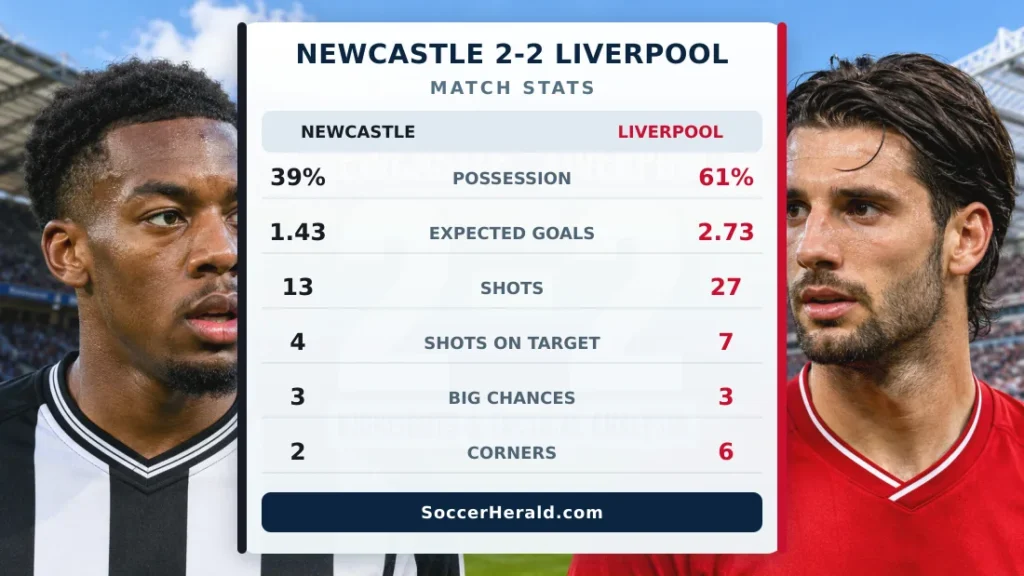
Possession: Newcastle 39%, Liverpool 61%
Shots: Newcastle 13, Liverpool 27
Shots on target: Newcastle 4, Liverpool 7
Big chances: Newcastle 3, Liverpool 3
Expected goals: Newcastle 1.43, Liverpool 2.73
Liverpool had more possession, more shots and the higher expected-goals total. That figure, however, included Szoboszlai’s late penalty.
The more revealing statistic was that both teams created three big chances. Liverpool produced greater volume, but Newcastle’s attacking moments were cleaner and more damaging.
Newcastle 2-2 Liverpool Highlights
A Kevin Keegan Afternoon Became a Kevin Keegan Match
Before the tactical arguments began, St James’ Park remembered Kevin Keegan.
Supporters raised a huge tribute to a man who belonged to both clubs, but whose greatest emotional connection was always with Newcastle. His belief that football should invite people to dream provided the theme for the afternoon.
Then the match began and immediately became the sort of contest associated with his name.
It was fast, open and emotionally unstable. Every successful press seemed capable of producing a chance. Every attacking commitment created space for the opposition.
The afternoon began as a tribute to Keegan. It ended with the kind of match his name still makes people expect.
How Newcastle’s Press Shook Liverpool
Matthias Jaissle set Newcastle up in a 4-2-3-1, with Sean Steur and Lewis Miley protecting the centre behind Yoane Wissa.
The formation was familiar. The aggression inside it was new.
William Osula did not simply chase Liverpool’s centre-backs. He curved his runs to discourage passes into Ryan Gravenberch and Dominik Szoboszlai. Wissa moved behind him, while Elanga and Harvey Barnes were prepared to jump towards Liverpool’s full-backs.
Newcastle were willing to leave space behind their first line because they believed Liverpool would struggle to reach it cleanly.
That judgement was largely correct.
Florian Wirtz occasionally received between the lines, but Liverpool could not find him consistently. Jeremy Jacquet was uncomfortable when forced to defend large spaces, while Milos Kerkez struggled with Elanga’s speed and directness.
This was the central achievement of Jaissle’s game plan. Newcastle did not need the ball to determine the rhythm of the match.
As explained in our Newcastle United 2026/27 season preview, the departures of Anthony Gordon, Sandro Tonali and Bruno Guimaraes left Jaissle with more than a tactical problem. Newcastle also needed a new source of energy and belief.
For long periods against Liverpool, they appeared to have found both.
How Elanga Exposed Liverpool’s Rest Defence
Newcastle’s opening goal began with Liverpool attacking.
Gravenberch lost possession near the Newcastle penalty area, but Liverpool were not positioned to stop the counterattack. Their attacking structure had players ahead of the ball without sufficient protection behind them.
Osula accelerated through the vacant centre before releasing Elanga on the right.
Kerkez could not match Elanga’s first steps. The winger took one steadying touch and drove his finish across Alisson.
It was not merely a goal created by pace. It was a goal created by Liverpool’s spacing.
When possession was lost, the distance between Liverpool’s attacking players and their defensive line was too large. Newcastle needed only one forward pass and one supporting run to turn a defensive situation into a clear chance.
Gakpo Finds the Space Newcastle Had Denied
Liverpool improved after half-time because their possession became faster and more direct.
Gravenberch found Gakpo on the turn, Newcastle’s midfield did not close quickly enough, and the Dutchman attacked the edge of the penalty area before driving a low shot into the bottom corner.
For once, Liverpool had moved the ball into the space behind Newcastle’s midfield before the home side could restore its shape.
Gakpo’s finish was excellent, but the important tactical detail was what happened before it. Liverpool stopped circulating the ball around Newcastle’s block and played through it.
It should have been the moment Iraola’s side took command.
Instead, Newcastle scored again two minutes later.
Willock Restores the Lead in Two Minutes
Osula’s injury forced Jaissle into a change, but it also altered Newcastle’s attack.
Joe Willock replaced the striker, allowing Wissa to move from the No.10 role into the centre-forward position. Wissa’s movement gave Liverpool a different problem.
Rather than competing directly with the centre-backs, he dropped towards midfield and then accelerated into the spaces around them.
For Newcastle’s second goal, Wissa escaped pressure during another transition and carried the ball through the centre. Willock continued his run to the left, received the pass and curled his finish beyond Alisson and in off the post.
Newcastle had restored their lead before Liverpool had emotionally or tactically settled after the equaliser.
Every Newcastle outfield player joined the celebration. Substitutes ran down the touchline. Willock, whose future at the club remains uncertain, had briefly become the centre of St James’ Park again.
Liverpool Had the Ball but Not Full Control
Liverpool finished with 61% possession and 27 shots, but many of those efforts came after Newcastle had recovered their defensive shape.
Liverpool were most dangerous when Wirtz received behind midfield or Gakpo moved inside from the left. Their attacks became predictable when the ball was repeatedly directed towards the full-backs without a clear route back into the centre.
The 3-3 big-chance count offered a more accurate description than possession or total shots.
Liverpool generated pressure. Newcastle generated danger.
Isak’s Return Became a Side Story
Alexander Isak’s return was supposed to dominate the afternoon.
The striker had left Newcastle for Liverpool in a widely reported £125 million transfer after a bitter breakdown in his relationship with the club. His first appearance at St James’ Park in red was greeted with predictable hostility.
Yet once the match began, he became peripheral.
Isak did not register a shot during the first half. He struggled to connect with Wirtz and Gakpo, while Newcastle’s centre-backs prevented him from receiving cleanly inside the penalty area.
His best opportunity arrived after the break, but he failed to make convincing contact.
Liverpool did not buy Isak simply to finish chances. His movement should open spaces for the players around him. Against Newcastle, those relationships still looked underdeveloped.
That is understandable in August, but it remains one of the key themes identified in our Liverpool 2026/27 season preview.
Liverpool have assembled elite attacking talent. Iraola must now turn those players into a functioning attack.
Iraola’s Press Is Still a Work in Progress
Andoni Iraola’s football depends on aggression without losing compactness.
Liverpool showed the aggression, but their front line, midfield and defence did not always advance together. Once Newcastle escaped the first challenge, large spaces appeared behind the press.
Both Newcastle goals came from transitions after Liverpool had committed players forward. It was a collective spacing problem, not simply poor defending by the centre-backs.
Alexis Mac Allister brought greater calm from the bench, while Victor Munoz added fresh running and eventually won the late penalty.
The changes rescued the result. They did not completely solve the tactical problem.
Szoboszlai Holds His Nerve in the 99th Minute
With the match entering its final seconds, Munoz attacked the space inside Lewis Hall and went down under the defender’s challenge.
Stuart Attwell pointed to the spot.
Szoboszlai faced a stadium that had spent the afternoon trying to overwhelm Liverpool emotionally. He responded by driving the penalty high into the top-left corner.
There was no time for Newcastle to restart.
Liverpool had not played with the authority expected from a potential title challenger, but they had refused to accept defeat. On an afternoon when their system remained fragile, resilience provided what structure could not.
Why Newcastle Can Believe in Jaissle’s Rebuild
Newcastle surrendered a lead in the final seconds, but the performance offered more encouragement than frustration.
Steur and Miley competed intelligently in midfield. Amar Dedic provided aggression from right-back. Malick Thiaw and Sven Botman defended the penalty area with authority.
Most importantly, Newcastle looked like a team that understood what its manager wanted.
Jaissle has inherited a squad transformed by major departures. Replacing individual quality will take time, but a clear collective identity can reduce the damage.
Newcastle pressed together, attacked space quickly and created three big chances from only 39% possession.
The result hurt. The performance suggested the rebuild may be further advanced than expected.
What Liverpool Must Fix Before Nottingham Forest
Liverpool’s first priority must be the protection behind their attacks.
If both full-backs advance, one midfielder must remain connected to the centre-backs. Against Newcastle, the distances were too large and the first defensive pass after losing possession was often unavailable.
The second issue is the connection between Wirtz and Isak.
Wirtz needs more central touches, while Isak needs runners close enough to benefit from his movement. Liverpool cannot allow both players to become isolated in different areas of the pitch.
Finally, Iraola must coordinate the press.
Intensity without compactness only creates space for the opposition. Liverpool’s front players cannot press effectively unless the midfield and defensive line move with them.
What This Draw Means for the Premier League
The first weekend has already shown that reputations will offer little protection this season.
Liverpool possess enough attacking quality to challenge for the title, but their rebuild under Iraola remains incomplete. Newcastle have lost several established stars, yet Jaissle may have given them a clearer collective identity.
Both conclusions can be true.
Liverpool deserved something from the match because of their second-half pressure and late persistence. Newcastle deserved something because their plan repeatedly exposed Liverpool’s weaknesses.
The Premier League 2026/27 hub will track how quickly these two projects develop.
At St James’ Park, neither team found control. Both found reasons to believe.
Final Verdict
Newcastle 2-2 Liverpool was not a polished tactical contest. It was something more revealing.
Newcastle showed that Jaissle’s pressing game can survive the loss of major players. Liverpool showed that Iraola has inherited outstanding attacking talent, but also spacing and transition problems that cannot be ignored.
Elanga supplied the first explosion. Gakpo briefly restored order. Willock gave Newcastle hope. Szoboszlai removed the victory without removing the optimism.
The afternoon began with Kevin Keegan asking a stadium to dream.
It ended with both teams discovering how exhausting those dreams can be.
Sources
Liverpool FC: Newcastle 2-2 Liverpool match report


