




USA vs Belgium World Cup 2026 Round of 16 Preview
USA vs Belgium brings the USMNT into one of the biggest tests of its World Cup 2026 run. The United States have home energy, crowd pressure and belief, but Belgium arrive with the experience and individual quality to turn one knockout mistake into a tournament-ending moment.
In Seattle, this Round of 16 tie will not feel neutral. It will feel like a judgment on whether American energy can become something harder, colder and more tournament-proof.
The United States beat Bosnia and Herzegovina 2-0 in the Round of 32 despite playing part of the match with 10 men after Folarin Balogun’s red card. Belgium, meanwhile, came from 2-0 down to beat Senegal 3-2 after extra time, with Romelu Lukaku and Youri Tielemans dragging them back from the edge.
So this is not simply USA vs Belgium. It is youth against memory. Home momentum against old tournament craft. Pressure against pressure.
And somewhere inside it, there is a tactical question that may decide everything: can the United States press Belgium without leaving the spaces Belgium’s passers still know how to find?
Quick Answer: Who Will Win USA vs Belgium?
USA vs Belgium is a Round of 16 tie about American speed, Belgian survival and one tactical problem that could decide the night: can the hosts replace Folarin Balogun’s depth without losing the pressure that makes them dangerous?
Prediction: USA 2-1 Belgium after extra time.
Balogun Red Card Update: FIFA Suspends Ban Before Belgium Clash
The biggest pre-match twist is no longer tactical. It is disciplinary.
Folarin Balogun is available to play for the United States against Belgium after FIFA suspended the automatic ban linked to his red card against Bosnia and Herzegovina. FIFA did not erase the red card, but it suspended the implementation of the one-match punishment, clearing the striker for the Round of 16.
That decision changes the football picture dramatically.
For the USA, it means their main striker remains part of the plan. Balogun gives Mauricio Pochettino a direct runner, a penalty-box reference point and the kind of movement that can stretch Belgium’s back line. Without him, the United States would have needed a major attacking adjustment. With him, their best version is still on the table.
For Belgium, the decision adds another emotional layer to an already difficult knockout match. The Belgian federation challenged Balogun’s eligibility, while UEFA also reacted strongly and accused FIFA of crossing a red line with the decision. That controversy gives Belgium a clear grievance before kickoff.
There is also a political shadow around the case after reports that Donald Trump personally urged FIFA president Gianni Infantino to review the red card. For this preview, though, the football consequence matters most: Balogun can play.
The USA now have their leading attacking threat available. Belgium have another source of motivation. And a Round of 16 tie that already carried huge pressure now arrives with one of the tournament’s biggest disciplinary debates attached to it.
USA vs Belgium Match Details
| Match | USA vs Belgium |
|---|---|
| Competition | World Cup 2026 |
| Stage | Round of 16 |
| Date | July 6, 2026 |
| Kickoff time | 20:00 ET / 00:00 UTC, July 7 |
| Venue | Seattle Stadium |
| USA route | Beat Bosnia and Herzegovina 2-0 in the Round of 32 |
| Belgium route | Beat Senegal 3-2 after extra time in the Round of 32 |
| Next round | Winner reaches the quarter-finals |
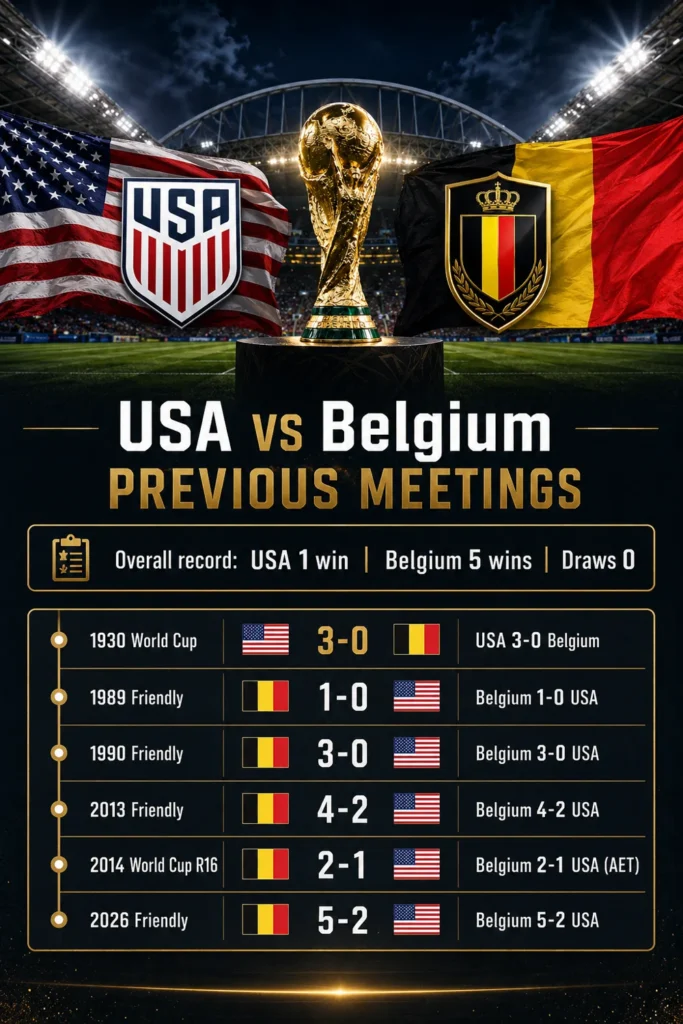
Bert Patenaude and the First World Cup Hat-Trick
Before Belgium built their modern head-to-head edge, the USA owned one of the earliest great World Cup moments in this matchup: Bert Patenaude’s hat-trick against Belgium in 1930, widely recognised as the first hat-trick in World Cup history.

The Big Picture
For the United States, this game is about proof.
Winning Group D mattered. Beating Bosnia and Herzegovina mattered more. But Belgium is different. Belgium have been through semi-finals, quarter-finals, collapses, rebuilds and all the heavy language that follows a generation when it begins to age in public.
The U.S. have spent years talking about potential. Now the question is no longer whether the squad has talent. It is whether that talent can manage a knockout game against an opponent that knows how to slow moments down.
That was part of the story in the World Cup 2026 Group D Guide: the United States had the athletic profile, the home platform and the pressure of expectation. What has changed is that the pressure now feels useful rather than suffocating.
Against Bosnia, in a tie already framed by American home pressure in our United States vs Bosnia and Herzegovina preview, the U.S. were not perfect. That is important. They were reduced to 10 men, lost some rhythm, and had to defend with more grit than glamour.
But knockout football often rewards the team that can suffer without losing its shape.
USA did that.
Belgium did something different against Senegal. They suffered, cracked, almost disappeared, then came back from nowhere. That kind of comeback can either revive a team or disguise its weaknesses. The truth may be both.
USA Are No Longer Just Hosting the Tournament
There is always a danger with host nations. The story can become bigger than the team.
Every crowd shot becomes symbolism. Every anthem becomes evidence of destiny. Every win becomes a national moment. That can lift players, but it can also make football feel too heavy.
The United States have handled that balance well so far. Mauricio Pochettino’s side have not played like a team waiting for the occasion to carry them. They have tried to impose themselves.
That matters here because Belgium will not be frightened by noise. They may be old in places, vulnerable in transition and less smooth than their best versions, but they are not emotionally naive.
For USA, the opening phase has to be aggressive without becoming wild.
Pulisic, Weah, Reyna, Tillman, McKennie, Musah and Adams all matter in different ways, but the collective idea is more important than any single name. The U.S. need the pitch to feel short. They need Belgium receiving under pressure, not lifting their heads and choosing passes.
If Belgium are allowed to play at walking speed, the game changes.
The Balogun Problem
The biggest selection issue is obvious.
Folarin Balogun scored against Bosnia and Herzegovina, then was sent off. If his suspension stands, the United States lose more than a finisher. They lose a forward who gives the attack depth, presses centre-backs and threatens the space behind.
That changes the geometry of the U.S. front line.
Ricardo Pepi would give USA a more penalty-box-focused option. Haji Wright would offer size, running and directness. Pochettino could also choose a more fluid front, using Pulisic and Weah to attack inside lanes while asking a central player to connect rather than simply run behind.
None of those options is identical to Balogun.
Belgium’s centre-backs can be exposed if they have to turn and sprint. Senegal showed that. But if USA lose depth, Belgium can hold a higher line, squeeze midfield and make the game more technical.
Without Balogun, the U.S. must find another way to threaten the space behind Belgium’s back line. That could come from Weah’s runs, Pulisic driving inside from the left, or late midfield surges from Tillman.
What they cannot do is become flat.
Belgium would welcome that.
Belgium Survived Senegal, But the Warning Was Loud
Belgium’s 3-2 win over Senegal was dramatic, emotional and dangerous to interpret.
On one hand, it showed belief. Senegal led 2-0 late in normal time, yet Belgium found a way back through Lukaku and Tielemans before winning in extra time. That is not nothing. Knockout tournaments are full of teams who look finished and then use one miracle to become dangerous again.
On the other hand, the match showed why Belgium can be attacked.
Senegal found space. Senegal ran through moments. Senegal looked faster, fresher and more connected for long stretches. Belgium were rescued by experience, substitutions and the sort of late chaos that can turn a match into a coin toss.
That context also changes the reading of Belgium’s route from World Cup 2026 Group G. They still have names, craft and penalty-box threat. What they do not always have is control.
The Americans will look at the Belgium vs Senegal Round of 32 preview and the match itself and see opportunity. Space around defensive transitions. A back line that can be pulled sideways. A midfield that can still pass but can also be forced to run toward its own goal.
Belgium can still hurt USA.
But Belgium can also be hurt.
The Tactical Battle: Press or Protect?
The U.S. have a clear temptation: press Belgium high.
It makes sense. Belgium’s older players do not want a match played at full American tempo. They do not want constant second balls, crowd pressure, wide runners and repeated duels.
But pressing Belgium is risky because Belgium still have players who understand pressure. Tielemans can receive in tight areas and play forward quickly. De Bruyne, if given time, can turn a messy possession into a chance with one pass. Lukaku can pin centre-backs and make clearances useful.
That means USA cannot press as individuals. They have to press as a team.
The first trigger should be Belgium playing into a full-back under pressure. The second should be a backward pass into the goalkeeper or centre-back. The third should be any loose first touch from Belgium’s midfield.
But if USA jump and Belgium escape, the back line will be exposed.
That is where Tyler Adams and Weston McKennie become essential. They cannot only chase. They must protect the space behind the press. They must stop Belgium turning one pass into a three-v-three attack.
This is the classic knockout dilemma: the thing that can win the game can also lose it.
Where USA Can Win It
USA can win this match in transition.
That does not mean sitting deep and countering for 90 minutes. It means creating moments where Belgium are stretched after their own attacks break down.
Pulisic is central to that. He does not need to dominate the ball to dominate the threat. If Belgium push a full-back high, Pulisic can attack the space behind. If Belgium narrow their midfield to protect the centre, he can isolate wide. If they defend deep, his combinations around the box become important.
Malik Tillman also feels like a key figure after his free kick against Bosnia. He gives the U.S. a different kind of danger: not just running power, but timing, calm and technique around the edge of the area.
Set pieces may matter too. Belgium looked uncomfortable when the Senegal game became chaotic. USA must treat dead balls as more than bonus opportunities. They are a route into Belgium’s nerves.
If the U.S. score first, Seattle becomes part of the match.
Not as decoration.
As pressure.
Where Belgium Can Win It
Belgium can win it by making the match slower and smarter.
They do not need to outrun USA. They need to make USA run at the wrong times. They need to draw the press, pass through the first line and then attack the spaces behind the American full-backs.
Lukaku remains central to that. Even when he does not move as sharply as before, he gives Belgium a reference point. Crosses become more dangerous. Long passes become more useful. Centre-backs have to defend his body before they defend the ball.
Tielemans is just as important in a different way. His goal and penalty against Senegal will get attention, but his passing rhythm may matter more here. If he can receive behind the American first press, Belgium can create the controlled possessions that drain a home crowd.
And then there is Belgium’s bench.
Against Senegal, the bench changed the game. That matters because this match could become a 70-minute tactical arm wrestle before turning into something looser. If Belgium are still level late, their experience becomes dangerous.
They know how to wait.
Key Players to Watch
Christian Pulisic
Pulisic does not have to carry every U.S. attack, but he has to give Belgium a problem they cannot solve with one defender. His movement inside from the left could be the best way to attack Belgium between full-back and centre-back.
Malik Tillman
Tillman’s goal against Bosnia gives him momentum, but his bigger value may be between the lines. If Belgium’s midfield drops too deep, he can receive and turn. If they step up, he can run beyond them.
Tyler Adams
This may be an Adams game more than a highlights game. If USA press, he has to close the escape routes. If Belgium counter, he has to stop the first forward pass. His discipline could decide the match’s balance.
Romelu Lukaku
Lukaku changed the Senegal game and remains Belgium’s most obvious route to penalty-box danger. USA have to defend him before the cross arrives, not after.
Youri Tielemans
Tielemans gives Belgium control, late runs and set-piece threat. If the game slows down, he becomes more influential. USA need to keep him facing his own goal.
What USA Must Avoid
USA must avoid turning the match into pure emotion.
Emotion is part of their advantage, but if the U.S. attack too early, press too wildly or chase the crowd’s energy instead of controlling the spaces, Belgium will find gaps.
The second danger is losing patience without Balogun. If the central striker situation becomes less direct, USA must not force crosses for the sake of it. Belgium can defend predictable balls into the box.
The third danger is late-game management. Belgium just proved they can survive until the match becomes strange.
USA cannot assume a one-goal lead is enough.
What Belgium Must Avoid
Belgium must avoid another slow collapse into survival mode.
Against Senegal, they escaped. Against USA, in Seattle, with the crowd behind the hosts, that may not happen twice.
They also have to manage fatigue. Extra time against Senegal was emotionally and physically expensive. If USA can make the first hour fast, Belgium may have to defend with tired legs before the match reaches its decisive phase.
Most of all, Belgium must avoid giving Pulisic and Weah open grass.
If the game becomes stretched, USA will believe.
Prediction: USA 2-1 Belgium After Extra Time
This is close because Belgium have the better late-game memory and the deeper bank of knockout scars. They will not panic easily. They will have spells where they slow the match, pull USA’s midfield apart and make the home side look impatient.
But the warning signs from the Senegal game were real.
Belgium looked vulnerable to speed, pressure and direct running. USA have all three. Even without Balogun, they have enough movement and enough home momentum to make Belgium defend more often than they want.
The pick is USA to win 2-1 after extra time.
Not because they are cleaner. Not because they are more experienced. But because this feels like the kind of match where home energy, younger legs and one decisive transition finally turn American promise into a quarter-final.
Final Verdict
USA vs Belgium already looked like one of the most emotional Round of 16 matches of the tournament. After the Balogun decision, it feels even bigger.
The United States now enter the match closer to full strength than expected. Folarin Balogun’s availability gives Mauricio Pochettino a true central reference point, a runner in behind and a striker who can turn pressure into goals. For a USA side playing at home, that matters.
Belgium, however, will not arrive quietly. FIFA’s decision to suspend Balogun’s automatic red-card ban has added controversy, anger and motivation to their preparation. Belgium may feel wronged, but they still have enough quality to hurt the USA if the game becomes too open.
That is the tactical danger for the hosts. If the United States turn the occasion into pure emotion, Belgium can punish the spaces. If they control the rhythm, use the crowd properly and give Balogun the right service, this becomes a match they can win.
The USA now have their leading attacking threat available. Belgium have another source of motivation. And that tension may define the night.
Prediction: USA 2-1 Belgium
Sources
The Guardian — USA 2-0 Bosnia and Herzegovina: World Cup 2026 last 32
Reuters — Belgium stage stunning comeback to sink Senegal in extra time


